


Prediction market insider trading now has a price tag for whoever exposes it: under a new House bill, tipsters could collect 10% to 30% of the penalties that follow.
Reps. Sean Casten of Illinois and Ted Lieu of California introduced the Policing Insider Trading in Prediction Markets Act of 2026 on Friday, Nov. 20.
The bill would set up a whistleblower award program at the Department of Justice, aimed at traders who use confidential government or corporate information to bet on platforms such as Kalshi and Polymarket.
For crypto investors, the interesting part is the design. It borrows the same reward formula that has turned the SEC’s tip line into one of Washington’s busiest enforcement pipelines.
The bigger question is whether paying informants can do for event contracts what it did for securities fraud.
What the Casten-Lieu Bill Actually Does
The text is short, about ten pages. Its core is a new award program run by the Attorney General.
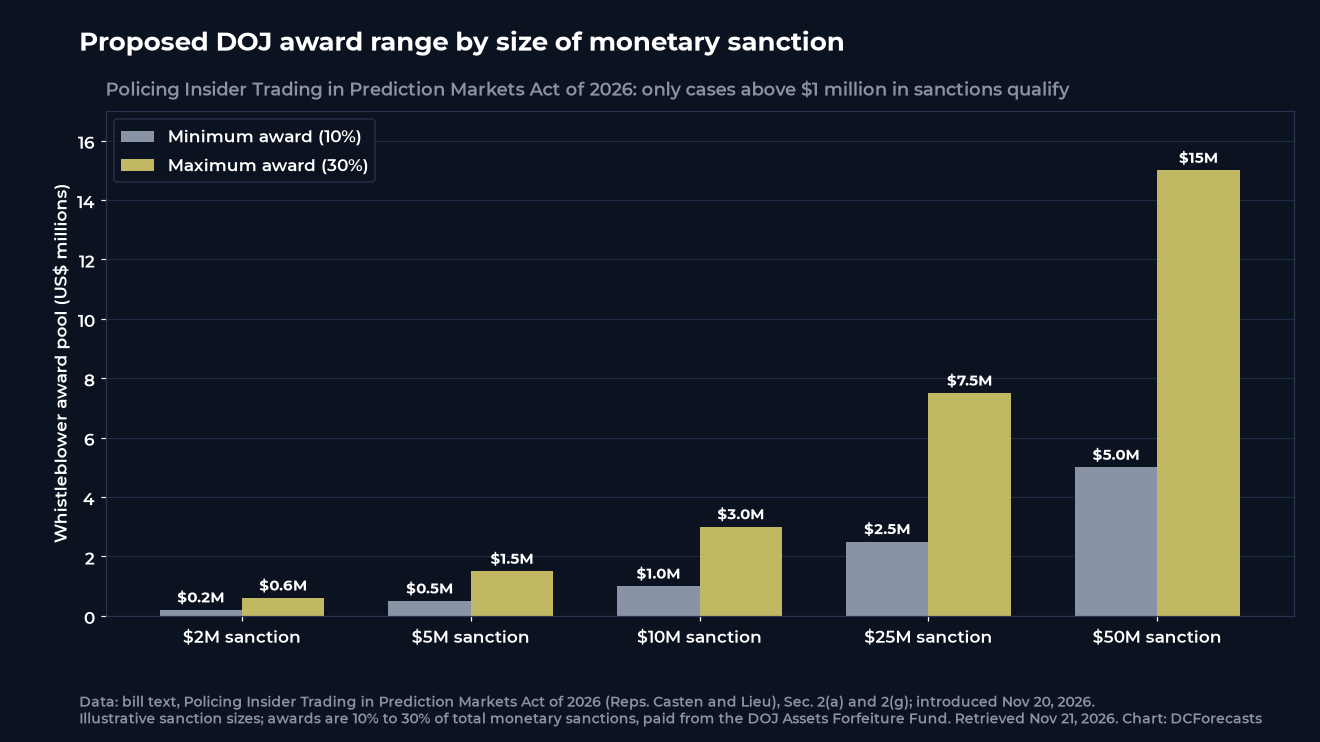
A whistleblower who voluntarily hands the DOJ original information that leads to a successful “covered enforcement action” would share an award worth at least 10% and no more than 30% of the total monetary sanctions.
A covered action is a criminal investigation, action or settlement tied to a federal fraud offense involving a prediction market platform. It must produce sanctions above $1 million.
Sanctions include penalties, disgorgement, interest and forfeited money. Awards would be paid from the DOJ Assets Forfeiture Fund.

The bill also gives tipsters a process. Awards can be appealed within 60 days, then taken to court. Employers would be barred from firing, demoting or harassing an employee for reporting.
The Attorney General would have 180 days after enactment to issue guidance, including rules for anonymous tips submitted through a lawyer.
Why Prediction Market Insider Trading Became a Target
The lawmakers’ release lists the cases that pushed them to act. According to the release, one anonymous trader made nearly $1 million from dozens of well-timed bets on US military action against Iran.
The release also cites a trader who made more than $550,000 betting on the removal of Iran’s Supreme Leader, a $100,000-plus profit tied to the words in presidential speeches, and a Nobel Peace Prize bet worth more than $50,000.
“Prediction markets have a serious insider trading problem,” Casten said in the statement. Lieu said the bill “will encourage whistleblowers to report insider trading on prediction market platforms like Kalshi and Polymarket.”
The pair previously led 54 House Democrats in a letter urging the DOJ to pursue these cases more aggressively.
The issue has been building for weeks. As we reported, a House Oversight memo found the platforms themselves had flagged most suspicious trades, and the Senate has since cleared the DEATH BETS Act.
A Proven Model From the SEC
The 10% to 30% band and the $1 million threshold are not new. They mirror the SEC program created by the Dodd-Frank Act in 2010.
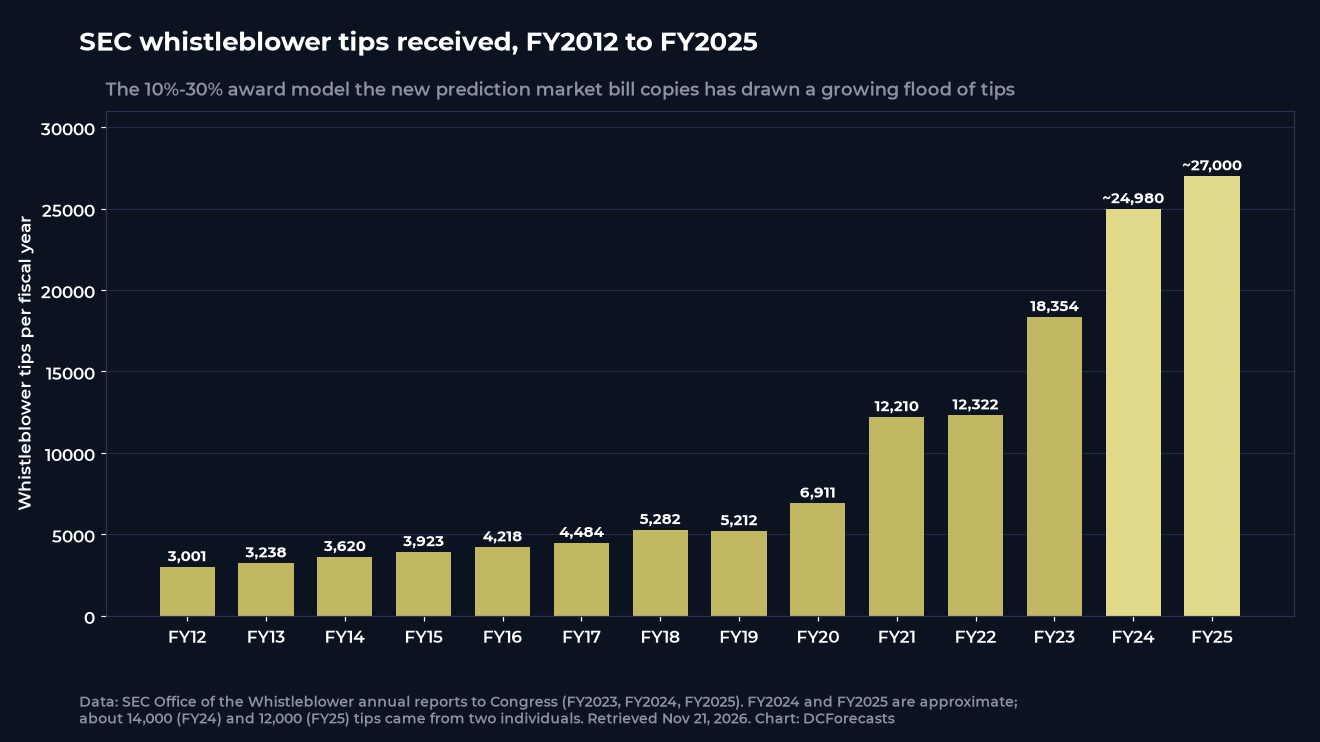
That program shows what money can do for tip volume. The SEC received 3,001 whistleblower tips in fiscal 2012, according to its reports to Congress. By fiscal 2025, the figure was about 27,000.
The numbers need context. The SEC says roughly 12,000 of the FY2025 tips came from just two people, and about 14,000 of FY2024’s did as well.
Even so, the payouts are real. The SEC awarded nearly $600 million in FY2023 and more than $2.2 billion to 444 people from 2011 through FY2024. Cryptocurrencies and crypto asset securities made up 7% of FY2025 tips.
The CFTC, which oversees regulated event-contract exchanges like Kalshi, runs its own program under the Commodity Exchange Act. On Sept. 14, it announced 10 awards worth more than $150 million.
The new bill would add a criminal-side channel at the DOJ on top of those civil regulators.
What Stands Out in the Fine Print
Three details matter for the crypto side of this market.
- The definition of a “prediction market platform” covers any website, application, exchange or protocol that facilitates trading in contracts tied to an event. That language reaches decentralized venues, not just licensed exchanges.
- “Original information” must come from the tipster’s own knowledge or analysis, and cannot be solely derived from public sources.
- Whistleblowers convicted or found liable in the same case get nothing.
The second point is interesting for on-chain markets. Bets placed on a public blockchain leave a permanent trail that anyone can study.
We believe that transparency cuts in favor of crypto-native venues. A public ledger does not stop insiders, but it makes their footprints far harder to erase.
The bill is still only a proposal. It has two Democratic sponsors in a Republican-led House, and the draft text leaves the committee referral blank.
Could Clearer Rules Strengthen the Market?
The endorsements are mostly from watchdog groups, including CREW, the Project on Government Oversight, Transparency International U.S. and Public Citizen.
No platform response was included in the release. Still, Kalshi and Polymarket both benefit when users trust that prices reflect public information rather than leaks.
For us, the key takeaway is that event markets are being pulled into the same rulebook as stocks and futures. Prices are only useful if the game is fair.
That same logic has served Bitcoin well. Its rules are public, its supply schedule is fixed, and every transaction is open to inspection.
As prediction markets mature, we would watch whether this bill gains a Republican cosponsor and whether the DOJ adds its own guidance.
The coming months will show whether Congress treats insider betting as a scandal to punish or a market flaw to fix. Either way, the push for fair, verifiable markets is one Bitcoin has been making since 2009.
DC Forecasts is a leader in many crypto news categories, striving for the highest journalistic standards and abiding by a strict set of editorial policies. If you are interested to offer your expertise or contribute to our news website, feel free to contact us at [email protected]










Discussion about this post