


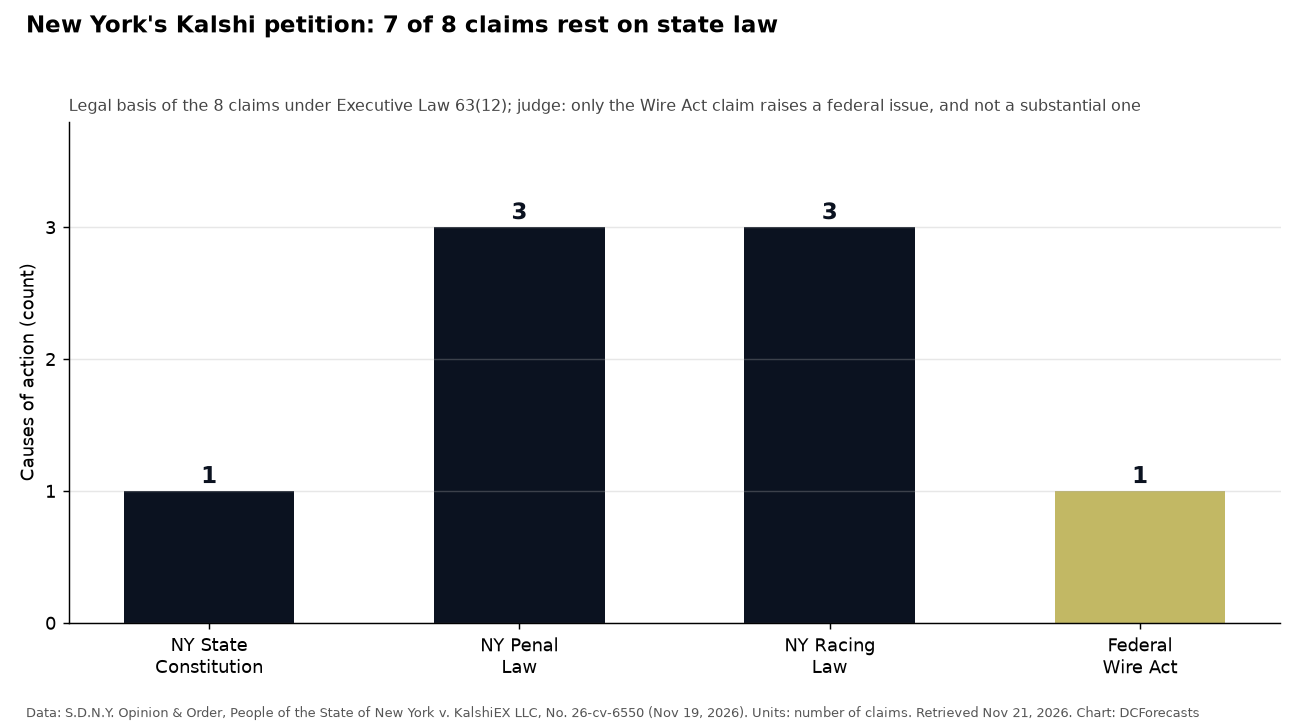
New York’s Kalshi lawsuit is back in a Manhattan state court after a federal judge ruled on Nov. 19 that he had no jurisdiction to hear it, handing Attorney General Letitia James the home-court route she asked for.
U.S. District Judge Vernon S. Broderick granted the state’s motion to remand in a 19-page opinion and order. The docket shows the case was formally sent back to the Supreme Court of New York, New York County, on Nov. 20.
The case had spent 112 days in federal court after Kalshi removed it on the same day it was filed, July 31.
For crypto investors, this matters more than it first appears. The same office sued Coinbase and Gemini over their prediction products in April 2026.
The bigger question now is how quickly New York moves, and whether a state court becomes the place where America’s event-contract fight is decided.
What Did Judge Broderick Decide in the Kalshi Lawsuit?
The ruling is about where the case is heard, not whether Kalshi broke the law. The judge made no finding of liability.
Kalshi had offered two routes into federal court. The first was the federal officer removal statute, built on its license from the Commodity Futures Trading Commission, which certified it as a designated contract market on Nov. 3, 2020.
Broderick rejected that path. He wrote that the state’s suit does not challenge the Commodity Exchange Act, so the federal law only enters as Kalshi’s defense, and a defense cannot support removal.
He also noted that the CFTC has not sought to intervene in this case, even though it successfully joined a Kalshi dispute with Rhode Island earlier this year.

The second route was the so-called Gunn-Grable test, which lets some state claims stay in federal court when they turn on a substantial federal question. That argument failed as well.
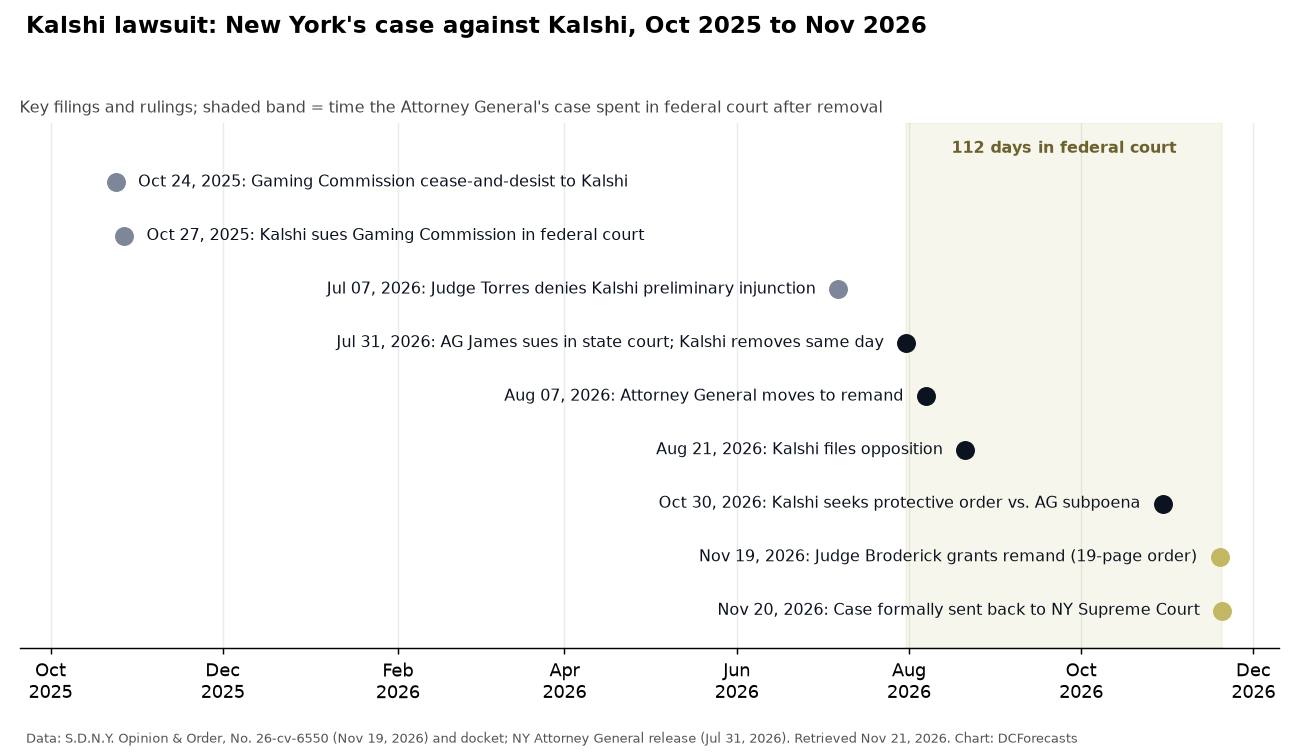
Seven of Eight Claims Rest on New York Law
The petition pleads eight causes of action under Executive Law Section 63(12), which lets the Attorney General seek to stop repeated illegal business conduct.
One rests on the state constitution, three on the Penal Law and three on the Racing Law. Only the eighth relies on a federal statute, the 1961 Wire Act.
Broderick agreed that the Wire Act claim raises a federal issue, but found it was not a substantial one. He pointed to the Act’s own safe harbor, which turns on whether betting is legal under state law.
He also called the federal-state balance “an independent reason” to send the case back, quoting a ruling that gambling regulation is “a matter of predominantly state concern.”
There was one small win for Kalshi. The judge denied the state’s request for attorneys’ fees, writing that he could not conclude Kalshi “lacked an objectively reasonable basis for seeking removal.”
Why the State Courtroom Matters
Section 63(12) works through a special proceeding, a faster track than ordinary civil litigation. Broderick noted that a federal forum would have cost New York those procedural tools.
The stakes are large. The Attorney General’s July 31 announcement said the state wants Kalshi to forfeit illegal gains, pay restitution and pay fines equal to three times those gains.
The petition adds a requested penalty of $100,000 for each offer of sports wagering in New York. It also cites Kalshi’s own reported figures: a $22 billion valuation and $178 billion in annualized transaction volume.
Kalshi’s lawyers have already asked the state judge, Justice Melissa Crane, for a status conference before any renewed request for an emergency order, according to sports-betting attorney Daniel Wallach’s account of the letter.
That letter reportedly argues the original order’s wording could reach Kalshi’s business nationwide, because the company is headquartered in New York. We would treat that as Kalshi’s argument, not a settled outcome.
What the Kalshi Lawsuit Signals for Crypto Platforms
This is not a Bitcoin case, and we see no reason to force one. But crypto exchanges have walked straight into it.
Coinbase and Gemini both face New York gambling suits over prediction products, and Coinbase has kept building out its own prediction markets. The CFTC has also been suing states to defend its claim over these markets.
The pattern across courts is getting clearer. Broderick cited other federal courts that sent similar Kalshi cases back to state court, including one in Alabama, while noting that at least one Georgia court had sided with the company.
Appeals courts are weighing in too. The Fourth Circuit let Maryland police Kalshi this month, and Broderick quoted the Sixth Circuit on the “long history of states regulating intrastate gambling.”
We believe the lesson is about product design. Event contracts tied to sports sit in a contested zone between federal derivatives law and state gaming law.
Bitcoin itself sits outside that fight. No one in this case is asking whether holding or trading BTC is gambling, and that distinction is worth keeping in view.
What Should Traders Watch Next?
The first signal is whether James renews her application for a temporary restraining order, and whether Justice Crane hears Kalshi first.
The second is the Second Circuit, where Kalshi’s appeal of Judge Analisa Torres’s July 7 ruling against it in the Gaming Commission case is still pending.
The third is Washington. If the CFTC steps into New York the way it did in Rhode Island, the case could change shape quickly.
For us, the key takeaway is that clear lines between products help everyone. Prediction markets may face a patchwork of state rules for some time, while Bitcoin’s fixed supply and growing institutional rails keep its own regulatory path far more settled.
The coming weeks in a Manhattan courtroom will show how much room New York intends to leave for event contracts at all.
DC Forecasts is a leader in many crypto news categories, striving for the highest journalistic standards and abiding by a strict set of editorial policies. If you are interested to offer your expertise or contribute to our news website, feel free to contact us at [email protected]










Discussion about this post