


Coins.ph, a Philippine crypto platform that CoinGecko lists as established in 2014, no longer lets customers send crypto to or receive it from self-custody wallets.
The change took effect on November 19. Transfers now work only with accounts at other regulated exchanges, and every one of them needs sender or recipient details, whatever the amount.
Coins.ph says the move is meant to comply with the Travel Rule set by the Bangko Sentral ng Pilipinas (BSP), the country’s central bank.
For Bitcoin holders, the interesting part is that the BSP guidance Coins.ph cites does not ban those transfers. It asks for extra checks.
The bigger question is whether other platforms follow the stricter route, or keep the door open the rules still allow.
What Changed on Coins.ph on November 19
The details sit in a Coins.ph help center article, updated on November 21.
“You can only send crypto to, and receive crypto from, accounts at other regulated exchanges. Self-custody wallets are no longer supported,” it says.
Withdrawals now require five pieces of information: the recipient’s name, wallet address, destination wallet type, destination exchange and the purpose of the transfer.
Deposits need six, including the sender’s address. Incoming funds stay on hold until those details are verified.

Coins.ph also warns that fictitious details, or names, platforms and addresses linked to illicit activity, will lead to a transfer being rejected.
The company adds that customers who never move crypto off the platform are not affected. Its API deposit and withdrawal endpoints also changed on November 19.
What the BSP Memo Actually Says About Unhosted Wallets
Coins.ph points to BSP Circular 1108 from 2021 and to Memorandum M-2023-042, issued on December 28, 2023. Both build on Financial Action Task Force guidance for virtual asset service providers.
That memo is more nuanced than a ban. It states that peer-to-peer transactions and transfers to or from unhosted wallets are “generally outside the regulatory perimeter of the Bangko Sentral.”
Because of money laundering risks, it says “stricter rules shall apply.” Platforms should collect and verify the sender’s details, keep the beneficiary’s wallet address and store the transaction hash, regardless of the amount.
Only if that minimum information is missing should a platform refuse the transfer.
For transfers between platforms, the memo sets a PHP 50,000 line for the fuller data set. That is about 0.0134 BTC, or roughly $780, at CoinGecko’s price on Saturday.
We believe the gap matters. Coins.ph has chosen a tighter policy than the published memo requires, and its help article cites no newer instruction from the central bank.
A Peso-Stablecoin Venue More Than a Bitcoin One
CoinGecko’s exchange data shows what Coins.ph customers mostly trade.
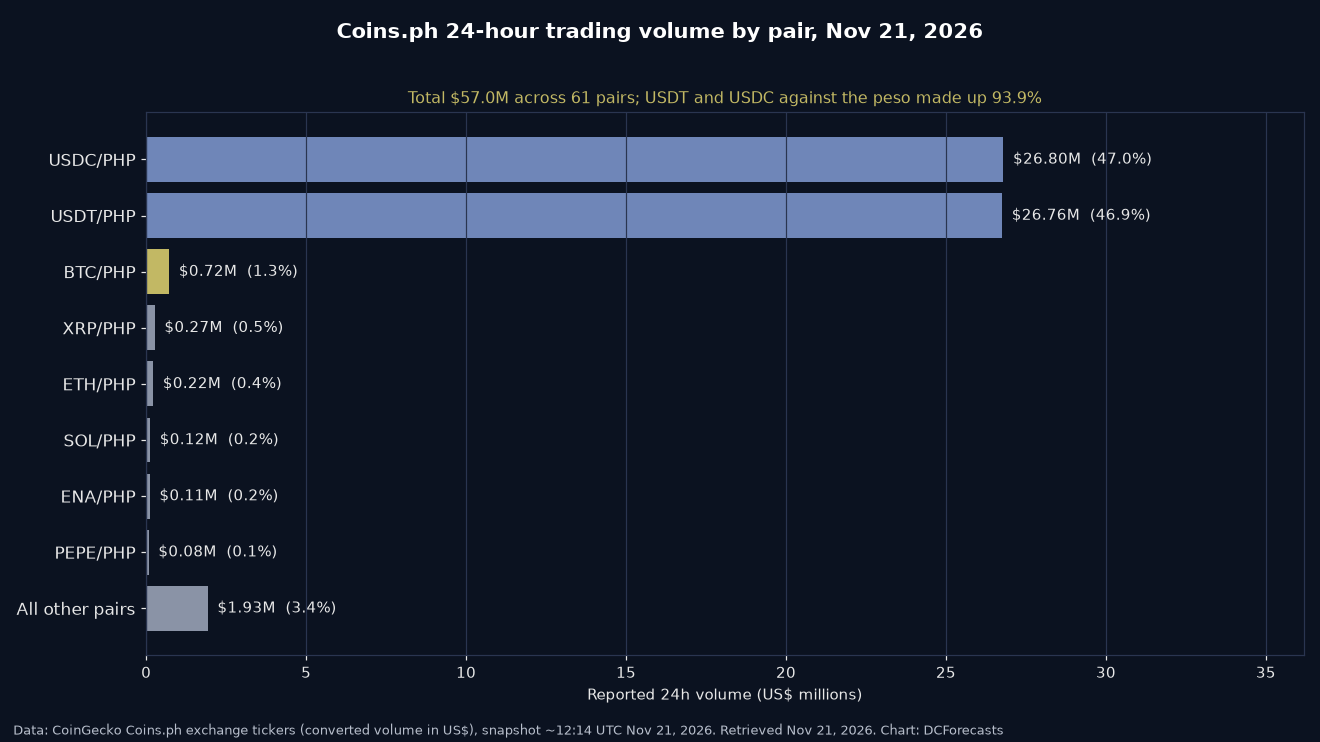
Of about $57.0 million in reported 24-hour volume across 61 pairs on Saturday, USDC and USDT against the peso made up 93.9%.
The BTC/PHP pair handled about $0.72 million, or 1.3%.
That mix points to a platform used largely to move between dollars and pesos. Many of those users send funds to other exchanges rather than to private wallets, and that route stays open.
The people most affected are likely those who buy Bitcoin in pesos and then withdraw it to keys they control.
Has Trading Slowed Since the Switch?
Not so far, based on the first few days of data.
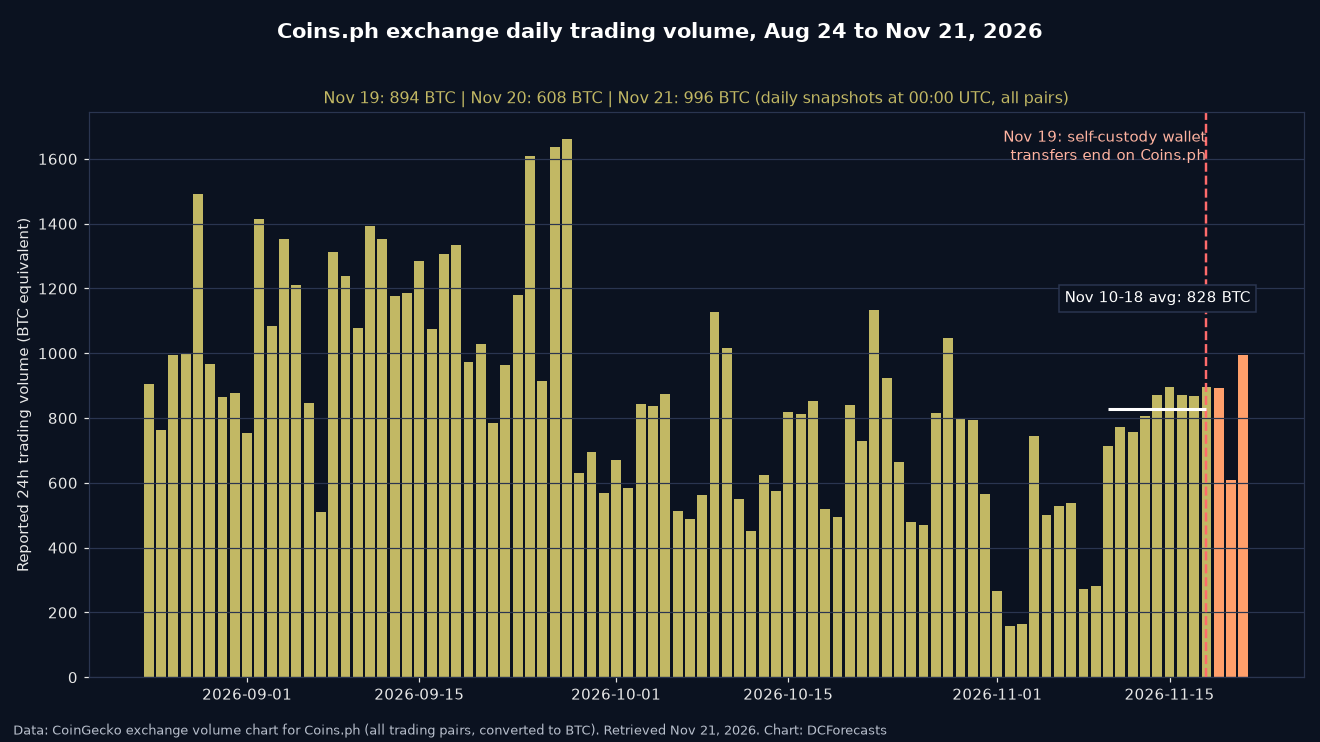
Daily snapshots averaged 828 BTC between November 10 and November 18.
The 24-hour windows ending on November 20 and November 21 showed 608 BTC and 996 BTC, close to that recent range. The November 20 reading was the lowest since November 9, but the next day’s snapshot was the highest since October 28.
Trading volume is not the same as withdrawals, so this does not measure how many transfers were blocked. It does suggest the platform’s core peso trading continued without a sharp break.
Why Self-Custody Still Matters for Bitcoin Holders
The constructive reading is simple. Philippine guidance still treats self-custody as legitimate, and Bitcoin itself works exactly as before.
Anyone can still hold their own keys and move coins on the network without asking permission. The change affects one platform’s gateway, not Bitcoin’s rules.
Customers who want coins in their own wallets can still use other regulated exchanges that support private wallets, although that adds steps and possibly fees.
We have seen similar pressure elsewhere. Thailand’s securities regulator recently proposed that stablecoins move only to wallets verified as the customer’s own, a narrower approach that still leaves room for self-custody.
Exchange hacks have also kept the case for holding one’s own coins in focus, as Ledger’s chief executive argued when he weighed wallet losses against the $6.3 billion Binance theft.
For us, the key takeaway is that compliance and self-custody can coexist. The BSP memo already describes how: collect the data, verify it, keep records.
The coming weeks will show whether Coins.ph eases its stance or whether rival Philippine platforms copy it. Either way, Bitcoin’s fixed supply and open network remain available to anyone who keeps their own keys.
DC Forecasts is a leader in many crypto news categories, striving for the highest journalistic standards and abiding by a strict set of editorial policies. If you are interested to offer your expertise or contribute to our news website, feel free to contact us at [email protected]










Discussion about this post