



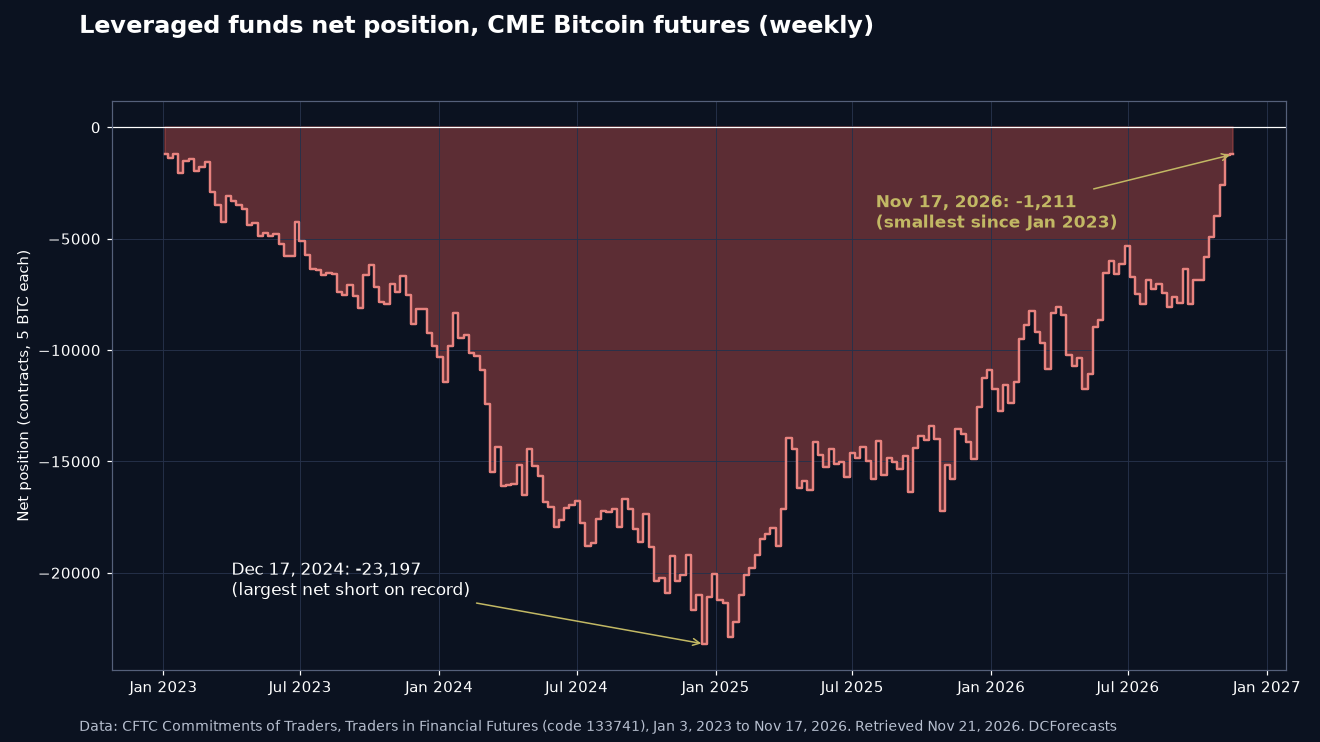
CME Bitcoin futures now carry the smallest hedge fund net short position since January 2023, according to the latest Commitments of Traders data from the U.S. Commodity Futures Trading Commission.
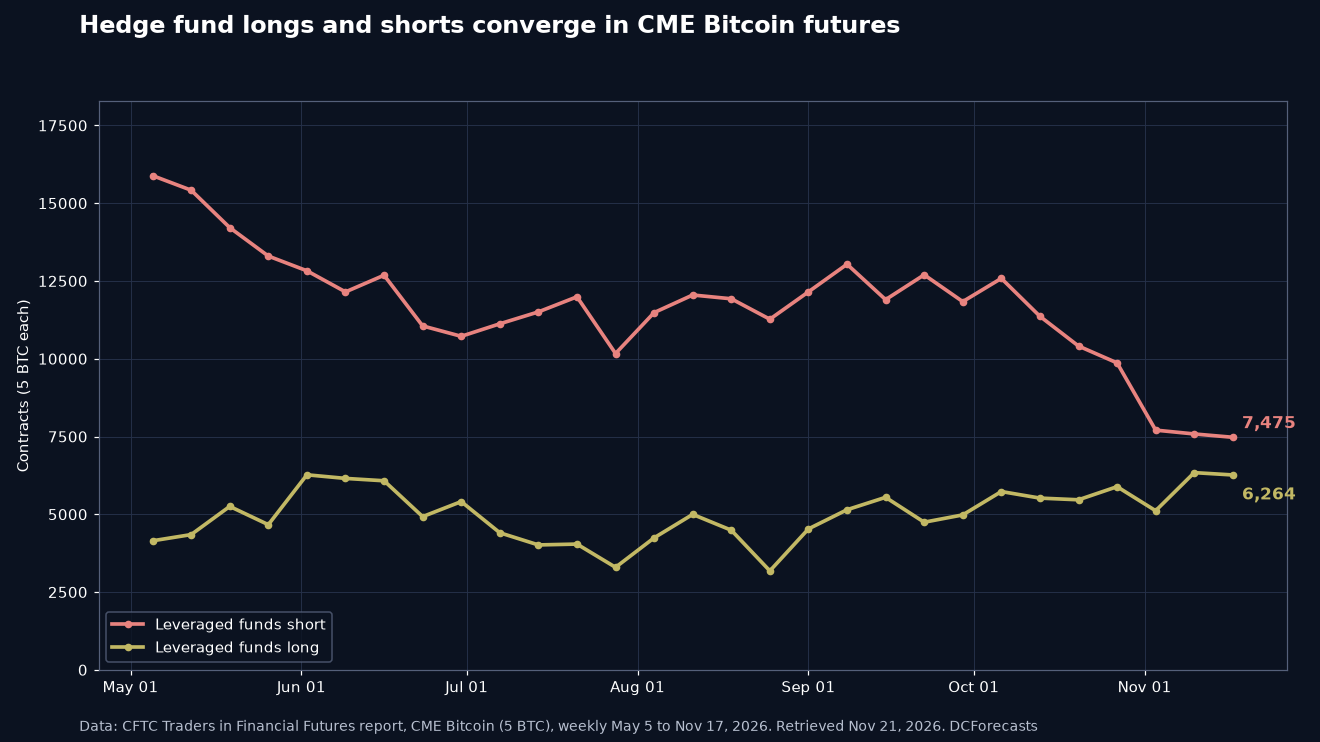
The weekly report, released on Friday with positions as of Tuesday, Nov. 17, shows leveraged funds holding 6,264 long contracts against 7,475 short contracts.
That leaves a net short of just 1,211 contracts, or roughly 6,055 BTC at five bitcoin per contract.
For Bitcoin investors, the striking part is how far this has come. In December 2024, the same group was short more than 23,000 contracts.
The bigger question now is whether a market with far less hedged supply behind it can respond more cleanly when demand returns.
What the CFTC Data Show for CME Bitcoin Futures
The CFTC’s Traders in Financial Futures report splits CME positions into dealers, asset managers, leveraged funds and other traders.
Leveraged funds, the category that covers hedge funds and commodity trading advisers, posted a record net short of 23,197 contracts on Dec. 17, 2024. That is the largest in CFTC records for the contract going back to 2018.
The Nov. 17 reading of 1,211 is about 95% smaller. The last time the figure was this close to flat was Jan. 17, 2023, when it stood at 1,199.
The move has also been fast. On Aug. 25, leveraged funds were net short 8,089 contracts, so the position has shrunk by about 85% in 12 weeks.

Both sides of the book moved. Gross shorts fell to 7,475 contracts, the fewest since May 30, 2023, and down from 19,134 a year earlier.
Longs went the other way. The prior week’s 6,339 long contracts were the most leveraged funds had held since August 2020, and Nov. 17 was only slightly lower.
The number of leveraged traders holding shorts also dropped to 36, compared with 52 on Aug. 25.
Why Hedge Fund Shorts Were Never Simple Bearish Bets
It would be easy to read a giant hedge fund short as a giant bet against Bitcoin. We believe that reading was always too simple.
A large share of that position is widely understood to come from the basis trade. A fund buys spot Bitcoin, often through a spot ETF, and sells CME futures that trade at a premium, locking in the gap.
In that trade, the short is a hedge, not a view on price. When the premium narrows, funds close both legs, selling ETF shares and buying back futures.
That fits what we have seen in recent weeks. As we covered when BlackRock’s Bitcoin ETF posted a record one-day outflow of $541 million, ETF redemptions have been heavy this month.
The CFTC data do not identify individual strategies, so we treat this link as interpretation rather than proof. Still, the timing of falling shorts and ETF outflows lines up closely.
Dealers and Asset Managers Have Shifted Too
Dealers, usually the banks and brokers that make markets, held 5,008 longs and 5,511 shorts on Nov. 17, a small net short of 503 contracts. In December 2024, dealers were net long more than 11,400 contracts.
Asset managers remain net long, with 3,901 long contracts against 1,616 shorts. That net long of 2,285 compares with roughly 10,600 at the December 2024 peak.
Total open interest in the standard contract stood at 19,257, or about 96,000 BTC. Two weeks earlier it dipped to 17,527, the lowest since October 2023, and it remains less than half of the 42,524 record set in December 2024.
One detail runs the other way. In CME’s micro Bitcoin futures, which cover 0.1 BTC each, leveraged funds widened their net short to 7,157 contracts. That equals only about 716 BTC, a small fraction of the standard-contract shift.
Does a Smaller Short Leave Bitcoin on Firmer Ground?
Bitcoin traded near $58,900 on Saturday, according to CoinGecko, after a weekend slide we tracked in our look at shorts paying longs again near $55,500. That is a real drawdown, and the CFTC figures do not change it.
What they show is that a large block of hedged, arbitrage-driven positioning has already been unwound. Much of the mechanical ETF selling tied to the basis trade may therefore be behind the market rather than ahead of it.
The reverse is also worth noting. When the futures premium widens again, basis traders typically rebuild by buying spot Bitcoin and selling futures, which would add fresh spot demand.
For long-term holders, we believe this is the kind of reset that leaves the market leaner. Bitcoin’s fixed 21 million supply has not changed, and regulated futures, ETFs and custody are all still in place for capital to return.
What We Will Watch in the Next CFTC Report
We will look first at whether leveraged funds flip to a net long position in CME Bitcoin futures. CFTC data show the group has not been net long in the standard contract since early February 2019, so that would be a genuine shift.
We will also watch open interest. A rebound in contracts alongside rising longs would point to new directional demand, not just arbitrage.
Next come the spot ETF flow numbers. A return to steady inflows with a wider futures premium would suggest the basis trade is being rebuilt.
The full weekly figures are published on the CFTC Commitments of Traders page.
The coming weeks will show whether this was simply hedges coming off or the first sign of funds leaning long again. Either way, the CME futures market is carrying far less bearish-looking weight than it was a year ago.
DC Forecasts is a leader in many crypto news categories, striving for the highest journalistic standards and abiding by a strict set of editorial policies. If you are interested to offer your expertise or contribute to our news website, feel free to contact us at [email protected]











Discussion about this post