


Ukraine’s crypto law may finally be close to a final text, after a senior lawmaker said on Friday that the long fight over its wording could end as soon as Monday.
Bill No. 10225-d has been parked at the “preparing for second reading” stage since parliament backed it at first reading on September 3, 2025. That is 444 days.
The holdup was not opposition to regulating crypto. It was a dispute between Ukraine’s two financial watchdogs over how the market should be policed.
For Bitcoin holders in Ukraine, the most interesting development is that both regulators now appear to be converging on one rulebook.
The bigger question is whether that rulebook can clear the committee and a full vote before the year runs out.
What Did Yaroslav Zhelezniak Actually Say?
Yaroslav Zhelezniak, first deputy chair of the Verkhovna Rada’s finance, tax and customs committee, set out the timeline in a Telegram post on November 20.
“There is every reason to believe that from Monday the unrestrained and endless process of agreeing the text on virtual assets (popularly, the law on legalizing crypto) will be completed,” he wrote.
He added that he hoped all state bodies, “first of all, the NBU and the NSSMC,” had found a common vision, with lawyers still to finalize the text.
If that work is done over the weekend, he said, the bill might even make the agenda of the nearest plenary week for a final vote as a whole.

He also called it, “without exaggeration, the most difficult” law he has worked on, because there is no single reference model anywhere in the world.
We believe that candour matters. It frames the delay as a hard design problem, not a political rejection.
How the Ukraine Crypto Law Got Stuck
The parliamentary bill card tells the story in dates. The revised bill, filed by a group of deputies including committee chair Danylo Hetmantsev, was registered on April 24, 2025.
It amends the Tax Code and other laws to regulate the circulation of virtual assets in Ukraine.
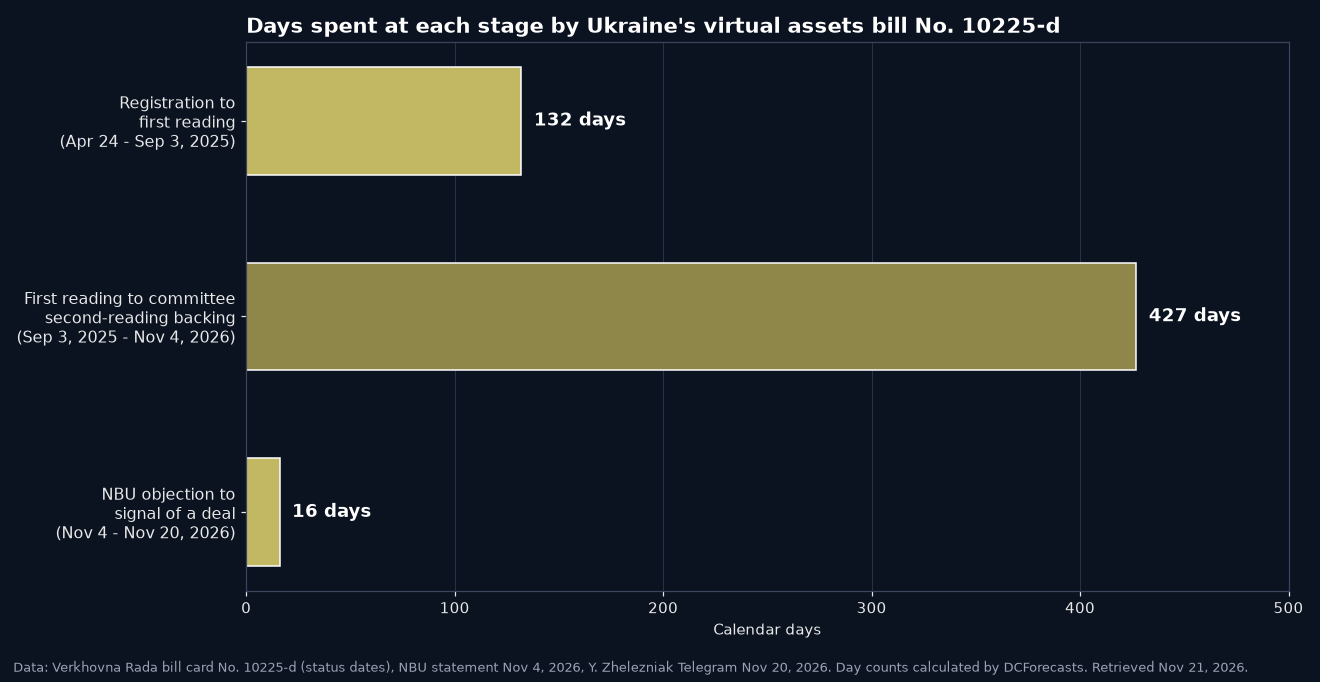
The Rada adopted it as a basis 132 days later. Then it waited another 427 days before the committee recommended it for second reading on November 4, 2026.
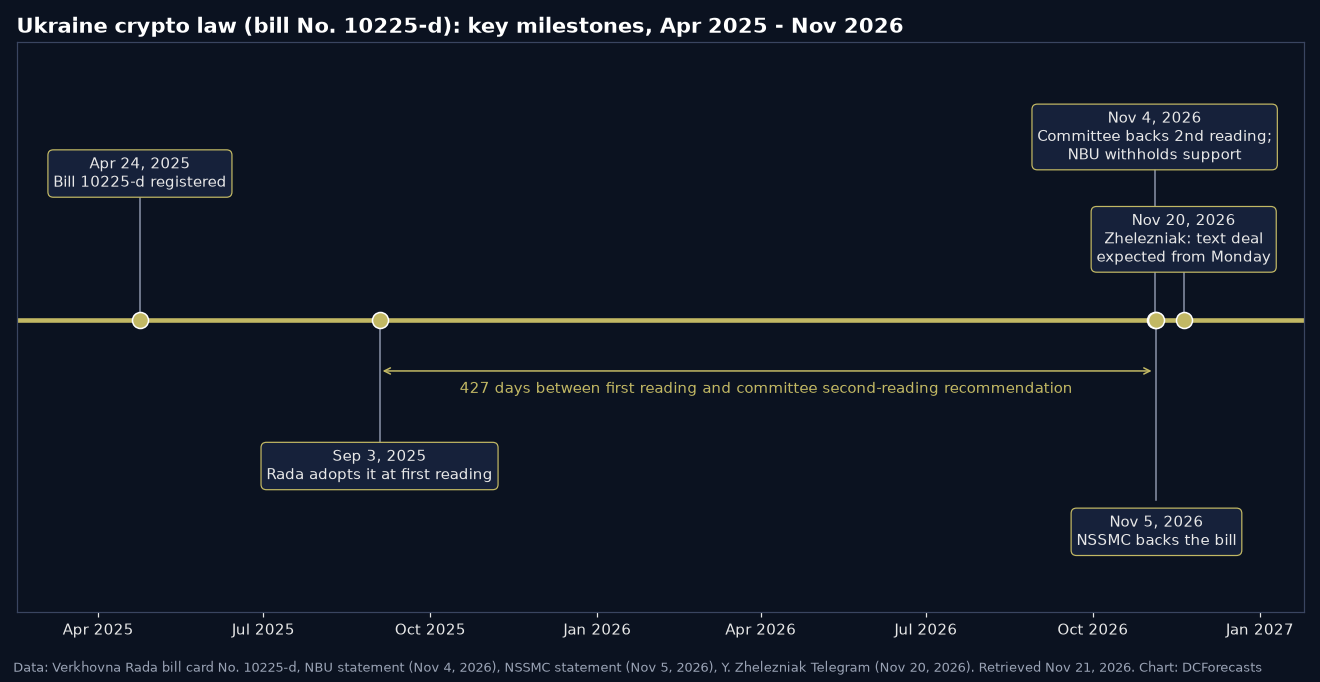
That same day, the National Bank of Ukraine said it could not support the draft in its current form.
The central bank said it had received the final version only late the previous evening, and that the text did not reflect several agreements reached in the working group.
As we reported when Ukraine’s central bank first pushed back, that objection effectively froze the vote.
The Three Fault Lines Regulators Had to Close
The NBU listed three risks. Each points to a specific clause that negotiators have had to rework.
- Foreign tokens: the draft let foreign tokens that work like electronic money enter Ukraine even if they are not supervised at home. The NBU wants power to assess and, if needed, restrict them.
- Regulatory arbitrage: simplified admission for foreign assets should not let them dodge rules that apply to comparable Ukrainian assets.
- Exchange licences: the NBU had accepted an initial cap of three trading platform operators chosen by competition. The final text left the number for the first five years to the securities regulator, without clear antitrust safeguards.
Notably, none of those concerns targets Bitcoin itself. They are about stablecoin-like foreign tokens and about who gets to run exchanges.
A day later, the National Securities and Stock Market Commission backed the bill. It said the draft is built on the EU’s MiCA model.
The NSSMC put the stakes plainly: the question is not whether Ukraine’s crypto market will exist, but whether it stays in a grey zone or works under clear rules and proper supervision.
Why a Ukraine Crypto Bill Deal Would Matter
The 16 days between the NBU’s objection and Zhelezniak’s post are short by this bill’s standards.
We would not treat Monday as guaranteed. The committee still has to sign off, lawyers must finish the text, and the full Rada must vote.
Parliament’s own expert reviews also flagged work to do. In August 2025, one review found the bill broadly consistent with EU law but in need of refinement, while an anti-corruption review found some provisions fell short.
Still, we believe crypto legalization through a MiCA-style framework would be a clear positive for adoption.
Licensed platforms, defined token categories and a tax regime give ordinary Ukrainians a legal route into Bitcoin rather than an informal one.
It would also put Ukraine closer to the EU rulebook that other states, such as France with its MiCA regulation wish list, are still fine-tuning.
What Should Investors Watch Next?
The first signal is whether the committee revisits its November 4 decision with a text both regulators endorse.
The second is the size of the exchange licence cap. A clear number and a transparent selection process would answer the NBU’s monopoly concern.
The third is how foreign stablecoins are treated. That clause will decide which dollar tokens Ukrainians can legally use next to Bitcoin.
For us, the key takeaway is simple. A virtual assets law that both the central bank and the securities regulator can defend is far stronger than one rushed through over their objections.
Bitcoin’s fixed supply and open network do not depend on any one country’s statute. But every new legal framework widens the door for people and businesses to use it.
The coming week will show whether Ukraine’s 444-day wait is finally over.
DC Forecasts is a leader in many crypto news categories, striving for the highest journalistic standards and abiding by a strict set of editorial policies. If you are interested to offer your expertise or contribute to our news website, feel free to contact us at [email protected]











Discussion about this post