



France wants the next round of MiCA regulation to make crypto staking opt-in, put tighter limits on crypto ads and close the door on offshore platforms that court Europeans from outside the bloc.
The requests come from the Comité consultatif du secteur financier (CCSF), the French financial sector advisory committee hosted by the Banque de France. Its recommendation is dated Nov. 10 and was published on Nov. 17.
France’s economy minister asked for the review in an April 8 mission letter. The paper is aimed squarely at Brussels, which closed a consultation on a possible MiCA revision on Sept. 30.
Nothing changes for investors yet. The real question is how much of this French wish list ends up in the European rulebook.
What France’s Advisory Panel Is Asking Brussels For
The CCSF reaffirmed its 2023 guidance on crypto investor protection and then listed six new requests for the European Commission.
- Clearer risk disclosures for crypto lending, borrowing and staking.
- Tighter limits on “reverse solicitation” by firms based outside the EU.
- Checks that retail clients understand the risks, applied in proportion.
- Stricter rules for promoting the most speculative tokens.
- Visible information on how to file complaints and disputes.
- Stronger protection of holders’ personal data.
The committee says it is setting consumer protection goals, not choosing the tools, whether new law, firm diligence or supervisory guidelines.
It also wants the European Securities and Markets Authority (ESMA) to get stronger powers to find and fight unauthorised crypto services aimed at EU consumers.
Opt-In Crypto Staking and Plainer Words for Yield
The staking section is the most concrete. Before a platform stakes a client’s coins, the CCSF says it should explain the hacking and smart contract risks, protocol penalties known as slashing, lock-up periods and how long unstaking takes.
Then comes the key line: explicit client consent should be obtained before a provider uses the client’s crypto for staking.

Lending gets the same treatment. Platforms should flag the risk of losing lent coins if a borrower or platform fails, and that interest paid in the same token can lose most of its value if the price collapses.
Borrowers should see the exact level at which their collateral would be liquidated.
The panel also takes aim at vocabulary. It calls labels such as “savings” or a crypto “livret” misleading, and suggests “remuneration” in place of “reward” for staking income.
Platforms linking clients to DeFi protocols should name who provides each service, so a firm’s MiCA license does not appear to cover everything on its app.
Crypto Advertising Rules Could Cover Every Token
On crypto advertising, the CCSF backs strict controls on promotions of the riskiest, most speculative tokens when they target retail investors.
It flags algorithmic promotion, referral and reward schemes, and “gamification” that can push people into rushed decisions around new token launches.
There is a catch. If regulators cannot reliably tell the most speculative tokens apart, the committee says strict promotion rules should be considered for all crypto-assets sold to retail investors.
It stresses that this would not be a ban. Ads would face stricter transparency, a balanced view of benefits and risks, and closer monitoring of how they are spread.
France already has building blocks. The Sapin II law of 2016 bars investment firms from sending electronic promotions for certain highly speculative contracts to likely retail clients, and a June 2023 law limits influencer crypto promotion to regulated providers.
How Many Firms Already Hold a MiCA License?
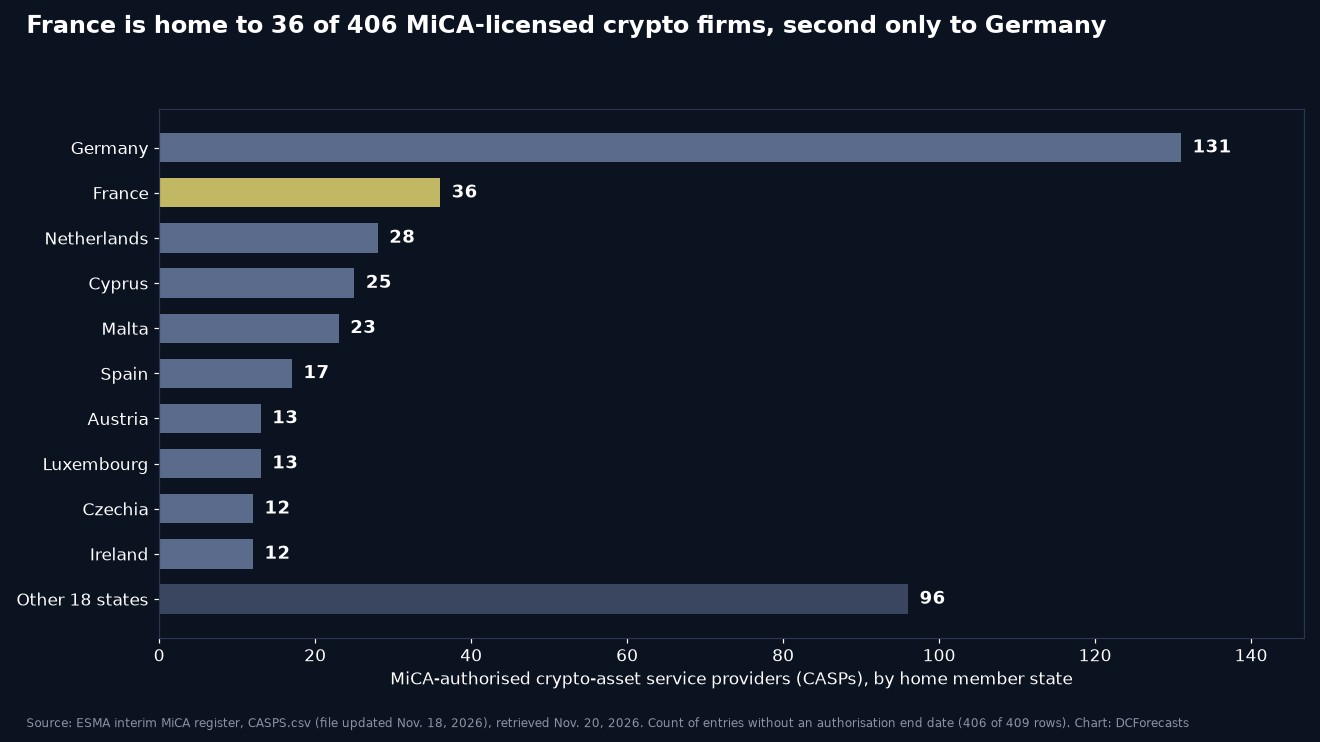
The proposals would land on a market that has already been reshaped by licensing. According to ESMA’s interim MiCA register, updated on Nov. 18, there are 406 active entries for authorised crypto-asset service providers.
Germany leads with 131. France is second with 36, ahead of the Netherlands with 28, Cyprus with 25 and Malta with 23.
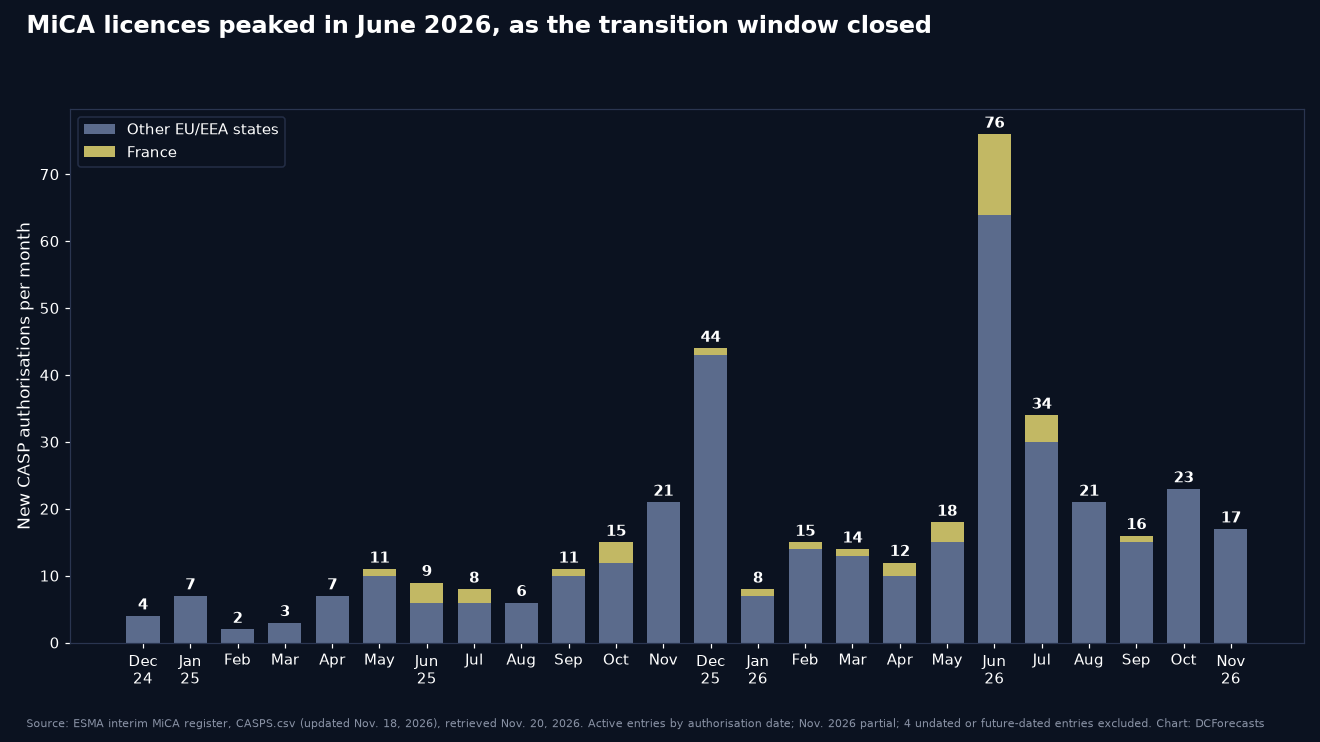
Licensing came in waves. The register shows 76 authorisations dated June 2026, 12 of them French, as the MiCA transitional period for existing providers ended on July 1, 2026.
Firms that missed that deadline had to wind down EU services, which is why Binance set a Dec. 31 deadline for affected EU accounts.
Demand is real. The CCSF cites an ADAN-Ipsos survey showing 11% of French residents own crypto-assets, while 93% have heard of them.
Why Clearer MiCA Regulation Can Help Bitcoin
For bitcoin holders, the paper is less of a threat than its headline items suggest. The document itself notes that crypto-assets with no identified issuer, such as Bitcoin and Ether, fall outside MiCA’s scope. The rules bite on the platforms that serve clients.
Bitcoin also runs on proof-of-work, so the opt-in staking rules would not touch the asset itself, only exchange products built on other networks.
The data section also has a constructive side. Citing a rise in assaults and extortion attempts against holders, the CCSF wants anyone storing holder data to protect it as strictly as licensed firms must. We believe that is the right priority.
The open question is the advertising test. A rule that cannot separate speculative launches from an asset with Bitcoin’s nearly 18-year record could end up treating both the same way.
The CCSF recommendation binds no one, and the Commission’s next MiCA draft is the step to watch. As our coverage of the EU’s DAC8 tax cases shows, Europe’s crypto rulebook is still being written country by country.
For long-term investors, clearer rules and a growing pool of licensed firms point the same way: more regulated doors into Bitcoin for Europe’s savers.
DC Forecasts is a leader in many crypto news categories, striving for the highest journalistic standards and abiding by a strict set of editorial policies. If you are interested to offer your expertise or contribute to our news website, feel free to contact us at [email protected]












Discussion about this post