



The Payoneer stablecoin plan cleared its first federal hurdle on Friday, when the Office of the Comptroller of the Currency granted preliminary conditional approval for PAYO Digital Bank, a new national trust bank in New York.
The approval, published as Corporate Decision #1395 and dated November 20, lets the bank start organizing. It cannot open until it meets every pre-opening condition and wins final approval.
The detail that stands out is the design of the token itself. PAYO-USD will run on a closed loop, so customers will not be able to send it directly outside the bank.
For anyone following crypto adoption, that makes this a different kind of stablecoin story: a payments company with billions in customer balances choosing a federal charter over an open token.
The bigger question is whether a walled-garden dollar token can still pull global businesses deeper into blockchain-based money.
What the OCC Approved for PAYO Digital Bank
PAYO Digital Bank will be a wholly owned subsidiary of Payoneer Global Inc. Its operations are limited to those of a trust company, including fiduciary activities.
According to the decision letter, the proposed services are stablecoin issuance, fiduciary custody of fiat currency and PAYO-USD, on-ramp and off-ramp services, and related transaction services.
Customers will be able to pay each other in PAYO-USD inside the bank’s platform. They will also be able to convert between fiat currency, PAYO-USD and other third-party stablecoins.
The OCC also waived the residency requirement for four directors and the citizenship requirement for one. The OCC raised no objection to Robert Morgan serving as organizer, director and chief executive.

The bank has been assigned OCC charter number 25416, but “In Organization” must follow its name until it opens.
Why the Payoneer Stablecoin Will Stay Inside the Platform
Payoneer’s own announcement explains the closed design. PAYO-USD “will not be listed on exchanges” and will serve as a balance within the Payoneer ecosystem, the company said.
Once final approval arrives, the plan is to issue it as a fully reserved stablecoin compliant with the GENIUS Act, then let businesses move that balance into local currencies. Payoneer already pays out in local currency in more than 190 markets.
“More than one third of our customers already use stablecoin today,” Morgan said in the release.
We believe that line matters more than the charter. It suggests demand came first and the bank is catching up to how customers already move money.
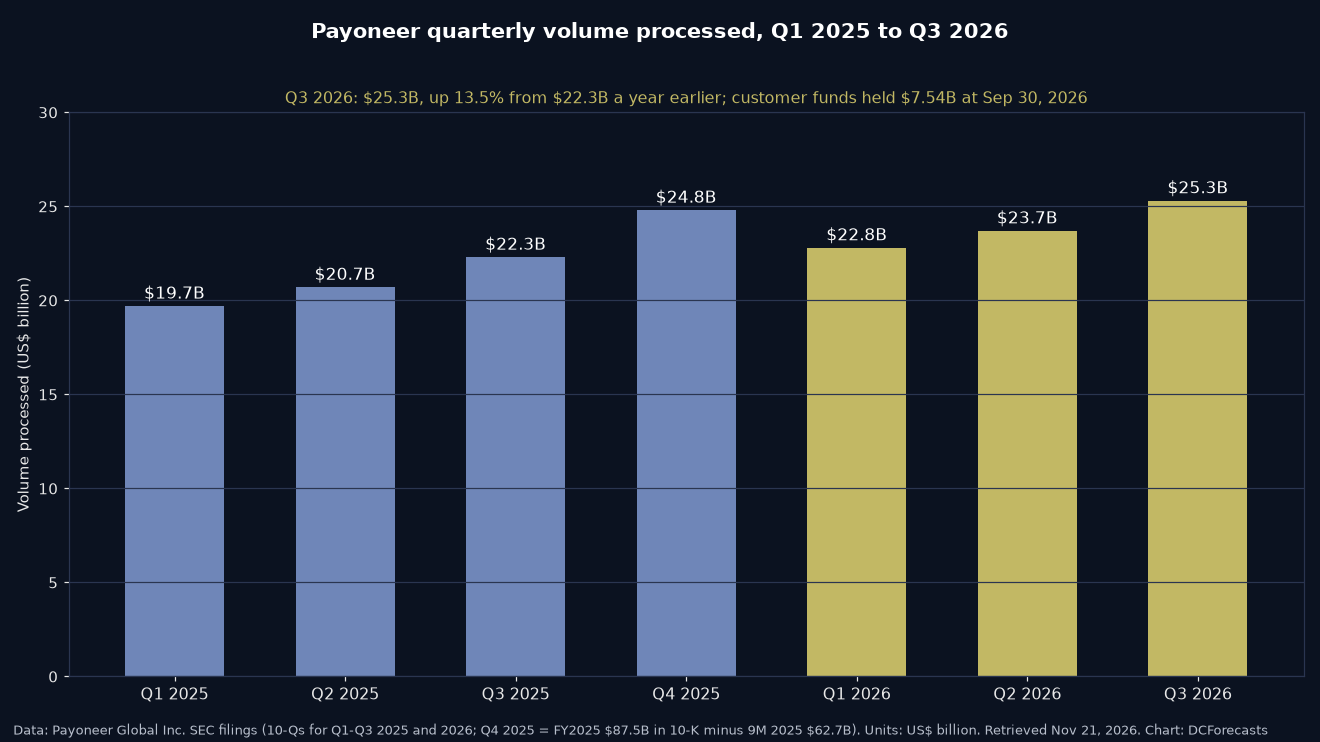
The scale is real. Payoneer’s latest quarterly filing shows $25.3 billion of volume processed in the three months to September 30, up from $22.3 billion a year earlier.
Over nine months, volume reached $71.8 billion against $62.7 billion in 2025. The company also reported $7.54 billion of customer funds on its balance sheet at the end of September.
Even a modest share of those balances moving into PAYO-USD would make it a meaningful regulated dollar token.
The Conditions: $8 Million in Capital and an 18-Month Clock
The approval comes with firm guardrails. The bank must hold at least $8.0 million in tier 1 capital, with the greater of half that amount or $4.0 million kept in eligible liquid assets.
It must also hold 180 days of operating expenses in separate eligible liquid assets. Both conditions apply through its first three years of operation.
Timing is strict as well. If the capital is not raised within 12 months, or the bank does not open within 18 months, the approval expires.
Crucially, the bank must conform, cease or divest its stablecoin activities in line with the GENIUS Act and its implementing rules. The OCC said it had “no indication” the bank would be unable to comply.
Bank Groups Objected, and the OCC Answered
The agency received three public comments, two from bank trade groups and one from a community group. All three questioned whether issuing a stablecoin amounts to taking deposits.
The OCC rejected that reading. It wrote that stablecoins “are not deposits under the FDI Act,” which it said Congress confirmed in the GENIUS Act.
Because the bank will not be FDIC-insured, the OCC also ruled the Community Reinvestment Act does not apply.
The letter places PAYO Digital Bank alongside nine earlier conditional approvals it cites for digital asset custody or stablecoin issuance, including BitGo, Paxos, Ripple, Bridge and World Liberty.
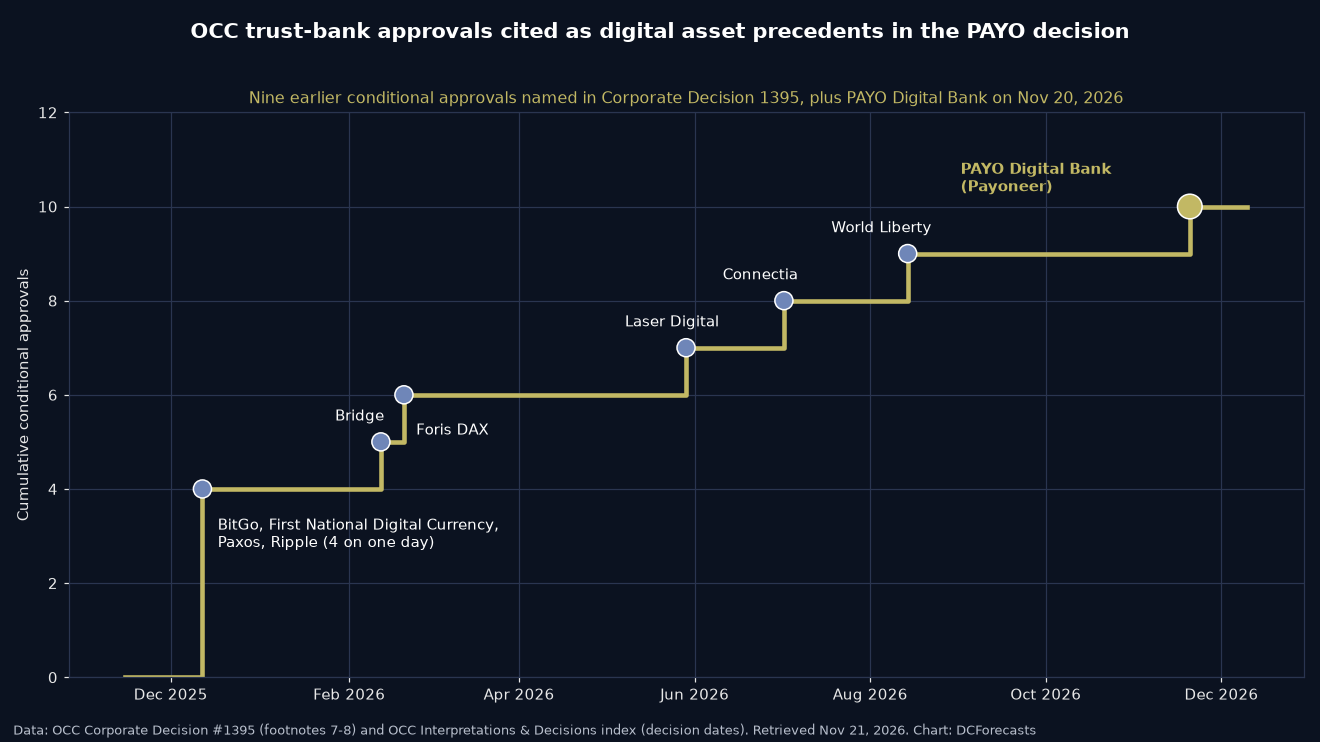
The pipeline keeps filling. As we reported this week, the MoonPay trust bank filing became the 17th pending digital asset application on the OCC’s list.
Comptroller Jonathan Gould has also said the agency approved 28 bank charter applications in two years.
What a Closed-Loop Dollar Means for Open Crypto Networks
There is a wrinkle. Payoneer agreed on June 12 to be acquired by Nuvei for $7.40 per share in cash, according to its filings, and its Friday release still lists completing that merger among its risks.
So the charter will likely mature under a new owner, with final approval still ahead.
The bigger picture is constructive, in our view. A regulated on-ramp that converts between local money and third-party stablecoins brings more businesses into blockchain-based settlement, even if the house token stays at home.
That contrast is also a reminder of what makes Bitcoin different. PAYO-USD can only move where one bank allows. Bitcoin moves across an open network that no single company controls, with a fixed supply that no issuer can change.
We believe every new federally supervised rail widens the road for digital assets as a whole. The next 18 months will show whether Payoneer turns a conditional approval into a working stablecoin bank.
DC Forecasts is a leader in many crypto news categories, striving for the highest journalistic standards and abiding by a strict set of editorial policies. If you are interested to offer your expertise or contribute to our news website, feel free to contact us at [email protected]












Discussion about this post