



MoonPay has applied for a national bank charter, and the proposed MoonPay trust bank would issue, redeem and manage reserves for stablecoins under direct federal supervision.
The crypto payments company applied on Nov. 17 to organize MoonPay National Trust Bank, according to the application the Office of the Comptroller of the Currency posted on its digital assets licensing page. The agency logged it as received on Nov. 18.
The proposed bank would be headquartered at 407 Lincoln Road in Miami Beach, Florida. It would be wholly owned by MoonPay Inc., which is based in New York.
MoonPay’s filing makes it the 17th pending digital-asset application on the OCC’s list, and the latest in a busy autumn for crypto firms seeking a federal license.
What the MoonPay Trust Bank Would Do
The application describes a non-depository national bank whose operations would be limited to those of a trust company. In plain terms, it would not take deposits or make loans.
Instead, the filing lists three lines of business once the charter is granted:
- fiduciary custody services;
- stablecoin services, including issuance, redemption and reserve management;
- conversion services, acting as an agent.
The organizers say the bank would aim to “promote trust and transparency in stablecoin markets” and provide “enterprise-grade infrastructure for digitally-native finance.”
The business plan itself is marked confidential, so the public file does not show projected volumes, capital levels or which stablecoins MoonPay intends to issue or manage.
The organizers also asked the OCC for full fiduciary powers and for waivers of the federal citizenship and director residency requirements for national bank boards.

Who Would Run the Bank
The filing names a five-member board. MoonPay chief executive Ivan Soto-Wright would chair it, joined by Victor Faramond, Michael Lempres, Caroline Butler and a fifth director yet to be named.
Lempres and Butler are designated as independent directors. The application says independent directors would chair both the Audit and Fiduciary Committee and the Board Risk and Compliance Committee.
Soto-Wright would also serve as interim president and chief executive. The other proposed senior officers are Anne Giviskos as chief financial officer, Yujush Saksena as chief risk officer, Faramond as chief technology officer, Laura Astrada as general counsel and Chris Gregor as chief operating officer and head of custody.
In the filing, MoonPay describes itself as a company founded in May 2019 with more than 30 million customers across 180 countries and over 500 enterprise clients in crypto and fintech.
A Crowded Line at the OCC
MoonPay is joining a long queue. The OCC’s table of pending digital-asset applications now lists 17 filings received in 2026, from Laser Digital National Trust Bank in January to MoonPay in November.
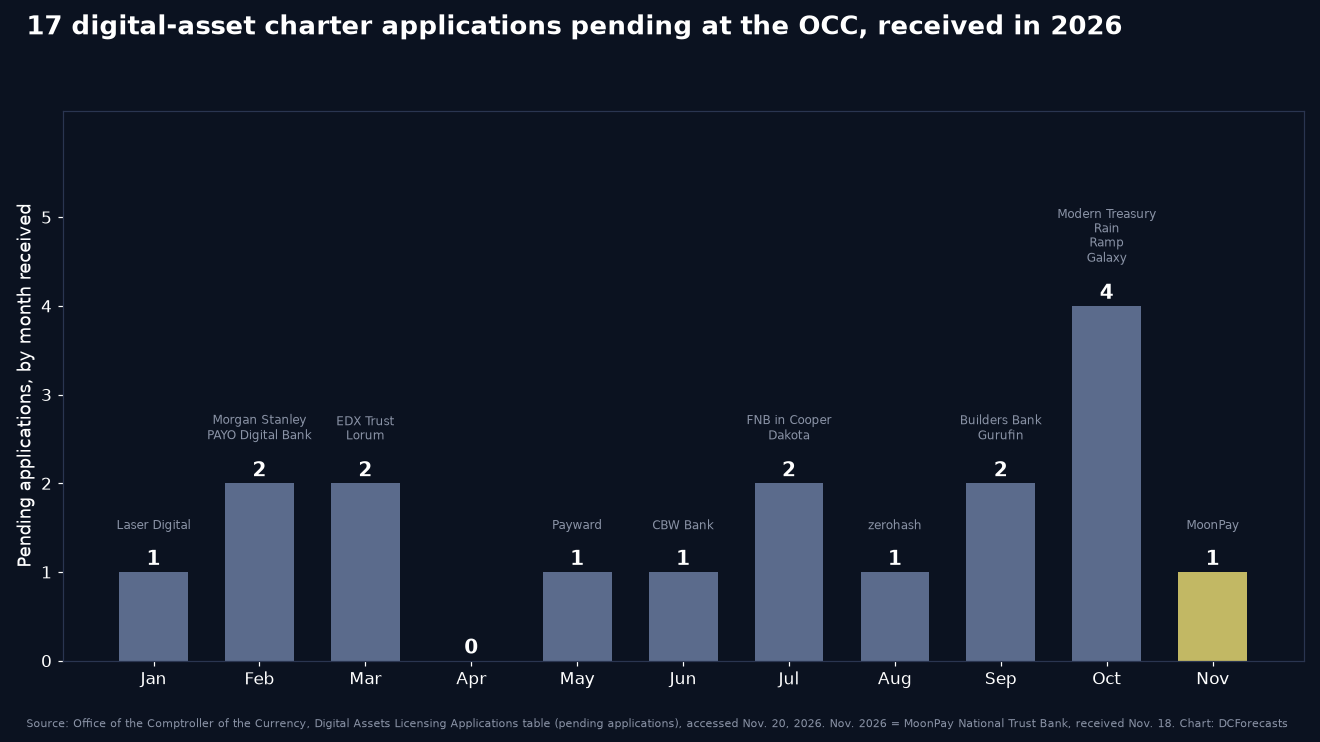
October was the busiest month on the list. The agency received four applications in just 26 days: Modern Treasury National Trust Bank on Oct. 1, Rain National Trust Bank on Oct. 5, Ramp National Trust Bank on Oct. 19 and Galaxy National Bank on Oct. 26.
Most of the pending filings follow the same model as MoonPay’s. At least 12 of the 17 applicants are proposed national trust banks or trust companies, including Payward National Trust Company, zerohash national trust bank, Dakota National Trust Bank and Morgan Stanley Digital Trust.
That pattern makes sense. A trust charter lets a firm hold client assets and run payment-adjacent services nationwide without becoming a deposit-taking bank, which carries a much heavier regulatory load.
The pace also matches what Comptroller Jonathan V. Gould described this week. As we reported on Nov. 19, Gould said the OCC has approved 28 bank charters in two years and has several dozen more in the pipeline.
Why the Stablecoin Piece Matters
The timing of MoonPay’s filing lines up with the federal stablecoin rulebook. The OCC issued its final rule implementing the GENIUS Act on Oct. 21, and the law and rule take effect on Jan. 18, 2027.
That framework sets reserve, redemption and risk-management standards for payment stablecoin issuers under the agency’s watch. A national trust charter would put MoonPay’s planned issuance and reserve work squarely inside that system.
We believe that is a constructive step for the wider market. Stablecoins are the main trading and settlement asset on many crypto platforms, and more regulated issuers and custodians can make it easier for institutions to move money into digital assets, Bitcoin included.
For MoonPay, the charter would also be a natural extension of its existing business. The company built its name on helping users buy and sell crypto through apps and wallets, and custody plus stablecoin services sit close to that core.
What Happens Next
The application is not an approval. The OCC still has to review the confidential business plan, capital structure and management before deciding whether to grant even preliminary conditional approval.
The public notice attached to the filing opens a 30-day comment window after publication. Comments go to the OCC’s Director for Licensing for trust banks, and the agency’s Weekly Bulletin will list the date the comment period closes.
Several of the earlier applicants on the list have waited months already, so a decision on MoonPay is unlikely to come quickly.
Still, the direction is clear. With 17 crypto-related charter bids pending and a federal stablecoin regime weeks from taking effect, the biggest names in digital asset payments are choosing to come inside the banking perimeter rather than stay outside it.
DC Forecasts is a leader in many crypto news categories, striving for the highest journalistic standards and abiding by a strict set of editorial policies. If you are interested to offer your expertise or contribute to our news website, feel free to contact us at [email protected]












Discussion about this post