



Europe’s MiCA register has a new dominant group, and it is not a crypto exchange. Germany’s local cooperative banks account for 57 of the 78 entries dated Aug. 1 or later.
The European Securities and Markets Authority refreshed its interim register of crypto-asset service providers on Friday, Nov. 20. Our count of that file shows 403 active firms across the EU and EEA, and 128 of them are supervised by Germany’s BaFin.
Of those German entries, 77 are Volksbanken, Raiffeisenbanken and other cooperative lenders. All of them are listed for one core service: executing crypto orders on behalf of clients.
For Bitcoin investors, that matters more than another exchange licence. It means the bank on the town square is preparing to offer Bitcoin inside an app its customers already use.
The bigger question is whether this wave of small banks can turn regulatory filings into real retail demand while Bitcoin trades near two-year lows.
What the MiCA Register Shows
ESMA publishes the register as a downloadable data file on its MiCA page. We counted entries without an end date and removed duplicate legal entity identifiers.
The pattern since summer is striking. Of the 78 entries dated Aug. 1 or later, 57 are German cooperative banks, or 73%.
November has followed the same script. Through Saturday, 11 of the 16 entries dated this month are co-op banks, from Volksbank Ettlingen to Volksbank Oberberg.
Three more are already queued with dates still ahead: Raiffeisenbank Kirchweihtal on Nov. 25, Raiffeisenbank Landshuter Land on Dec. 3 and VR-Bank Passau on Dec. 7.

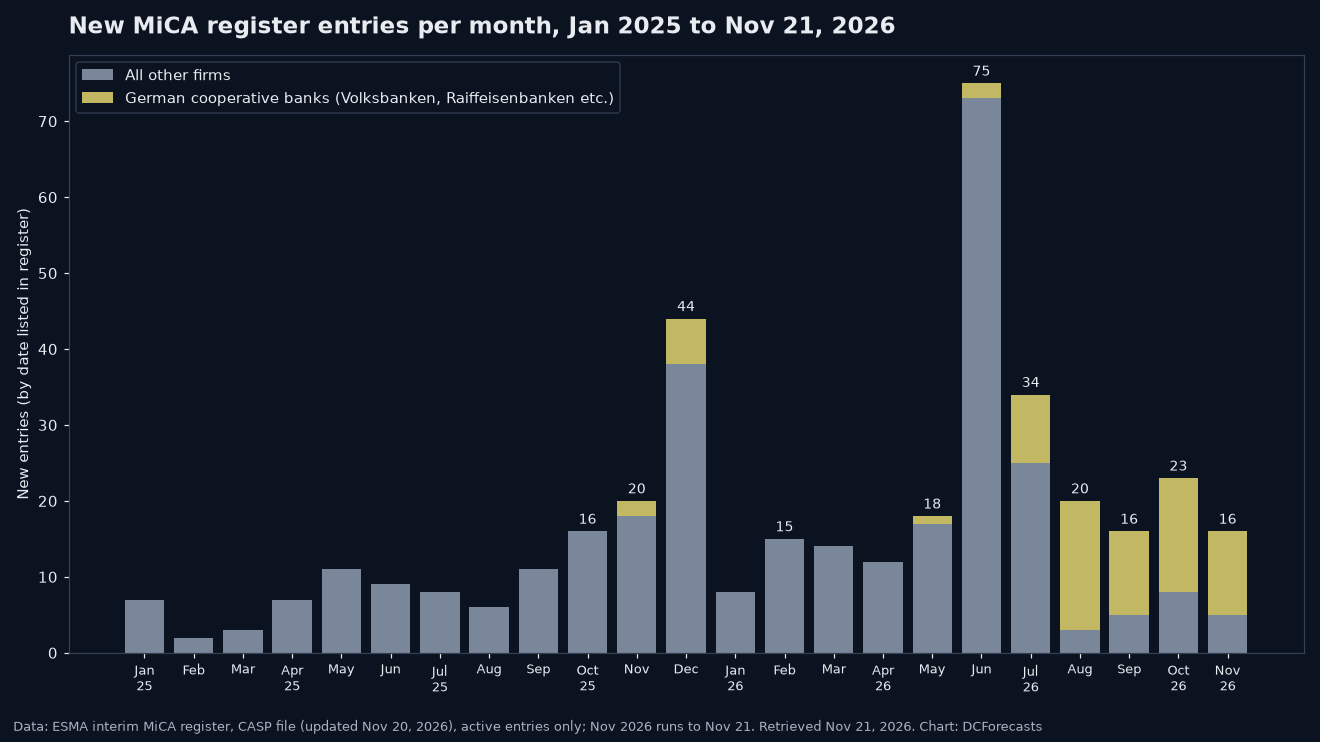
The chart also shows how different this wave is. June’s spike of 75 entries came almost entirely from other firms, just before MiCA’s longest transition window closed on July 1.
The co-op wave arrived later, and it has been steady rather than rushed. That looks like a planned rollout, not a deadline scramble.
Why Germany’s Co-op Banks Are Signing Up
All 77 co-op entries are filed under Article 60 of MiCA. That route lets already regulated credit institutions offer crypto services by notifying their supervisor, instead of applying for a separate crypto licence.
The common thread is a shared platform. DZ BANK, the central institution of Germany’s cooperative banking group, said on Jan. 12 that BaFin had cleared it in late December 2025 to run a crypto platform called “meinKrypto”.
According to DZ BANK, each Volksbank and Raiffeisenbank must then file its own MiCA notification before it can switch the service on for retail clients.
The product is a wallet built into the VR Banking App. At launch it offers Bitcoin, Ether, Litecoin and Cardano, with custody by Boerse Stuttgart Digital and order execution through EUWAX AG.
The platform was developed by DZ BANK and Atruvia, the group’s IT provider. Each bank decides on its own whether to join, and DZ BANK cited a September 2025 Genoverband survey in which more than a third of banks planned to introduce it.
How Far Has the Rollout Reached?
There is plenty of room left. Germany’s cooperative banking association BVR counted 646 independent cooperative banks at the end of 2025.
That puts the 77 banks on the register at roughly 12% of the group. In other words, the wave so far is still only a first slice of the network.
The terms are simple for customers. VR Bank Schleswig-Holstein Mitte, one of the listed banks, says users need to be adults resident in Germany with an account and the VR Banking App.
The same bank says coins are held in omnibus wallets at Boerse Stuttgart Digital Custody, and it warns plainly that crypto holdings are not covered by deposit insurance.
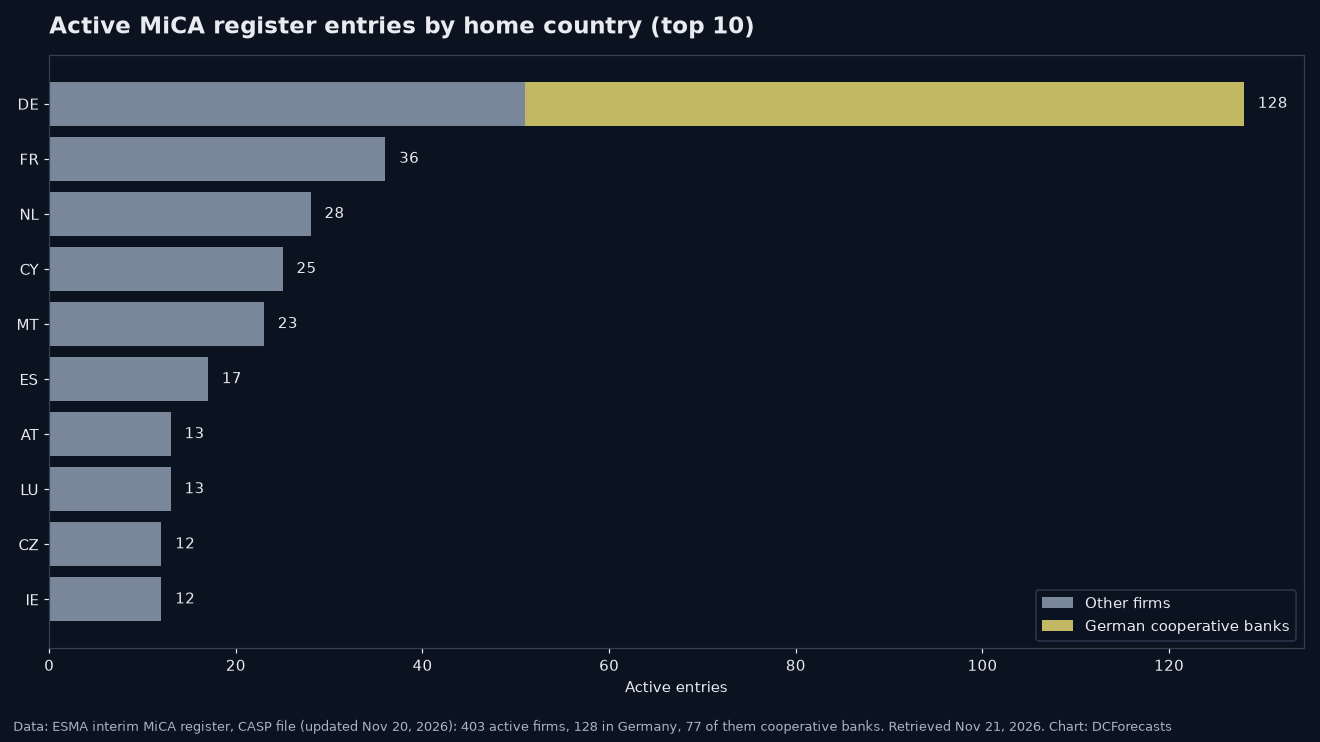
Germany’s lead is now hard to miss. Its 128 active entries are more than triple France’s 36, and the co-op banks alone outnumber every other country on the list.
Bitcoin Demand Meets a Familiar Banking App
The timing looks awkward at first. Bitcoin traded near $60,300, or about €55,000, at 21:45 Jerusalem time on Saturday, according to CoinGecko, after an hourly low near $55,700 that morning.
We believe that is exactly why the register matters. Infrastructure built during a drawdown is usually ready by the time sentiment turns.
Europeans already lean toward Bitcoin when they own crypto. As we covered when the ECB surveyed euro area crypto holders, Bitcoin came out as the first choice.
Large German banks are moving too. We recently looked at the partners behind Deutsche Bank’s Bitcoin custody, and the co-op network now adds a retail layer underneath.
Still, a register entry is not a launch. Neither DZ BANK nor the listed banks have published user numbers, so we treat the filings as capacity, not proof of flows.
Can Small Banks Bring the Next Wave of Bitcoin Buyers?
For us, the key signal is the pace of new co-op entries in ESMA’s next updates. If it holds near a dozen a month, the share of cooperative banks able to offer Bitcoin could double within a year.
We would also watch for any first disclosure of meinKrypto users or trading volumes, and for Bitcoin to hold above $60,000 as wider markets steady.
The long-term case does not change with one weekend. Bitcoin’s supply is fixed at 21 million coins, and the infrastructure to buy it through regulated European banks keeps growing.
The coming months will show how many savers in small German towns tap that new button in their banking app.
DC Forecasts is a leader in many crypto news categories, striving for the highest journalistic standards and abiding by a strict set of editorial policies. If you are interested to offer your expertise or contribute to our news website, feel free to contact us at [email protected]












Discussion about this post