



The SEC crypto custody proposal has 15 days left in its comment period. Major banking and Wall Street trade groups have asked the agency for 45 more.
The request came in a Nov. 4 letter signed for AIMA, the American Bankers Association, the Association of Global Custodians, the Bank Policy Institute, LSTA, SIFMA and SIFMA AMG.
As of Nov. 22, the SEC’s rule page still lists a Dec. 7, 2026 deadline. We found no extension notice in the Federal Register.
For Bitcoin, the stakes are practical. The rule decides how registered investment advisers and regulated funds may legally hold client crypto, and that shapes how much professional money can reach the asset.
The open question is whether the SEC keeps its December timetable or gives the industry’s heavyweights more time to shape the final text.
What the SEC Crypto Custody Proposal Would Change
The SEC proposed the package on Oct. 1, 2026, as Release Nos. IA-7023 and IC-36353, File No. S7-2026-35. The Federal Register version was published on Oct. 6.
We walked through the mechanics when we first covered the custody rule proposal. Two pieces matter most for Bitcoin.
First, advisers could self-custody client crypto when no permitted custodian is available. They would have to recheck that every quarter, require two people to approve transactions and keep each client’s coins at separate addresses.
Second, advisers and funds could use state trust companies as crypto custodians. They would need to confirm the trust company is authorized by its state banking regulator, review its audited financial statements and keep client assets segregated.

In the SEC’s announcement, Chairman Paul S. Atkins said the plan would give advisers and funds “a compliant pathway where none existed before.”
Why Banks and Asset Managers Want More Time
The Nov. 4 letter does not oppose the proposal. It says the signers “welcome the efforts” of the Commission to update custody rules.
The problem, they argue, is scale. The release “poses more than 300 specific requests for comment,” according to the letter.
The groups also point to three other SEC investment-management proposals with overlapping comment periods: interval fund modernization, performance-based adviser fees and fund cross trading.
Many of the same people are working on responses to all of them, the letter says. It asks the SEC to push the Dec. 7 deadline back by 45 calendar days.
The weight behind the request is real. The American Bankers Association alone describes itself as the voice of a $26.5 trillion banking industry.
We believe the request is a sign of engagement, not resistance. Banks and broker-dealers that want to offer crypto custody need the final rule to work, and they are asking for time to make sure it does.
Who Has Written to the SEC So Far?
The public file is still thin for a rule of this size. The SEC’s comment page lists 28 public comment letters and two memos of staff meetings.
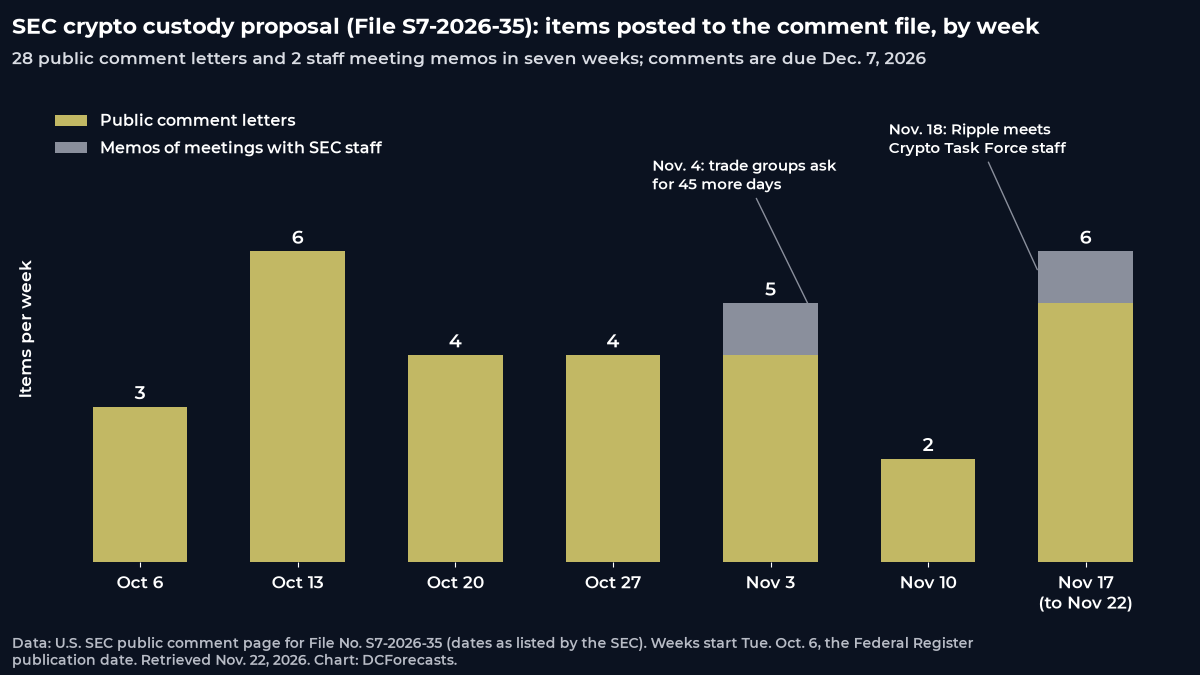
The most recent memo shows Crypto Task Force and Corporation Finance staff met Ripple Labs representatives, including Stu Alderoty, on Nov. 18. The memo lists the custody proposal among the topics but gives no detail.
Earlier, on Nov. 3, staff from the SEC’s economics division met University of Toronto professor Andreas Park on the same rules.
The letters so far come mostly from smaller advisers, law firms and individuals. Several of them describe how crypto custody already works in practice.
What Practitioners Are Asking For
SkyBridge Capital, which said it has held Bitcoin in client portfolios since 2020, called the proposals “thoughtful, proportionate, and overdue.”
It asked the SEC to allow segregation through “cryptographically verifiable sub-accounts or ledger entries” where one address per client is impractical. It also wants the rule to say that briefly moving assets to a trading venue for settlement is not a custody violation.
Honeybear Financial, a Chicago adviser running a digital asset fund, said it holds assets at Coinbase Custody Trust Company, which it described as a limited purpose trust chartered and supervised by New York’s financial regulator. It supports the state trust company test and asked the SEC to confirm that a SOC 1 Type 2 report meets the internal-control requirement.
Denver adviser Protocol Wealth described a multi-party computation wallet in which a provider and the adviser each hold a key shard and the client holds the backup. It asked for a self-custody path that fits that model.
The latest letter, filed Nov. 20 by the LeGaye Law Firm, focused on traditional accounts. It backed dropping the requirement that custody-rule accountants be registered with the PCAOB.
For us, the common thread is that the market has already built the custody plumbing. As we noted when Coinbase Custody moved to a federal trust bank, the remaining work is matching rules to the infrastructure.
What Happens Before Dec. 7?
The SEC can grant the 45 days, grant a shorter extension or keep Dec. 7. The public comment file will show which way the next two weeks go.
In our experience, the most detailed comment letters tend to arrive in the last days of a window. We would watch for detailed filings from the signers of the Nov. 4 letter, custody banks and the big exchange-affiliated trust companies.
Even a delay would not change the direction. The proposal would replace years of case-by-case guesswork with a written path for advisers to hold Bitcoin through a qualified custodian, a state trust company or, under strict conditions, their own keys.
We believe that path matters more than the date. Bitcoin’s supply is fixed, and every rule that lets a fiduciary hold it cleanly widens the channel for long-term demand.
The coming two weeks will show whether Washington’s custody rewrite stays on its December clock or gets a few more weeks of polish.
DC Forecasts is a leader in many crypto news categories, striving for the highest journalistic standards and abiding by a strict set of editorial policies. If you are interested to offer your expertise or contribute to our news website, feel free to contact us at [email protected]












Discussion about this post