



21shares is sticking with a bold call: Bitcoin should set a new all-time high in 2027, and the top of this cycle should come even later.
The crypto ETP issuer put that view first in its 2027 Investment Outlook, published on November 19 by global head of research Eliézer Ndinga.
Two days later, the market tested it. Bitcoin dropped to $55,106 on Coinbase on Saturday, November 21, below the roughly $59,000 June low that anchors the forecast.
For Bitcoin holders, the interesting part is not the headline target. It is the demand data underneath it.
The bigger question now is whether that demand can outweigh a weaker starting point.
What 21shares Actually Predicts for 2027
The first of the report’s ten predictions reads: “Bitcoin reaches a new all-time high, but not its cycle top.”
Its reasoning rests on two pillars. The first is buying. Since 2024, ETFs, corporations and sovereigns have absorbed 1.75 million BTC, which 21shares puts at about 3.4 times the supply mined and roughly $145 billion in value.
The second is cycle history. In each of the three prior cycles, Bitcoin traded at least 2.2 times above its cycle low twelve months later.
In an earlier note dated November 9, 21shares analyst Adrian Fritz applied that multiple to the June low and arrived at “roughly $130,000 by mid-2027, a new all-time high above the $126K peak.”

The firm does not expect 2027 to be the peak. The next halving arrives in 2028, and 21shares notes that the last three cycles each topped about 18 months after a halving.
Buyers Took 180,000 BTC While Miners Made 122,000
This is the number we would put at the centre of the 21shares Bitcoin case.
During the bear market alone, ETFs, companies and governments added 180,000 BTC against 122,000 newly mined coins, according to 21shares data compiled with Glassnode, Farside and BitcoinTreasuries.net through October 6.
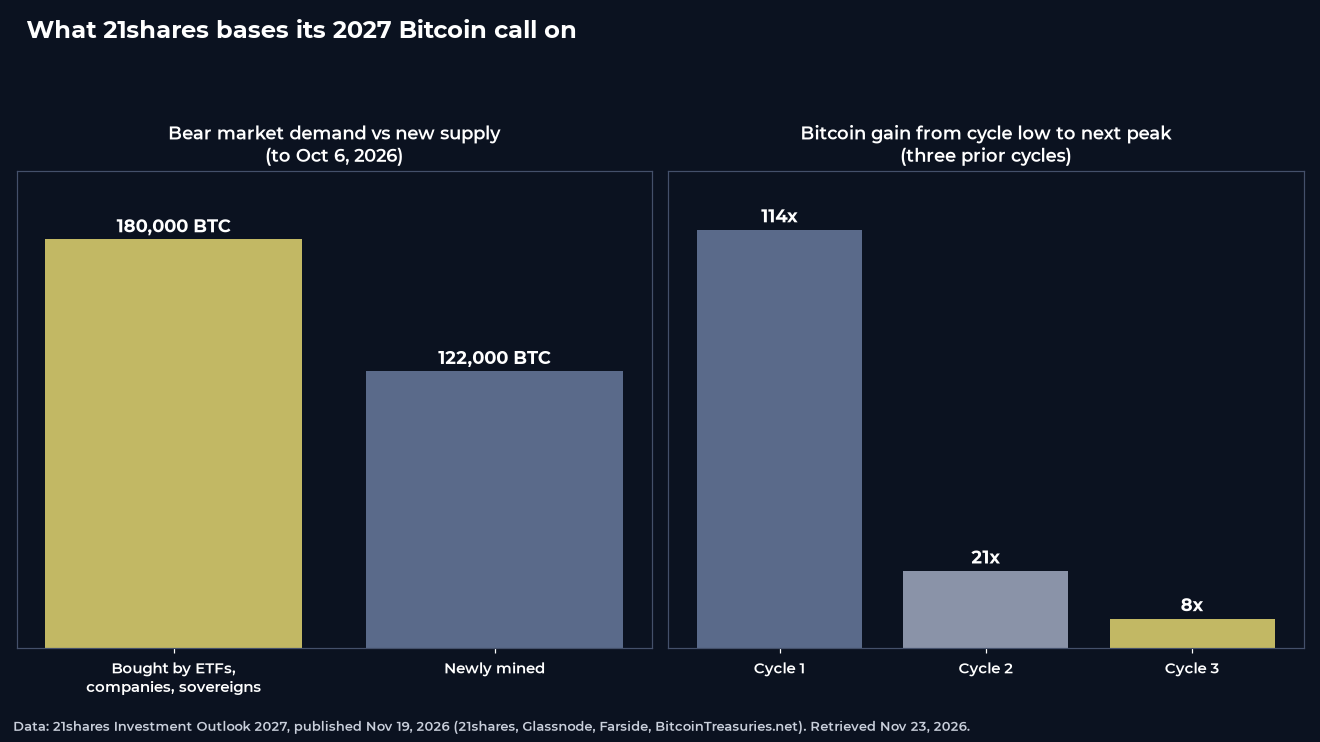
In other words, the largest buyers took roughly 1.5 coins for every coin miners produced, while the price was falling.
That matters because a fixed-supply asset only needs persistent net demand to tighten.
The earlier 21shares note added that US spot Bitcoin ETFs entered November with roughly flat net flows for 2026. About $1.6 billion left in the first week of November, which it described as less than 2% of roughly $94 billion in fund assets.
As we noted when we looked at the Bitcoin ETF cost basis near $75,200, most fund holders have stayed put even while underwater.
Does Saturday’s Low Break the Bitcoin Price Prediction for 2027?
Here is the honest complication. The outlook uses data to October and a June low of about $59,000.
Coinbase daily candles show Bitcoin’s June 30 intraday low at $58,056. On November 21, the price fell further, to $55,106, before closing at $60,086.
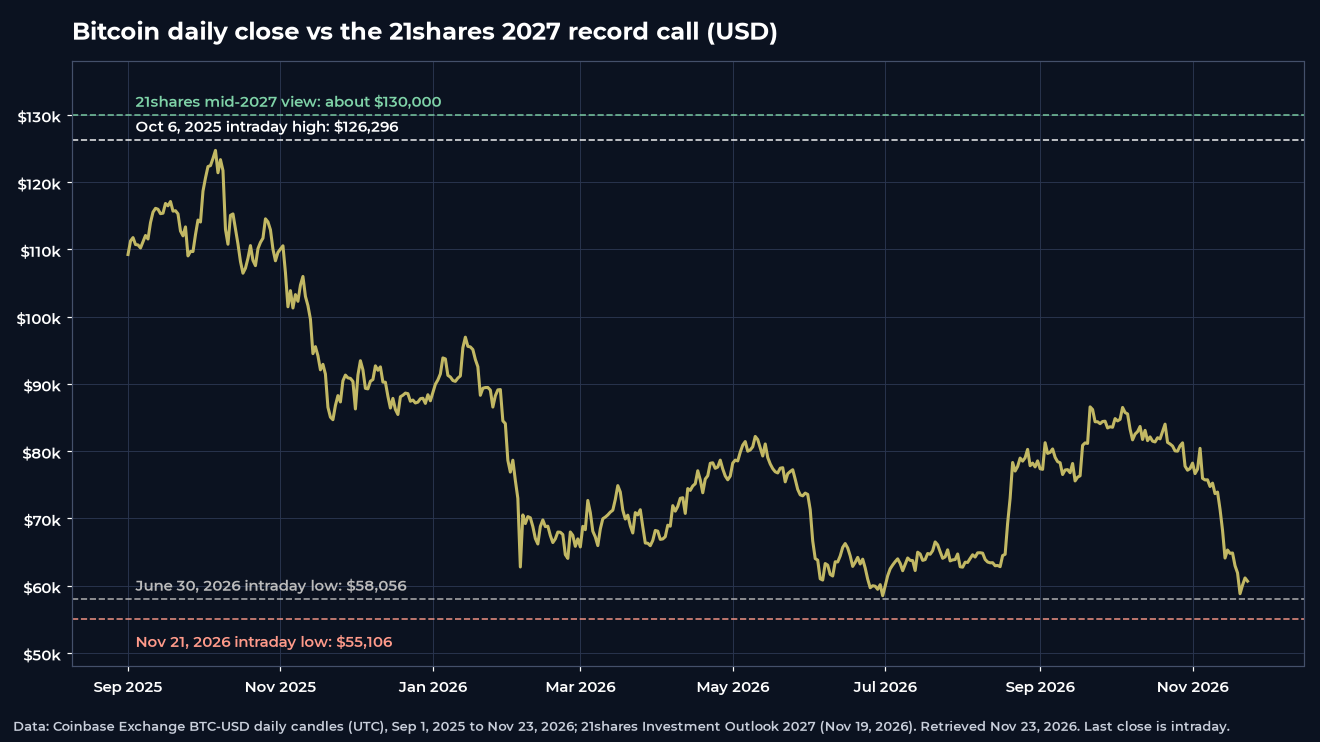
If the November low becomes the new cycle low, the minimum 2.2x multiple gives about $121,000 twelve months later. That is just short of the $126,296 record on Coinbase.
So the timeline may stretch. We do not believe the thesis collapses, though.
The 2.2x figure is the weakest of three historical outcomes, not the average. And 21shares’ own data shows Bitcoin rallied at least 8x from each prior cycle low to its next all-time high.
The firm is also upfront about limits. Three cycles is “a small sample,” it writes, and Bitcoin “has already fallen more than 50% and can do so again.”
We think that candour makes the call more useful. It is a view to track, not a promise.
The Other Nine Calls Point to Deeper Plumbing
The Bitcoin forecast sits inside a broader argument that digital assets are being absorbed into mainstream finance.
- 21shares expects 15 of the 21 G20 members to run a digital asset rulebook by the end of 2027.
- It sees stablecoins passing 100 million monthly active addresses, up from 76.4 million in September 2026.
- It projects tokenized real-world asset trading rising from $6.3 trillion in 2026 to $15 trillion.
- It expects exchanges to move at least 50,000 BTC to addresses that hide public keys, as a first step on quantum readiness.
The last point is worth a second look. 21shares stresses that no quantum computer capable of breaking Bitcoin keys exists today, and that protocol-level proposals such as BIP-360 are under discussion.
For us, that reads as an industry preparing early, which is what long-term capital wants to see.
What Bitcoin Needs From Here
Bitcoin traded near $60,800 on Monday morning. Reaching the $126,296 high needs a gain of about 108%. The roughly $130,000 mid-2027 view implies about 114%.
The nearer 21shares target of $100,000 by year-end looks much harder. It would need about 64% in under six weeks, and Fritz already noted in early November that Bitcoin was tracking below past recovery paths.
As we covered when the Bitcoin rebound reclaimed $60,000 within hours of Saturday’s low, buyers have been quick to defend that level.
We would watch three things: whether $55,000 holds as the low, whether ETF flows turn positive into December, and whether the Federal Reserve’s tightening cycle eases, a risk 21shares names directly.
We believe the demand math is the stronger part of the 21shares case. Bitcoin’s supply is capped at 21 million, issuance shrinks again in 2028, and institutional buyers kept outpacing miners through a 50%-plus drawdown.
The coming months will show whether the cycle clock simply runs a little late. If Bitcoin reclaims the $70,000 to $80,000 range, a 2027 record may start to look less like a forecast and more like a schedule.
DC Forecasts is a leader in many crypto news categories, striving for the highest journalistic standards and abiding by a strict set of editorial policies. If you are interested to offer your expertise or contribute to our news website, feel free to contact us at [email protected]












Discussion about this post