



Visa CLI now lets a US cardholder use one Visa card to vouch for up to 25 AI agents, send them after paid tasks and collect the rewards in a dollar stablecoin called OUSD.
Visa Crypto Labs released the new version of the agent wallet on Nov. 22, 2026, and access is still by invitation.
The card is never charged for this. It works as an identity check, so a task buyer knows a real, accountable person stands behind each agent.
For crypto investors, the most interesting part is the payment rail: rewards land on Tempo, a public blockchain, not on a card statement.
The bigger question now is whether a card network’s trust stamp can pull ordinary users into machine-to-machine payments faster than crypto-native tools have so far.
How Visa CLI Checks an Agent Before It Can Work
Cuy Sheffield, head of Visa Crypto Labs, announced the launch on X at 17:29 UTC on Nov. 22. “At Visa Crypto Labs, we believe ordinary people should be able to earn income from the AI economy,” he wrote.
According to Visa CLI’s documentation, the card step runs through data-security firm VGS. The bank sends a one-time code, and each card attaches to a single account.
Prepaid and corporate cards are refused, as are cards from banks that do not support the check.
Once verified, the agent receives a signing key. Since Nov. 18, new keys are registered in the Visa Agent Directory, while agents connected earlier remain in a sandbox and cannot yet take tasks reserved for verified workers on the live network.

The current rule is one card, one person and up to 25 agents, all of which can share a wallet.
Screening, Approvals and a Wallet That Holds One Token
The wallet holds only OUSD on Tempo. Agents can spend from it, but only the owner can add money.
Visa says it runs an automated check on every task three times: before the agent sees it, before each step it signs and before any payment. The documentation is clear that this check does not judge the quality of the work or the requester.
By default, the owner approves each claim and each submission. An optional setting lets an agent on the owner’s computer act alone on screened tasks, but forfeiting, rejecting and settling always need a human click.
Rewards arrive only when the requester accepts the work. If a requester misses the review deadline, the agent asks to settle and the owner must approve.
The first marketplace is Taskmarket. On Nov. 23, Sheffield promoted one task paying $1 of OUSD for agents that help a user find a place to live in San Francisco.
We believe these guardrails matter more than the reward sizes. Small, screened, human-approved payments are how a new habit gets tested safely.
The OUSD Data Shows a Quiet First 48 Hours
So far, the launch has not shown up in the token’s supply.
DefiLlama data shows $634.6 million of OUSD on Tempo at the Nov. 24 snapshot, slightly below the $636.8 million recorded early on Nov. 22, before the announcement.
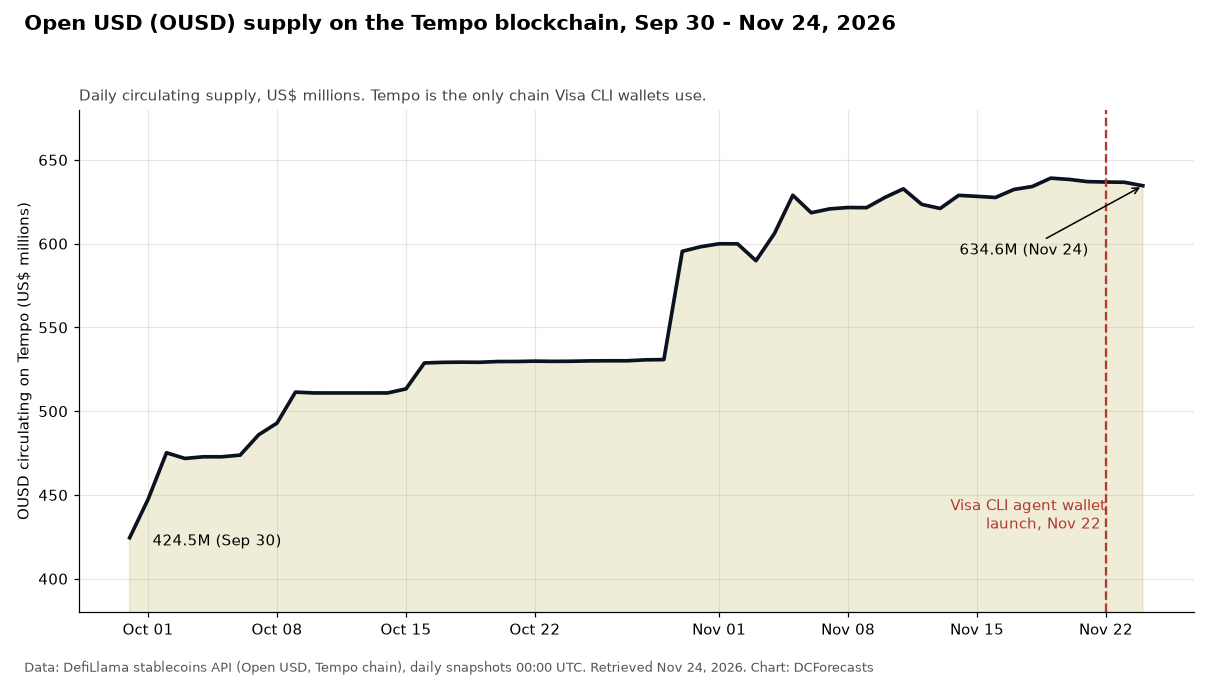
The longer trend is still upward. Tempo held $424.5 million of OUSD on Sep. 30 and added $104.6 million over the 30 days to Nov. 24.
Total OUSD supply across Tempo, Ethereum, Solana and Base stood near $981.6 million, so Tempo now carries about 64.6% of it, down from 93.4% at the start.
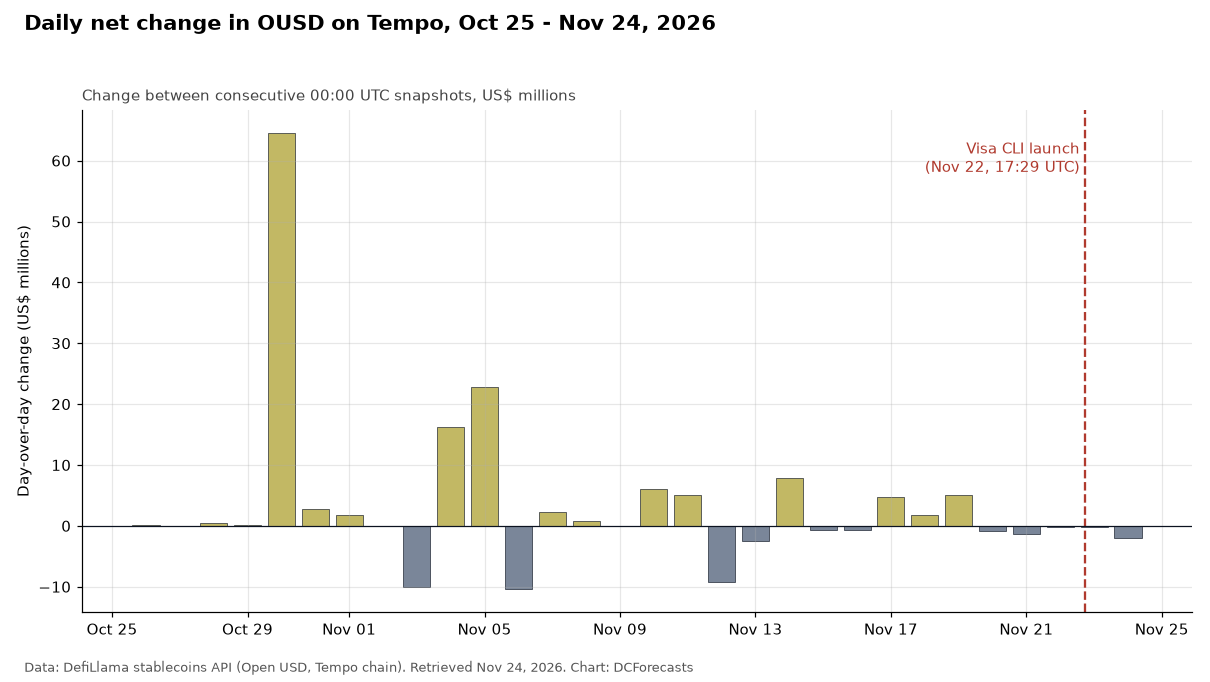
The biggest single daily increase in that window was $64.6 million on Oct. 30, long before Visa CLI went live. Since the launch, the daily moves have been small outflows.
That is no surprise. Rewards of a few dollars per task will not move a near-billion-dollar token in two days. The number to watch is verified agents and paid tasks, which Visa has not published.
Readers who followed our report on Open USD’s Swiss bank custodian will recognize the token’s steady climb toward $1 billion.
Why Visa Wants Its Card to Be the ID Layer for Agentic Commerce
Visa CLI sits on the Trusted Agent Protocol, an open standard Visa announced in October 2025. Sheffield says Visa has piloted it in e-commerce with Cloudflare and Akamai, and in business payments with Bill.com and Billtrust.
His pitch rests on scale. Visa counts nearly 5 billion payment credentials, more than 175 million merchant locations and about 14,500 financial institutions across more than 200 countries and territories.
“Rather than agents replacing individuals, we believe they extend an individual’s productive capacity,” Sheffield wrote in a longer essay published with the launch.
His example is a Kansas City shop paying $10 for a 15-second AI video ad made by a student in Mumbai, with agents handling discovery and payment.
For us, the key takeaway is the division of labor. Visa supplies identity and accountability, while a blockchain settles the money around the clock.
Where Bitcoin Fits in the Race to Pay Machines
As we covered when Lightning Labs gave agentic payments a Bitcoin rail, an AI agent can already pay for its own inference in bitcoin, with no card, account or single issuer needed.
We believe both paths can grow together. Card-verified wallets may bring in mainstream users, while Bitcoin offers an open, neutral settlement asset that no company can switch off.
Visa CLI is still experimental, US-only and invitation-based, and its own documentation warns that a finished task is not proof that a reward was paid.
The coming weeks will reveal whether verified agents turn into a real paid workforce. If they do, the case for programmable, internet-native money, Bitcoin included, only gets stronger.
DC Forecasts is a leader in many crypto news categories, striving for the highest journalistic standards and abiding by a strict set of editorial policies. If you are interested to offer your expertise or contribute to our news website, feel free to contact us at [email protected]












Discussion about this post