



Open USD, the dollar stablecoin issued by Stripe’s Bridge, now has a European bank willing to hold it for institutions, and the token is approaching $1 billion in supply less than eight weeks after launch.
Swiss crypto bank AMINA Bank AG said on November 20 that custody and on/off-ramp services for OUSD are “available now for professional and institutional clients.”
AMINA, which is regulated by FINMA and based in Zug, called itself the first European bank to offer institutional access to the token.
Bridge’s reserve page showed 979,498,899 OUSD in circulation as of November 21, backed by $981.5 million in reserve assets.
The bigger question is whether bank custody can turn a fast launch into lasting institutional demand before the US stablecoin rules take effect in January.
What AMINA Actually Switched On
The announcement covers two services: holding OUSD for clients and moving money between OUSD and traditional currency.
AMINA’s own register of supported assets is narrower than the headline suggests.
Open USD appears there with “Hot” custody only. The columns for trading, staking and loan collateral show dashes.
OUSD is the only one of the 32 listed assets without a tradable mark. Circle’s USDC, Paxos’ USDG and Ripple’s RLUSD all have hot and cold custody and are tradable. Bitcoin is listed with hot and cold custody too.

That gap matters. Clients can park OUSD at a regulated bank and convert in and out, but they can’t yet trade it there or borrow against it.
AMINA’s chief financial officer, Mike Foy, framed the service as an operations question rather than a token bet.
“For corporate treasurers adopting a stablecoin for the first time, the question is not which token to choose. It is how custody, reporting, and compliance are handled,” he said.
We think that is the right way to read the news. Treasurers don’t need another dollar token. They need a bank that will hold it and report on it.
How Fast Has the OUSD Stablecoin Grown?
OUSD went live on September 30 on Ethereum, Solana, Base and Stripe-backed Tempo.
DefiLlama data shows about $454 million in circulation on launch day. By November 21, supply had reached a record $980.5 million.
That is a 116% increase in 52 days. Over the last 30 days alone, supply rose by roughly $148 million, or about 18%.
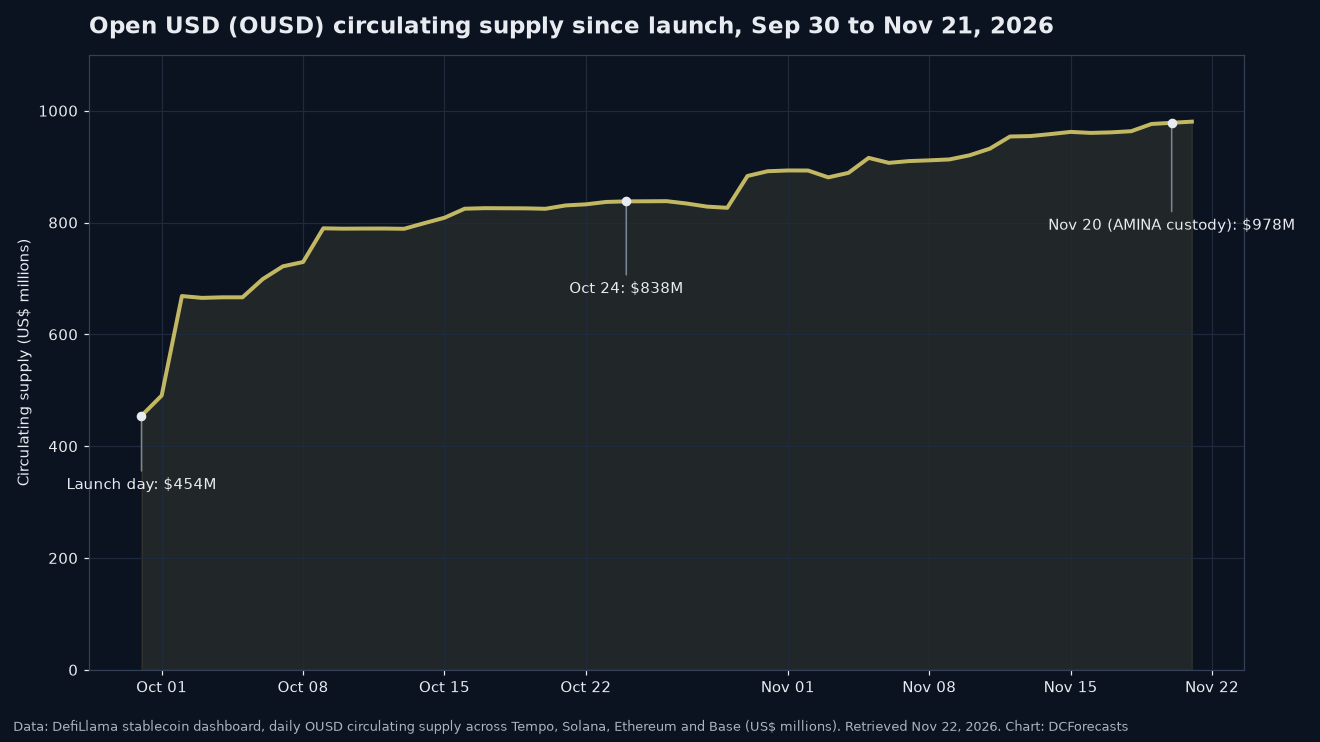
The growth has not been a straight line. Supply fell on 13 of those days, including a $12.2 million drop on November 3. But each dip was small next to the overall climb.
The timing stands out. As we reported on Friday, USDT supply shed $8 billion in 30 days, its steepest drop since June 2022. OUSD kept adding supply over the same stretch.
It remains small. At about $980 million, OUSD ranks 14th among dollar stablecoins tracked by DefiLlama, far behind USDT near $174 billion and USDC near $69 billion.
Tempo Holds Most of the Supply
One detail in the data deserves more attention than it gets.
About $637 million of OUSD, or 65% of the total, sits on Tempo, the payments blockchain backed by Stripe. Solana and Ethereum hold about $125 million each, and Base about $93 million.
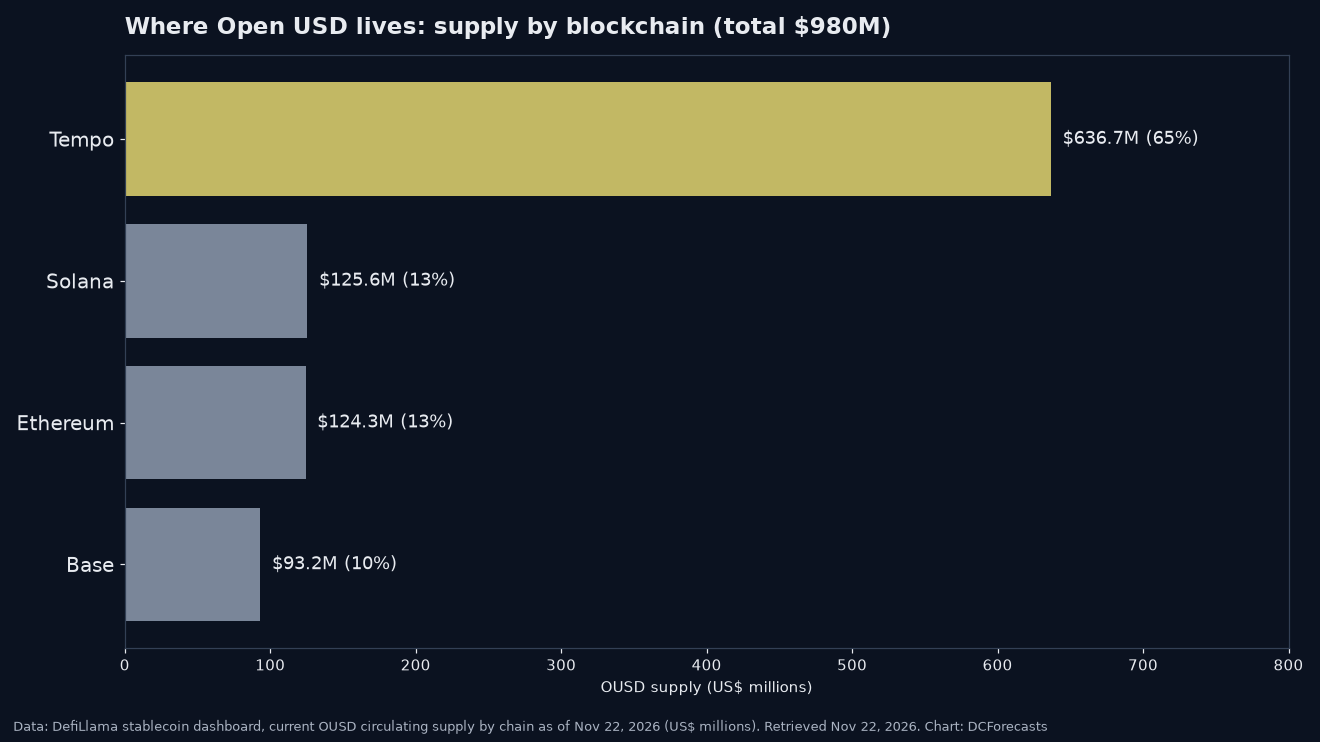
Tempo also carried most of the supply from day one, with about $424 million of the roughly $454 million issued on launch day.
For us, that concentration shows OUSD is still mainly a Stripe-ecosystem product. Bank custody in Switzerland is one way to widen that base.
Reserves, Attestations and the GENIUS Act Clock
Bridge says OUSD is backed one-to-one, and its reserve page shows a small cushion: $2.0 million above supply, or 100.20% collateralized.
The page lists $117.3 million in cash (12%) and $862.2 million in money market funds holding short-dated Treasury bills (88%). Bridge says a Big Four accounting firm provides monthly attestations.
AMINA describes Bridge as the “day-one issuer under the US GENIUS Act,” with governance set to move to Open Standard, the company behind OUSD.
The regulatory picture is still being built, though. The OCC granted Bridge National Trust Bank only preliminary conditional approval on February 12, 2026. Bridge itself says that trust bank is not yet operating and does not currently issue OUSD.
The OCC’s final GENIUS Act rule takes effect on January 18, 2027. From then, the Act generally bars anyone other than a permitted issuer from issuing a payment stablecoin in the US.
We covered a similar path this week when Payoneer’s stablecoin bank won preliminary OCC approval. Charter applications are piling up ahead of that deadline.
Why Stablecoin Custody at Banks Matters for Crypto
Most stablecoin news is about supply. This story is about plumbing.
A corporate treasury team can’t hold a token it can’t account for. Regulated stablecoin custody, with bank reporting and fiat conversion attached, removes one of the most practical barriers.
AMINA’s register now lists six dollar stablecoins: USDT, USDC, USDG, RLUSD, PYUSD and OUSD. The bank calls this a “stablecoin-agnostic” approach.
We believe that is healthy for the whole digital-asset market, Bitcoin included. Firms that learn to hold dollar tokens on a blockchain have already built the controls they would need to hold BTC.
There are limits to keep in view. AMINA hasn’t disclosed any volumes, and OUSD isn’t tradable on its platform yet.
The next signals to watch are whether AMINA adds trading or collateral support, whether more European banks follow, and whether OUSD can hold its growth past $1 billion as the January rules arrive.
DC Forecasts is a leader in many crypto news categories, striving for the highest journalistic standards and abiding by a strict set of editorial policies. If you are interested to offer your expertise or contribute to our news website, feel free to contact us at [email protected]












Discussion about this post