



JPMorgan’s tokenized money market fund can now put tokens in an investor’s wallet before the shares behind them are officially on its books.
That change sits in a prospectus for the JPMorgan OnChain Liquidity-Token Money Market Fund, ticker JLTXX, that JPMorgan Trust IV filed with the SEC on Nov. 23.
If the fund accepts a purchase order and receives payment the same day, new token balances will be minted to the buyer’s blockchain address that day, even if the order has not yet reached the fund’s official shareholder record.
The fund’s own monthly filings show why speed matters. In October alone, $906.1 million flowed in and $739.5 million flowed out of a fund that ended the month with $795.1 million.
The bigger question is whether bank-run, on-chain cash funds like this one are becoming the plumbing that stablecoin issuers and institutions use every day.
What Changed in the JLTXX Prospectus
The fund keeps its official ownership record the traditional way, in a book-entry ledger the prospectus calls the Investor Register. Tokens on a public blockchain are meant to match that record one for one, and Kinexys Digital Assets, a unit of JPMorgan Chase Bank, watches the chain for token transactions on the fund’s behalf.
Under the August version of the prospectus, the minting language did not exist. The Nov. 23 version adds four sentences to the purchase section.
Tokens may be minted before the purchase order is registered. The buyer does not legally own the matching shares until registration happens. And the fund may “claw back or adjust” those tokens, including if registration never occurs.
The filing also widens an existing control. The fund could already claw back balances that drift from the register; it can now also adjust them.

Two smaller edits stand out. The burn address used for on-chain redemptions will now be shown on the J.P. Morgan Funds website, and future “interoperability” is now described as moving balances between an investor’s own accounts on different blockchains, rather than peer-to-peer.
The filing also folds in the Oct. 1 supplement that added Solana. Ethereum and Solana are now the only blockchains available to investors.
A Tokenized Money Market Fund Near $800 Million
JLTXX took its first $200 million on May 13, according to its first Form N-MFP3 report. Net assets reached $682.2 million at the end of June and $800.0 million at the end of July.
The fund then slipped to $777.3 million in August and $628.5 million in September, before climbing back to $795.1 million on Oct. 30.
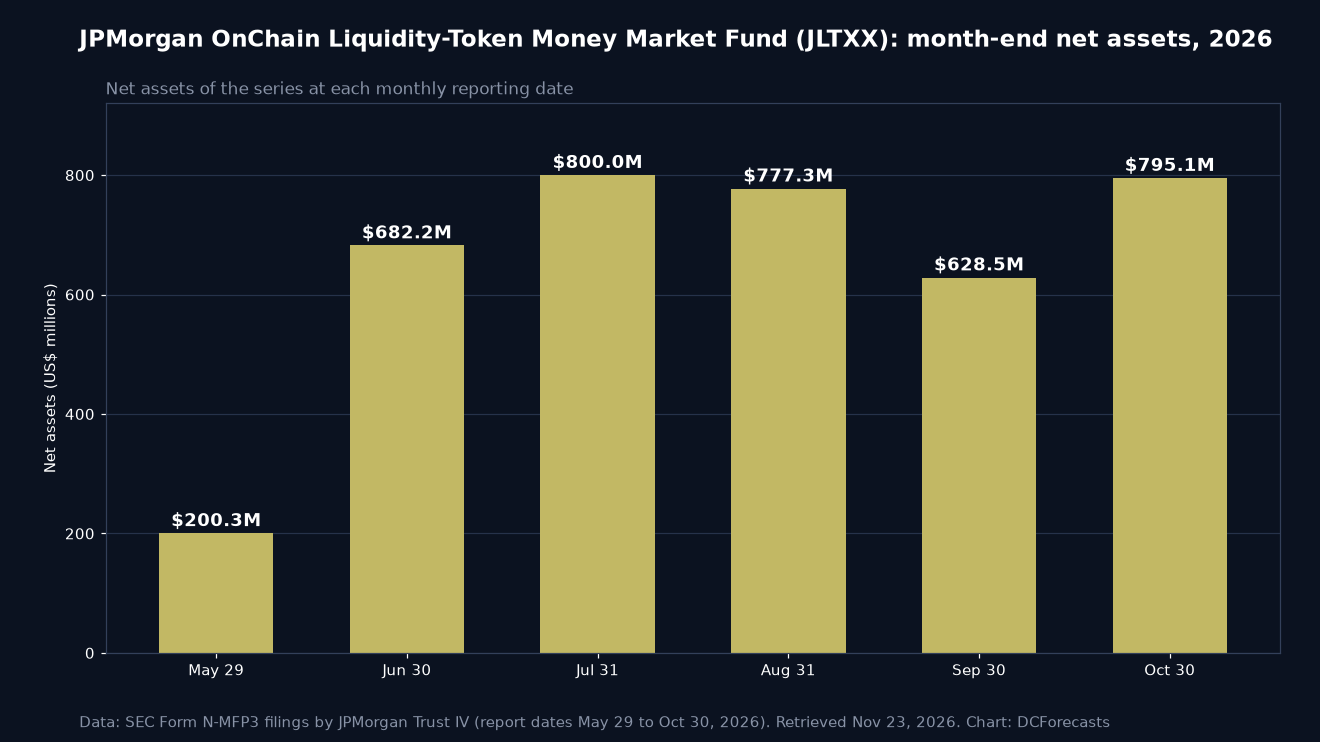
From launch through October, gross subscriptions totaled about $1.90 billion and redemptions about $1.11 billion.
The portfolio is plain by design. At the end of October it held $341.1 million of Treasury debt and $487.3 million of repurchase agreements backed only by Treasuries and cash, with a weighted average maturity of 19 days.
Its seven-day net yield was 3.82% on Oct. 30. Shares require a $1 million minimum, and the fund carries gross expenses of 0.71% a year, capped at 0.16% after JPMorgan’s contractual waiver.
Why October’s $1.6 Billion of Flows Matters
October’s gross flows added up to roughly twice the fund’s size. Most of it came on three days.
On Oct. 20, $217.1 million came in and $200 million went out. On Oct. 21 it was $213.1 million in and $200 million out. On Oct. 27, $285.6 million arrived and $287.6 million left.
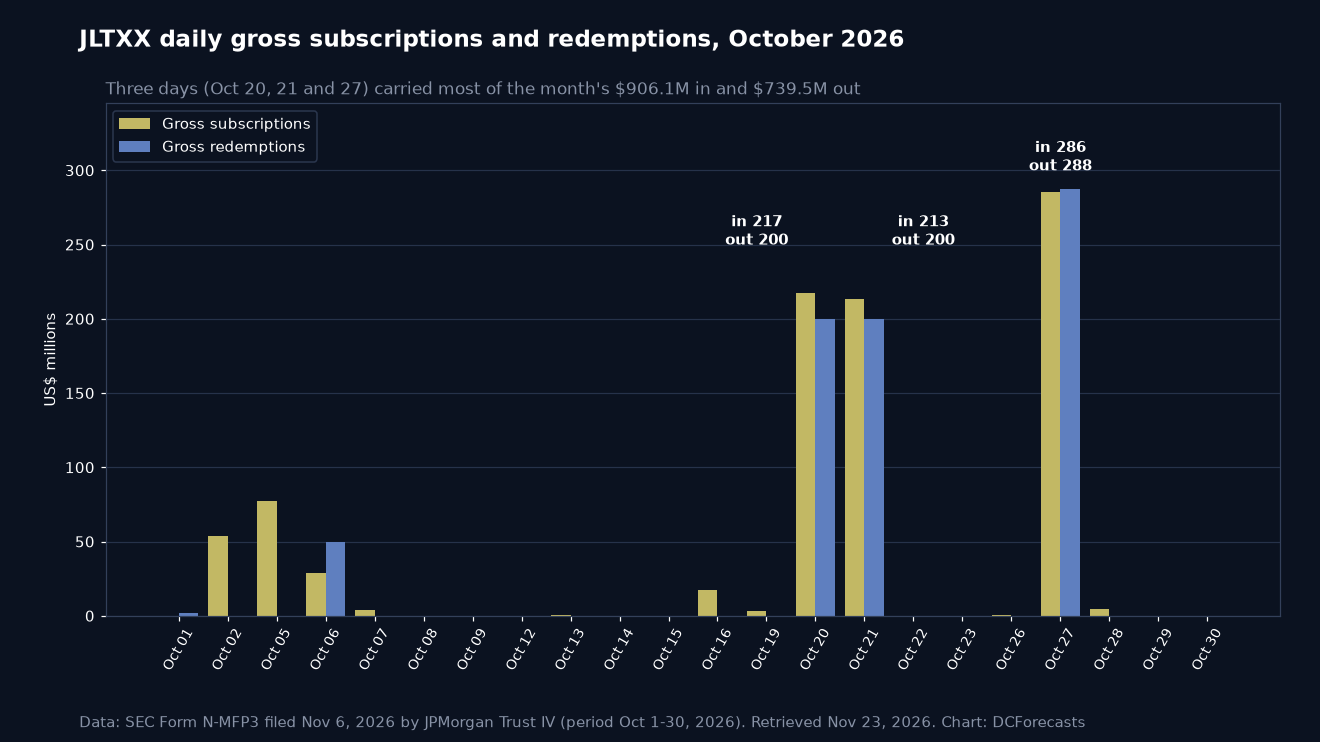
The filing does not say who moved the money or why. But matched flows of that size look like cash being parked and pulled for short periods, the way a treasury desk uses a money fund.
We believe that pattern explains the prospectus change. A holder that cycles hundreds of millions of dollars within days gains from tokens that arrive the same day the cash does, rather than after the register update, which happens at least daily on business days.
Who holds the shares fits that read. On Oct. 30, depository institutions or other banks were record holders of 93.15% of shares, with non-financial companies holding the remaining 6.48%.
Built for GENIUS Act Stablecoin Reserves
The fund says it invests in a way intended to meet the reserve rules that stablecoin issuers must follow under the GENIUS Act, to support investment by issuers seeking to comply.
That rulebook is close to final. As we reported over the weekend, the FDIC and FinCEN sent their final GENIUS Act rules to the White House.
The prospectus is careful on one point. Neither the fund’s shares nor its tokens are stablecoins, and the fund is not a stablecoin issuer.
It also notes that on-chain holders such as stablecoin issuers could one day give shareholders ad hoc liquidity outside normal hours, while warning there is no guarantee that will happen.
What We’re Watching Next for JLTXX
The first signal is the November N-MFP3 report, due in early December. It will show whether October’s large two-way days were a one-off or a habit.
The second is whether same-day minting draws new holders beyond the banks that dominate the register today.
The third is the next blockchain. The fund says more networks are anticipated, and each one widens where tokenized cash can move.
For us, the key takeaway is simple. A $795 million fund managed by an arm of the largest U.S. bank now settles on two public blockchains and is rewriting its rules to move faster, a sign that the on-chain asset market tracked in IOSCO’s tokenization report keeps maturing.
The coming months will show how much of the stablecoin reserve market chooses a JPMorgan money market fund that lives on-chain.
DC Forecasts is a leader in many crypto news categories, striving for the highest journalistic standards and abiding by a strict set of editorial policies. If you are interested to offer your expertise or contribute to our news website, feel free to contact us at [email protected]












Discussion about this post