



Witness encryption, a 13-year-old idea for locking data behind a proof instead of a key, just got a version small enough to run on a laptop, and its authors list Bitcoin bridges, covenants and proof checks among its uses.
The paper, “Praxis: Practical Witness Encryption for NP”, went up on the Cryptology ePrint Archive on Nov. 23, 2026, two days after it was submitted.
At 100-bit security, its ciphertext is 7.88 GiB. The closest earlier design needed more than 110 billion GiB for the same job.
For Bitcoin holders, the interesting part is what that gap could unlock: ways to move BTC to other systems without handing the keys to a custodian.
The bigger question now is how fast builders can turn a 66-page preprint into working code that Bitcoin users can trust.
What Praxis Claims to Have Solved
Witness encryption was introduced in 2013 by Sanjam Garg, Craig Gentry, Amit Sahai and Brent Waters.
The idea is simple to state. A message is encrypted to a statement, and anyone who can prove that statement true can read it. No key has to be shared, and no one has to be trusted to release it.
The authors are David Tse of Byzantine Research and Stanford University, with Nikhil Vanjani and Psi Vesely of Byzantine Research. Tse is also a co-founder of the Bitcoin staking project Babylon.
They write that every construction since 2013 has had at most two of three properties: it works for any statement, its security rests on well-studied assumptions, and it is practical to run.

Praxis, they argue, is the first to have all three. Its security rests on Module-SIS, a lattice problem, inside standard theoretical models, and the team published Lean 4 machine-checked proofs of its correctness and extraction results.
How Big Is the Witness Encryption Breakthrough?
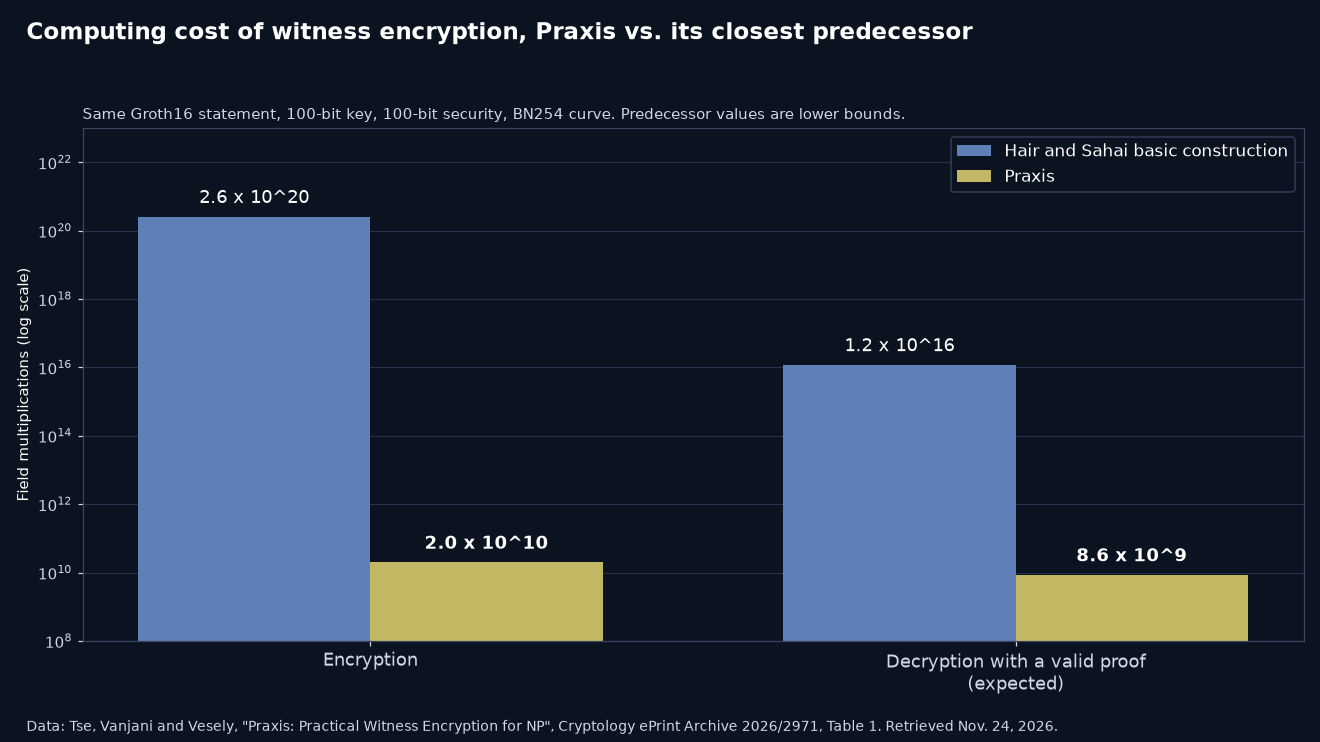
The numbers explain why this paper stands out. The authors compare Praxis with the basic construction of Hair and Sahai, the 2026 result it builds on, for the same statement and security level.
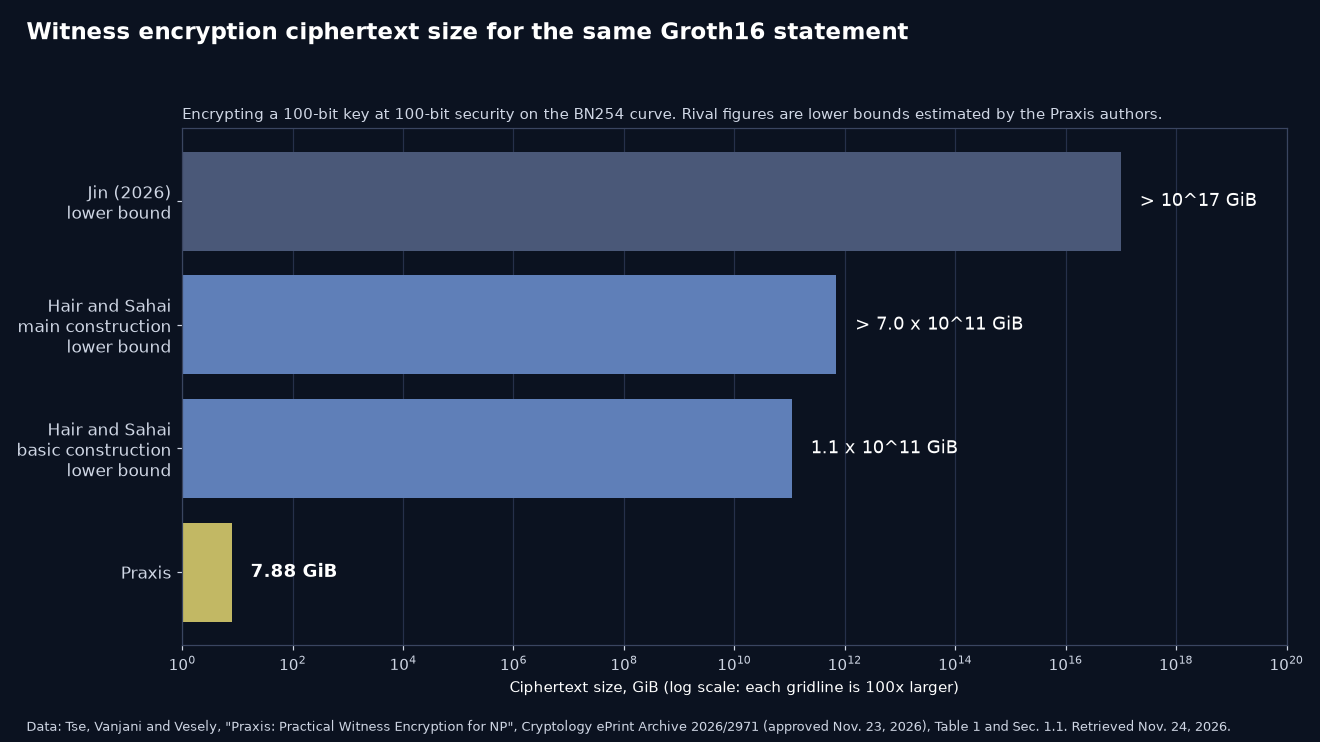
Praxis cuts ciphertext size and encryption cost by more than ten orders of magnitude, and decryption cost by more than six.
In concrete terms, encryption takes about 2.0 x 10^10 field multiplications and decryption with a valid proof about 8.6 x 10^9 on average. The paper says both take seconds on a laptop.
Memory is still heavy. Encryption needs about 12 GB and decryption about 5 GB, with the 7.88 GiB ciphertext streamed rather than held in memory.
We believe that drop matters more than any single benchmark. A scheme that needed roughly 118 exabytes of ciphertext has become one that fits on a consumer drive.
Why a Bitcoin Bridge Could Be the First Real Test
Bitcoin’s script is deliberately limited. It cannot check a complex proof from another chain directly.
Today’s workaround is BitVM-style designs, where computation happens off Bitcoin and at least one honest participant must be able to challenge a false claim. As we covered when Citrea moved its Bitcoin rollup proofs to SP1, that machinery is improving fast, but it still depends on watchers.
Witness encryption offers a different route. The secret needed to release BTC from a bridge could be encrypted to a statement such as “this withdrawal was processed correctly.” Whoever can prove it gets the secret, and nobody else can.
The paper cites three Bitcoin uses: bridges without a custodian, proof verification on Bitcoin, and covenants that limit how coins can later be spent.
We see these as some of the most wanted features in the Bitcoin smart contracts debate, and witness encryption approaches them from the cryptography side.
Where the Zero Knowledge Proof Toolkit Fits In
Praxis encrypts to a Groth16 verifier on the BN254 curve. Groth16 is one of the most widely used zero knowledge proof systems, and one fixed key serves every statement at the same cost.
That has a practical upside. Because modern zero-knowledge virtual machines can end their proofs in Groth16, the authors say a message could even be encrypted to a program written in Rust.
It also brings a clear caveat. The setup must be honest. Anyone who kept the secret randomness from that setup could decrypt every ciphertext made for the key.
The work is also a preprint. Its claims have not yet been through peer review, and no Bitcoin bridge uses it today.
We would watch three things next: independent review of the proofs, an open implementation with real timings, and whether bridge teams publish designs built on it.
What It Means for Bitcoin Builders
Bitcoin is trading near $60,000 after a hard November, yet research on its base layer keeps arriving at a steady pace.
Recent weeks brought work on post-quantum signatures such as SHRINCS, rollup upgrades and now practical witness encryption. None of it depends on the price.
For us, the key takeaway is that Bitcoin’s conservative design keeps pushing innovation into cryptography that sits on top of it, rather than into risky changes to the protocol itself.
If Praxis holds up under review, the trusted middlemen that guard many cross-chain BTC deposits could, over time, give way to math. The coming months will show whether builders can make that 7.88 GiB ciphertext as practical in production as it looks on paper.
DC Forecasts is a leader in many crypto news categories, striving for the highest journalistic standards and abiding by a strict set of editorial policies. If you are interested to offer your expertise or contribute to our news website, feel free to contact us at [email protected]









Discussion about this post