



Bitcoin’s quantum defense effort took a concrete step forward this week.
A 131-page draft security analysis of SHRINCS, a post-quantum signature scheme designed for Bitcoin, was published on Nov. 18. The paper is written by Mikhail Kudinov, one of the scheme’s co-authors alongside Blockstream research director Jonas Nick and others.
It fills a gap the draft specification itself flagged: until now, the SHRINCS proposal listed its security proof as a to-do item.
The headline result is reassuring. Under the paper’s framework, the scheme’s classical security bounds land between 121.4 and 122.7 bits, close to the 128-bit classical target the specification sets.
Every page also carries the same caution: “Proposal for discussion — not a specification. Not audited; not for deployment.”
What Is SHRINCS?
SHRINCS stands for “Shrunken SPHINCS.” It is a hash-based signature scheme built on SHA-256, the same hash function that already secures Bitcoin’s proof-of-work and much of its design.
That choice is the core of its appeal. Many post-quantum schemes rely on newer mathematical assumptions, such as the hardness of lattice problems. SHRINCS leans only on hash-function security, which Bitcoin developers already trust.
The scheme pairs two signature methods under one 48-byte public key.
The first is a compact stateful path, built from one-time signatures arranged in a tree. The second is a stateless fallback based on SLH-DSA, the NIST-standardized version of SPHINCS+, with a non-standard parameter set tuned for Bitcoin.

A signature from either path is enough to pass verification.
How Big Are the Signatures?
Size is the main obstacle for any quantum-resistant upgrade, because every extra byte takes up block space and adds fees.
Bitcoin’s current Schnorr signatures, defined in BIP340, are 64 bytes. According to the specification, SHRINCS stateful signatures range from 548 to 4,619 bytes, while the stateless fallback is 5,777 bytes.
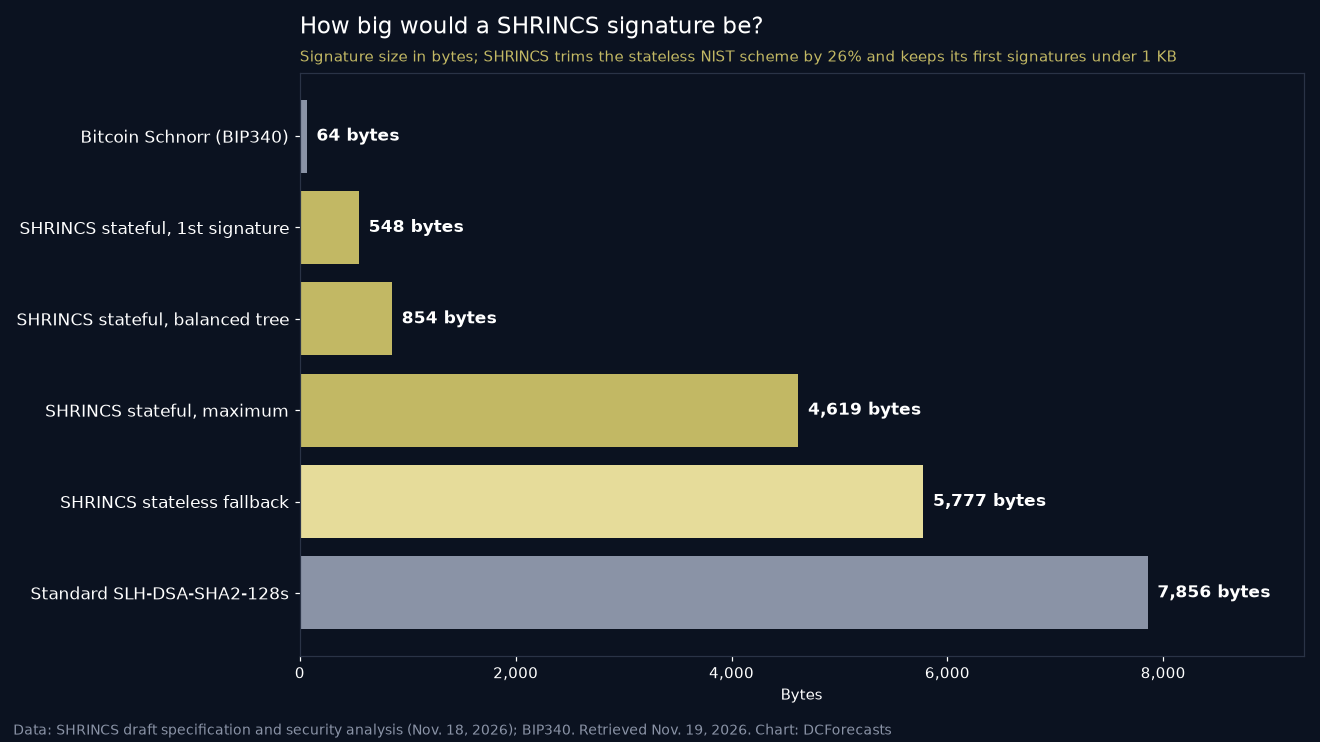
The analysis adds detail on how the stateful path behaves in practice. With an unbalanced tree, the first signature from a key takes 548 bytes, and each later one adds 16 bytes for the first eight signatures.
With a balanced tree, every signature is a fixed 854 bytes.
Verification stays light as well. The paper says a balanced-tree signature verifies with 262 tweakable-hash calls at the reference tree depth of 20, which matters for nodes that must check every transaction.
The stateless fallback is also leaner than the standard it is based on. The specification says limiting how many signatures a key can produce cuts the size from 7,856 bytes for SLH-DSA-SHA2-128s to 5,777 bytes, a 26% reduction.
For a network where block space is precious, keeping everyday signatures below 1 KB is a meaningful win.
The authors also weighed a dedicated hybrid with today’s Schnorr signatures. The specification notes that a technique called Bird-of-Prey-2 could save 32 bytes compared with simply attaching both signatures, but it chose not to define one, citing limited added benefit and extra complexity.
Keeping things simple has another upside. The specification points out that BIP340 already relies on SHA-256 for its security, so SHRINCS does not ask Bitcoin to adopt a new kind of cryptographic bet.
The Trade-Off: Wallets Must Track State
The compact path comes with a strict rule. The specification states that a state counter value must never be reused under the same key pair, because reuse “can enable anyone who observes the resulting signatures to produce forgeries.”
That puts the burden on wallet software. If a key’s state counter is lost, corrupted or uncertain, the specification says an implementation must refuse stateful signing.
SHRINCS is built to handle that case. It supports static seed-phrase backups and a “stateless-only after recovery” mode, so a restored wallet can keep signing safely with the larger fallback.
In other words, users who restore from a seed phrase would not lose access. They would simply pay for bigger signatures until a fresh key is in use.
What the Security Proof Covers
The paper reduces the scheme’s security to properties of its underlying hash functions and evaluates concrete bounds for the proposed parameters.
It is upfront about its limits. The figures rest on three stated conjectures, and some of the quantum results depend on them. The project’s repository also notes the documents have not yet been sufficiently peer reviewed or independently audited.
That candor is a strength. Bitcoin upgrades move slowly by design, and a public, line-by-line proof invites the scrutiny any change to the signature system will need.
Why This Matters for Bitcoin
Pressure to prepare is growing. Global securities regulators recently told financial firms to plan for quantum code-breakers within five years.
Bitcoin’s exposure is concentrated in coins whose public keys are already visible on-chain, and as we reported, 35.4% of Bitcoin had a visible public key, much of which can be fixed by moving coins.
SHRINCS does not settle the debate, and it would still need extensive review, a separate consensus change and broad agreement before any use. But a compact, SHA-256-based option with a published proof gives developers a serious candidate to test.
For long-term holders, that is the kind of slow, careful engineering that has kept Bitcoin secure since 2009. Each draft like this one brings the network closer to a tested, conservative path for the quantum era.
DC Forecasts is a leader in many crypto news categories, striving for the highest journalistic standards and abiding by a strict set of editorial policies. If you are interested to offer your expertise or contribute to our news website, feel free to contact us at [email protected]












Discussion about this post