



Japanese bond yields climbed this autumn to levels last seen in 1996, yet the yen is trading weaker against the dollar than it was a year ago.
The 10-year Japanese government bond yield closed at 2.838% on Friday, Nov. 20, according to Japan’s Ministry of Finance. That is 101 basis points above its level a year earlier, and below a 3.111% peak on Oct. 7.
Meanwhile, the dollar bought about 159 yen on Tuesday morning.
For Bitcoin investors, that split matters, because the market’s last big scare from Japan came when the yen surged, not when yields crept higher.
The bigger question now is whether the Bank of Japan’s Dec. 17-18 meeting can turn a slow repricing into a sudden one.
How Far Have Japanese Bond Yields Climbed?
The move has been large and steady. The Finance Ministry’s constant-maturity data show the 10-year yield at 1.111% on Dec. 30, 2024.
It first closed above 2% on Dec. 19, 2025, and above 3% on Sept. 2, 2026.
The Oct. 7 close of 3.111% was the highest since August 1996. Even after easing, Friday’s 2.838% is higher than any close between late May 1997 and the end of 2025.
The rest of the curve tells the same story. The 2-year yield rose from 0.965% a year ago to 1.826%. The 30-year moved from 3.334% to 4.014%, after touching 4.168% on Oct. 6, the highest in a series that starts in 1999.

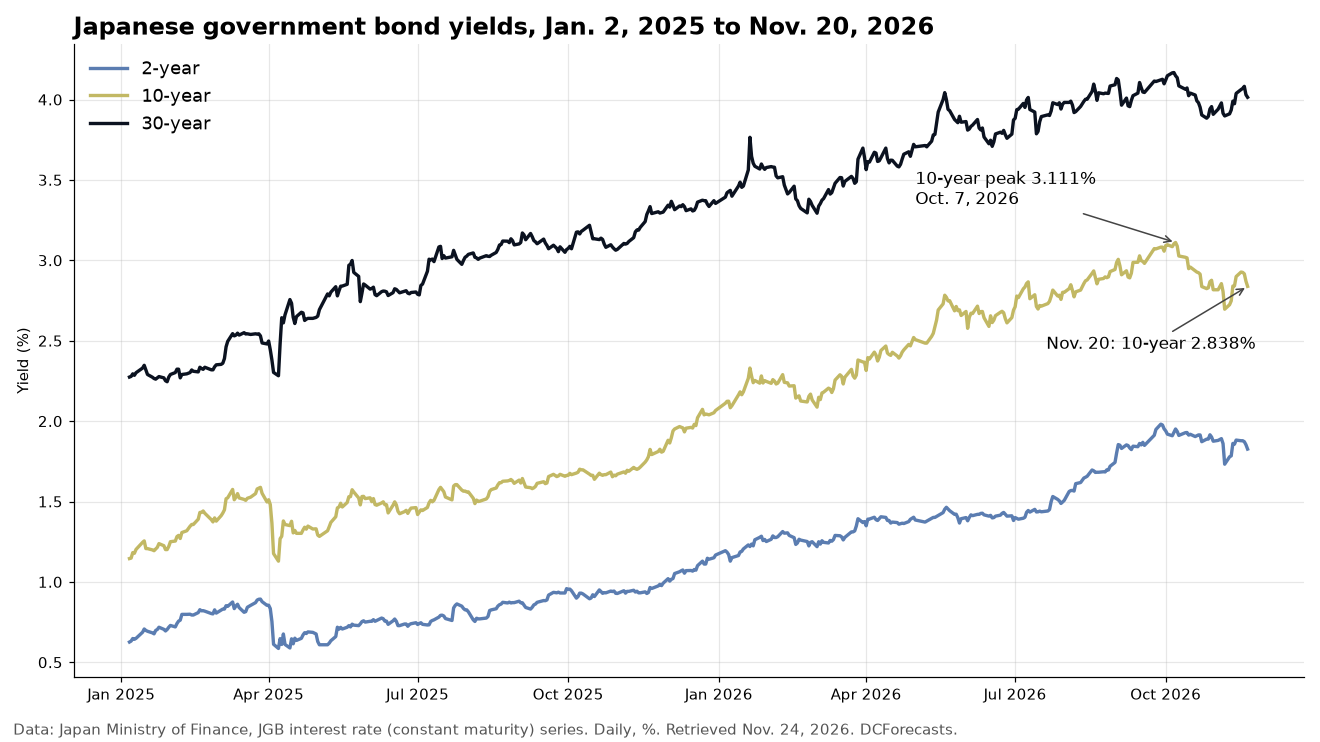
The chart also shows something easy to miss. Yields have pulled back since early October, by about 27 basis points on the 10-year.
We believe that pause gives markets breathing room heading into December.
What the Bank of Japan Is Signaling
Policy has moved with the market. The Bank of Japan raised its overnight call rate target to around 1.25% from around 1.0% at its September meeting, in a 7-2 vote, effective Sept. 24.
On Oct. 30, it held at 1.25% in an 8-1 vote. Board member Hajime Takata dissented and proposed 1.5%, arguing that underlying inflation had reached the bank’s price stability target.
The same meeting also more than doubled the pace of the central bank’s ETF sales from January 2027, to about 860 billion yen a year at book value from about 330 billion yen.
A dissent for a faster hike keeps a December move on the table. Still, the board has so far chosen gradual steps, and we see no sign in its statements of a rush.
Why the Yen Carry Trade Has Not Snapped
The yen carry trade works by borrowing in low-yielding yen and buying higher-yielding assets elsewhere. It tends to hurt when the yen rallies quickly and forces borrowers to cover.
That is what happened in mid-2024. The dollar fell from about 161.6 yen on July 3, 2024, to about 145.8 by Aug. 5, a drop of nearly 10%, according to Yahoo Finance data. The Bank of Japan had raised rates on July 31.
Bitcoin was caught in the unwind. Coin Metrics data show BTC falling from $66,867 on July 29, 2024, to $54,344 on Aug. 5, about 19% in a week.
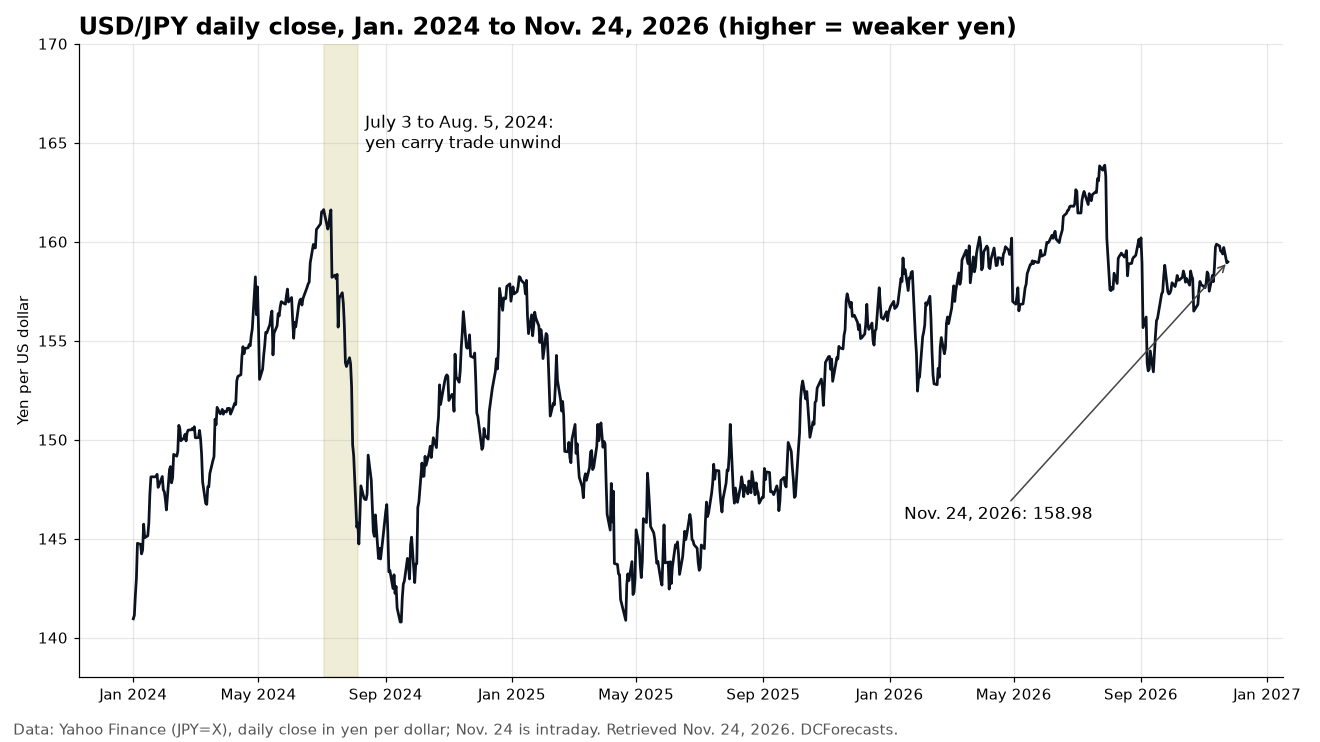
This time looks different. Despite a full point of extra yield on the 10-year, the dollar is near 159 yen, up from about 157 a year ago. The 2026 range runs from about 152.5 in late January to about 163.9 in late July.
In other words, higher Japanese yields have not pulled money home fast enough to lift the yen. That is the trigger we would watch, not the yield level alone.
Do Japanese Yields Explain Bitcoin’s Slide?
The data say no. We compared daily changes in the 10-year Japanese yield with Bitcoin’s daily returns. Over the last 60 Japanese trading days to Nov. 20, the correlation was 0.04. Over roughly a year, it was effectively zero.
Bitcoin did fall hard over the same stretch. It slid about 29% between Oct. 7 and Nov. 20, to $58,851, even as the 10-year yield eased. Coin Metrics put its Nov. 23 daily price near $61,250.
That fits what we found in our look at Bitcoin’s correlation with the Nasdaq: tech stocks have been the bigger driver lately, while rates have barely registered.
The stronger dollar, which we covered when the Fed’s broad dollar index hit its highest since April 2025, is another pressure point that has little to do with Tokyo.
For us, the takeaway is reassuring. Bitcoin’s drawdown does not look like a forced carry trade unwind, which leaves its recovery tied to risk appetite and demand rather than to a funding crisis in Japan.
What to Watch Before Dec. 18
Three markers stand out.
- The Japan 10-year bond yield: a return toward 3.1% would show the October selloff resuming.
- The yen: a fast move below about 150 per dollar would echo the 2024 pattern far more than any yield level.
- The Bank of Japan decision on Dec. 18: a BoJ rate hike to 1.5% would match Takata’s October proposal.
We believe the market has had months to price higher Japanese rates, and the yen’s calm suggests it has largely done so.
Bitcoin’s fixed supply, growing institutional rails and a funding backdrop that has stayed orderly are why we think this cycle’s reset can hold. If the yen stays steady through December, investors may start to see Japan as background noise rather than the next shock.
DC Forecasts is a leader in many crypto news categories, striving for the highest journalistic standards and abiding by a strict set of editorial policies. If you are interested to offer your expertise or contribute to our news website, feel free to contact us at [email protected]












Discussion about this post