



Cboe indices are now live inside Binance, which means the world’s largest crypto exchange can show its users the S&P 500 and Bitcoin on the same screen.
Binance said on Nov. 24 that it has integrated the Cboe Global Indices Feed into its platform and app, starting with the S&P 500, the Dow Jones Industrial Average and the Nasdaq-100.
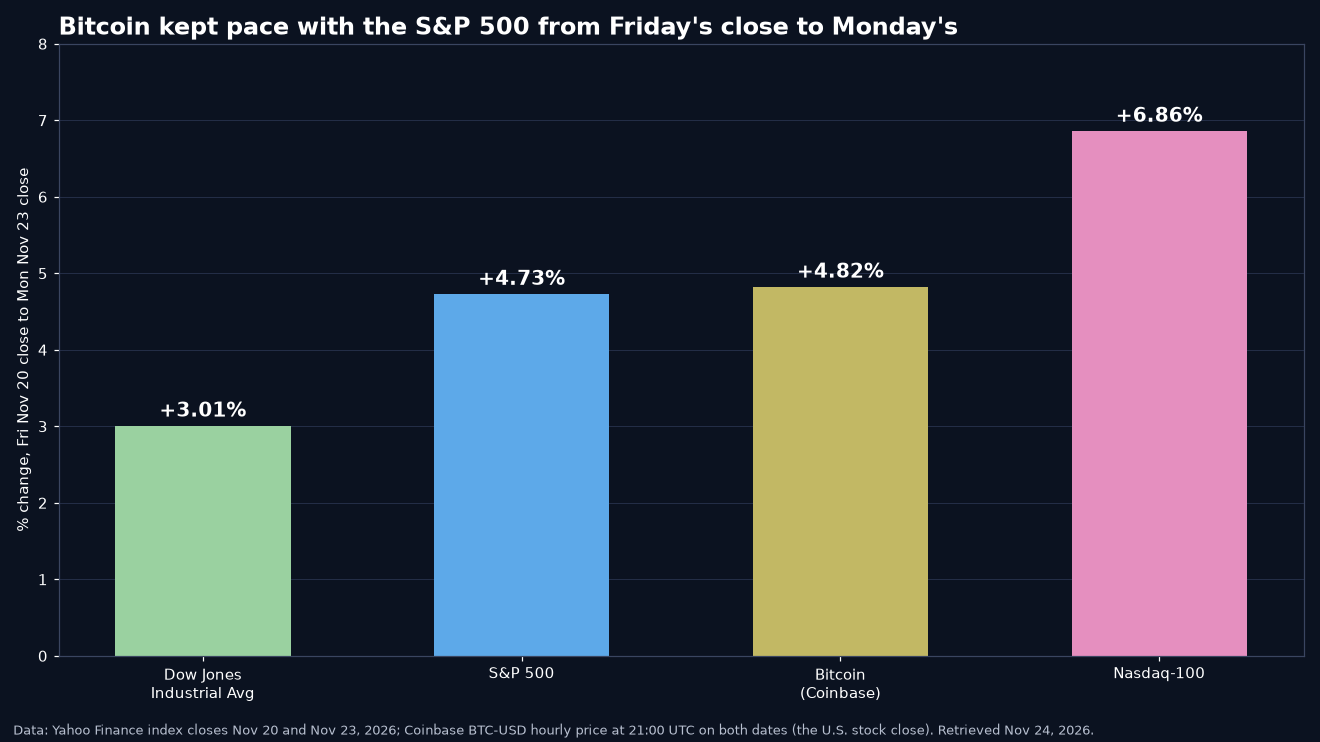
The timing is striking. A day earlier, the Nasdaq-100 jumped 6.86%, its best session since April 9, 2025, according to index closing data.
For Bitcoin holders, the more useful detail is what happened over the same window. Measured from Friday’s stock close to Monday’s, BTC rose 4.82%, slightly more than the S&P 500.
The bigger question now is whether putting both markets side by side changes how crypto traders read the next move.
What Binance Added With the Cboe Indices Feed
The announcement, dated from Abu Dhabi, describes a collaboration with Cboe Global Markets, the exchange operator behind the feed.
The first rollout covers three benchmarks: the S&P 500 (SPX), the Dow Jones Industrial Average (DJX) and the Nasdaq-100 (NDX). Binance says it plans to add more index data over time.
The data will also flow into Binance AI, a set of AI-powered features the exchange launched recently. According to the release, Binance AI will use the feed to explain cross-market moves and highlight context tailored to each user.
“The next generation of financial platforms will not just display more data — they will help users understand what matters,” said Jeff Li, vice president of product at Binance.

Christopher Archbell, Cboe’s global head of market data sales, said the deal broadens access to index data “for a wider audience of digital asset users.”
Binance says more than 330 million users in over 100 countries use its platform. That is a large new audience for licensed Wall Street benchmark data.
Why Binance Stocks Context Matters After Monday
Binance framed the feed as part of a wider multi-asset push, covering both crypto and traditional market-linked products. For anyone using Binance for stocks-linked exposure, the reference benchmarks now sit right beside it.
Monday showed why that context helps. Stocks rallied hard, with the S&P 500 up 4.73% and the Dow up 3.01%, both measured against Friday’s close.
Bitcoin also climbed, but on a different clock. It was trading around $58,350 on Coinbase at Friday’s 4 p.m. ET stock close and about $61,170 at Monday’s close.
Much of Bitcoin’s gain arrived while U.S. stock markets were shut. BTC then touched $64,534 on Coinbase on Monday before fading into the close.
A trader watching only crypto might have read that fade as weakness. A trader with the Nasdaq-100 on the same screen would have seen that Bitcoin had simply priced much of the rebound first.
We believe that is the real value of the feed. Bitcoin trades every hour of every week, so it often reacts to news before Wall Street can.
Bitcoin vs the S&P 500, Dow and Nasdaq-100 This Year
The longer view is less flattering, and we won’t pretend otherwise.
From Dec. 31, 2025 to Nov. 23, 2026, the S&P 500 gained 5.7%, the Nasdaq-100 5.9% and the Dow 3.2%. Bitcoin fell 30.1% over the same period, based on Coinbase daily closes.
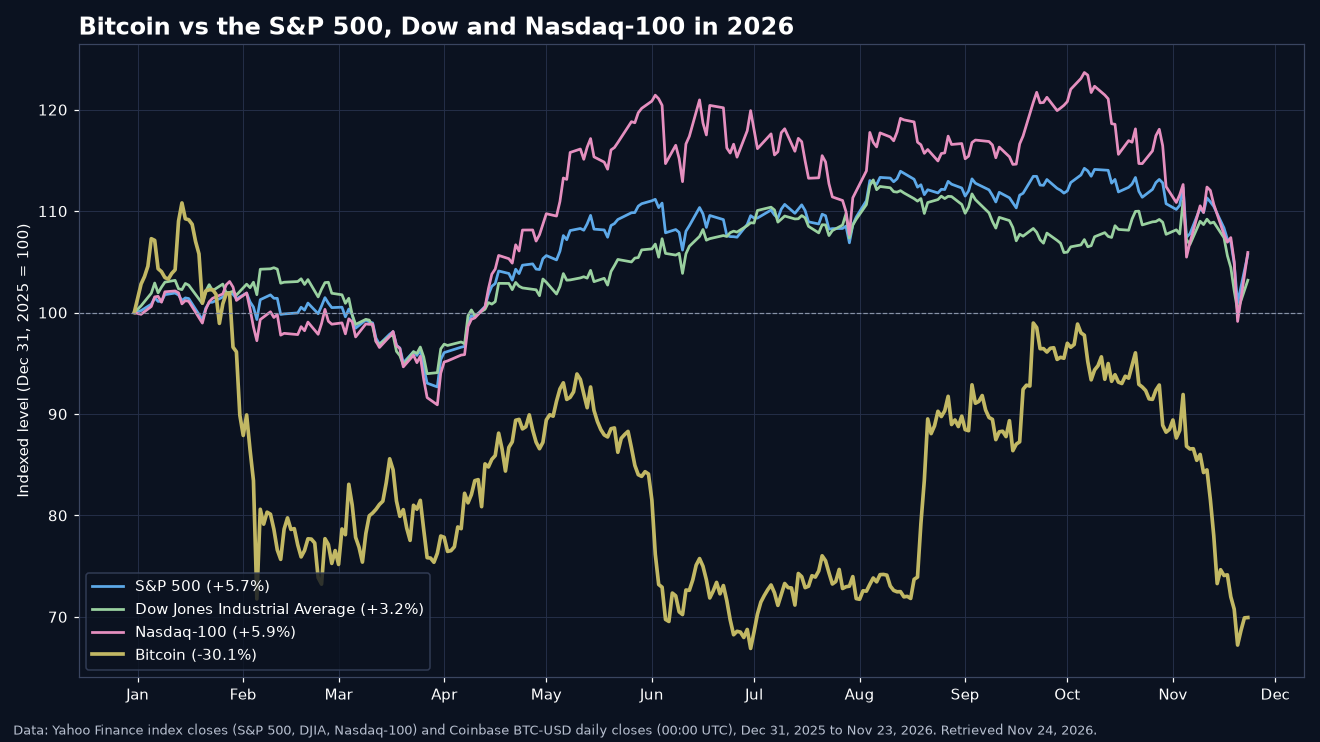
November has been hard on everything, though. Since the Oct. 30 close, the S&P 500 is down 4.5%, the Dow 4.2% and the Nasdaq-100 5.8%. Bitcoin is down 21% since Oct. 31.
As we noted in our recent look at the Bitcoin Nasdaq correlation, the two markets have been moving together more closely than usual.
In our view, the gap between them is the opportunity. The three indices sit between 7% and 14% below their 2026 closing highs, while Bitcoin’s Nov. 23 close was 37% below its 2026 high close of $96,955 on Jan. 14.
Long-term buyers have historically treated stretches like this as accumulation windows, though nothing guarantees a repeat.
What the Cboe Deal Says About Binance
The feed is one more sign that crypto venues and traditional market infrastructure are growing closer.
A regulated U.S. exchange operator is now supplying its benchmark data to a crypto platform. We think that would have been hard to imagine a few years ago.
It also fits a busy stretch for the exchange. As we reported on Monday, Binance has brought in three outside security firms to review its systems.
We see both moves as part of the same effort: to look and work more like a full financial platform, not only a crypto trading app.
There is a limit to keep in mind. Index data is information, not a trading product. The release does not say Binance is listing the indices for trading.
What We Would Watch From Here
First, which indices come next. Binance says more data will be added, and volatility or international benchmarks would add useful context for crypto traders.
Second, how Binance AI uses the feed. Explaining why Bitcoin moved against the Nasdaq-100 is helpful. Nudging users into trades would deserve closer scrutiny.
Third, whether Bitcoin keeps moving ahead of stocks on weekends. BTC was near $59,900 on Coinbase on Tuesday morning, below Monday’s high but still about 2.6% above its level at Friday’s stock close.
We believe the bigger story is simple. Wall Street’s benchmarks move during a 6.5-hour session, five days a week, while Bitcoin never closes. Putting them on one screen makes that difference easier to see, and the coming weeks will show which market moves first.
DC Forecasts is a leader in many crypto news categories, striving for the highest journalistic standards and abiding by a strict set of editorial policies. If you are interested to offer your expertise or contribute to our news website, feel free to contact us at [email protected]











Discussion about this post