


Crypto exchange security at Binance is about to be graded by outsiders. The exchange said on Nov. 23 that Mandiant, SlowMist and Verichains will independently review its security procedures, 25 days after attackers drained about $6.34 billion from its hot wallets.
According to Binance’s announcement, the three firms will validate its current security infrastructure and assess its security posture going forward.
The Binance security review delivers on a promise. Binance’s initial findings, published Nov. 3, said its conclusions would be “subject to further independent review” by outside security firms.
For Bitcoin holders, one detail stands out. The 18,270 BTC taken directly from Binance has not moved since the night of the theft, according to blockchain analytics firm Elliptic.
The bigger question is whether outside reviewers can close the human gaps that let the attackers in, because no code exploit opened the first door.
Who Is Reviewing Binance, and What Did It Promise?
Binance describes Mandiant, part of Google Cloud, as an incident response and threat intelligence firm with more than two decades of experience investigating nation-state attacks.
SlowMist is a blockchain security and threat intelligence firm founded in 2018. Verichains is a security research firm that has worked on some of the largest incidents in Web3.
“They will review our systems and tell us where we can be stronger. We are committed to acting on what they find,” said Jimmy Su, Binance’s chief security officer.
Co-CEO Richard Teng called the security of users’ assets the company’s “first responsibility.”

Verichains CEO Thanh Nguyen went further: “You cannot out-patch AI-powered attackers, so the industry must shift from patching vulnerabilities faster to designing systems where attacks fail.”
We think that line captures the real assignment. Binance has not published a scope or timeline for the reviews, so the findings, and whether they are made public, are what to watch.
How the Binance Hack Actually Unfolded
Binance’s own account shows why a broad review makes sense. The exchange described a multi-stage campaign, not a single broken lock.
In June, a wallet DevOps engineer downloaded a tampered Homebrew installation while trying to install a popular AI coding tool. Security staff caught the anomaly, replaced the device and rotated credentials, but the wallet team had been exposed.
In September, a second engineer was approached on a job platform by a fake “project director.” After two staged interviews, he was told to download an “assignment” onto his work computer. It contained malicious code.
On Oct. 20, the attackers used an internal AI tool to reach two more engineers’ machines and found a container deployment token. On Oct. 29, they used it to reach the wallet signing service and launch the transfers.
The FBI attributed the theft to North Korea’s TraderTraitor group on Oct. 31. Binance said its security team had detected and prevented 57 suspected North Korea-linked threat cases during 2026.
Which Crypto Exchange Security Gaps Will the Reviewers Test?
Binance said that by Nov. 3 it had rebuilt the affected wallet system in a new environment, rebuilt the internal AI tool and its access controls, replaced affected devices and decommissioned related credentials.
It also tightened device controls, strengthened wallet-service risk controls and expanded AI-based behavioural anomaly detection.
One technical point deserves attention. The attackers abused Ethereum’s EIP-7702 delegation feature, which let them keep moving assets after withdrawals were suspended.
Because the hot wallet used multi-party computation, there was no single key to revoke the delegation instantly. Binance had to build a special procedure, and the delegation was cleared at 00:10 UTC on Oct. 30.
That is exactly the kind of incident-response question we would expect independent reviewers to press on.
For users wondering whether Binance is safe now, the company’s answer so far is financial. It said it would absorb the loss, not its users, and that 98% of the impacted token assets had been replenished by Oct. 31.
Where the Stolen Funds Stand Now
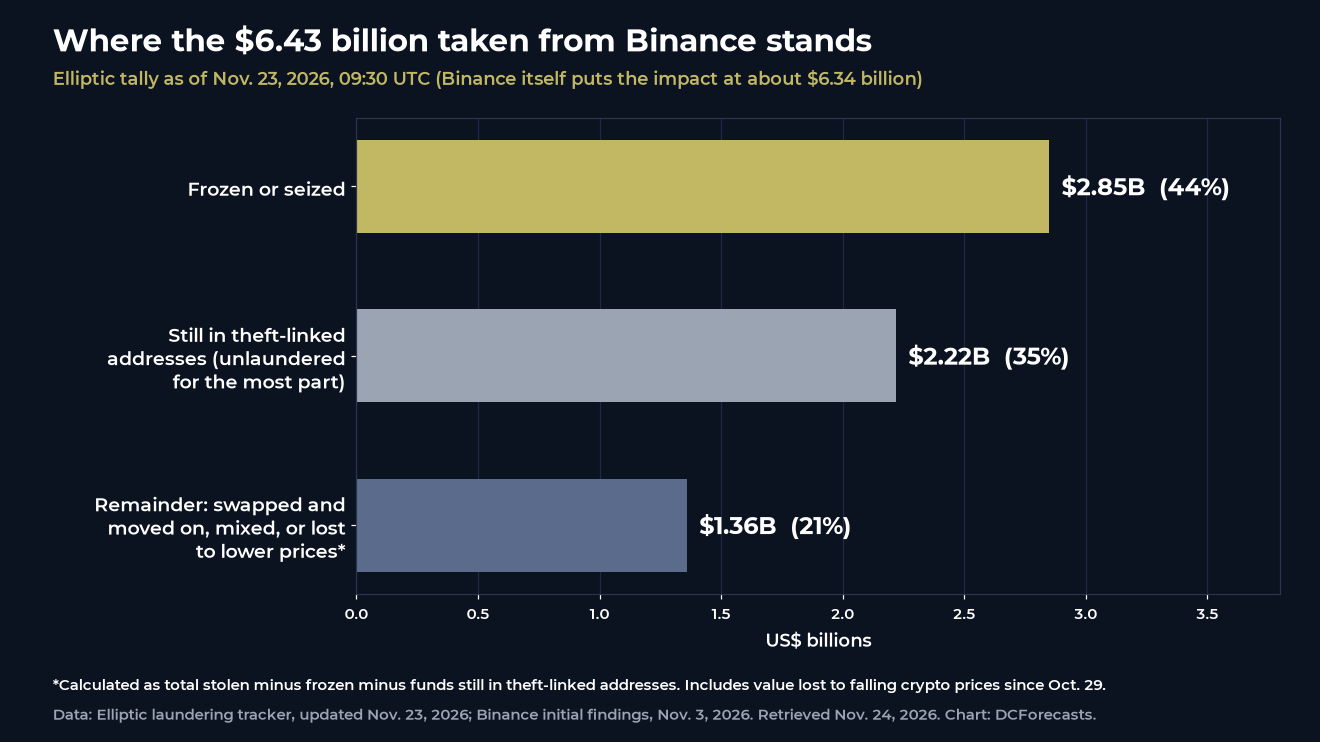
Elliptic, which counts $6.43 billion stolen across 11 blockchains, said in its Nov. 23 update that $2.85 billion, about 44%, has been frozen or seized. Around $2.22 billion still sits in theft-linked addresses.
That freeze rate is unusual for a crypto hack of this size. Elliptic notes that only around 3% was frozen after the $1.5 billion Bybit theft in February 2025.
Part of the frozen money is now in a U.S. forfeiture case, as we detailed in our report on the $1.1 billion USDC haul.
The laundering of the rest has been uneven. Ether-to-bitcoin swaps paused for two days from Nov. 21 before resuming on Nov. 23.
About 58,000 ETH has been swapped for roughly 1,630 BTC since Nov. 17. That is a small part of the roughly 425,000 ETH still waiting in batches.
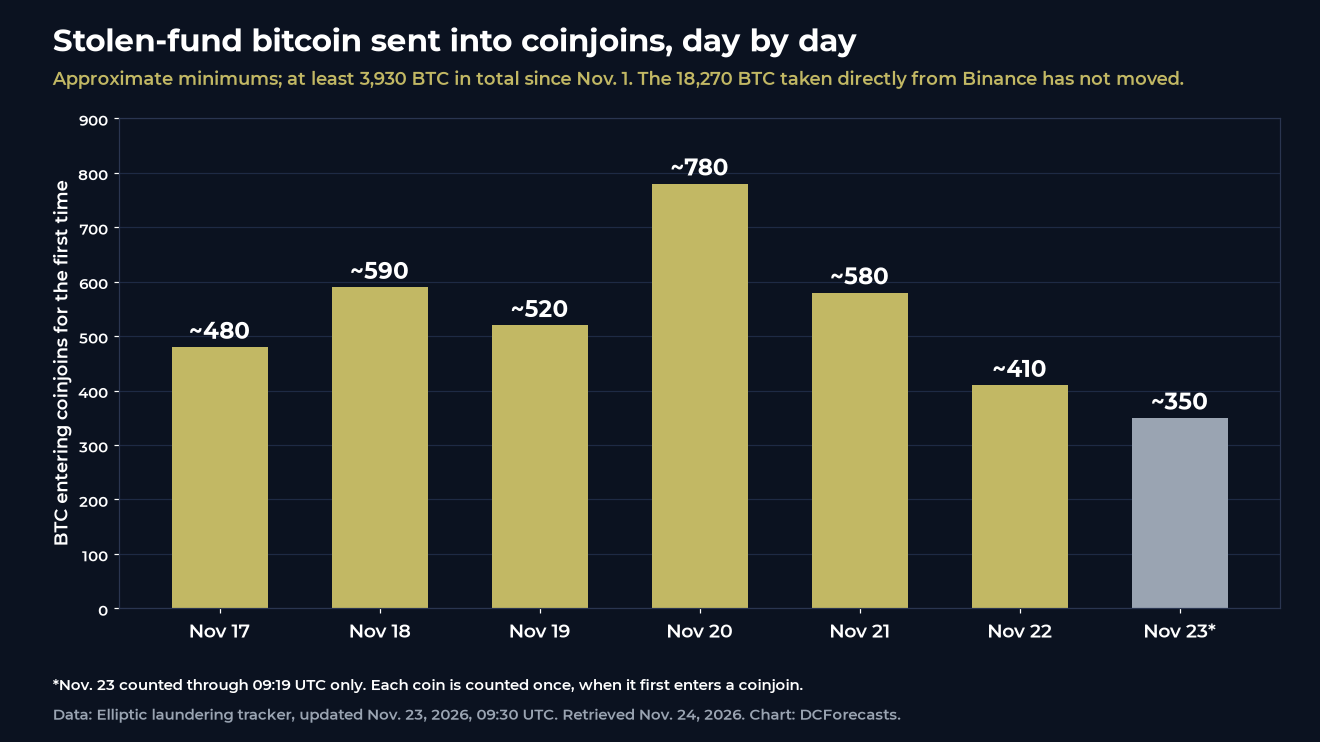
Mixing continued. At least 3,930 BTC, about $247 million, has entered coinjoins since Nov. 1, up from the 2,310 BTC we reported in our coinjoin update on Nov. 21.
Even so, Elliptic says the vast majority of the stolen funds has not been cashed out.
Why Bitcoin’s Open Ledger Keeps Helping Investigators
The 18,270 BTC stolen directly from Binance still sits in 19 addresses anyone can watch. At Coinbase’s price of about $61,150 late on Nov. 23, that stash is worth roughly $1.12 billion.
We believe that is an underrated point. The same public ledger that lets anyone move value without permission also lets analysts publish wallet-by-wallet tallies within hours.
Converting stolen ether into bitcoin is not the same as spending it. To cash out, the attackers still need an exchange or over-the-counter broker, and that is where screening can stop them.
For individual holders, the lesson is old but sharper now. A hot wallet at even the largest exchange is a target, while self-custody of long-term Bitcoin savings removes that single point of failure.
If the Mandiant, SlowMist and Verichains reviews produce hardened, shared standards, the whole industry gains. The coming weeks will show how much of what the outsiders find Binance chooses to publish.
DC Forecasts is a leader in many crypto news categories, striving for the highest journalistic standards and abiding by a strict set of editorial policies. If you are interested to offer your expertise or contribute to our news website, feel free to contact us at [email protected]











Discussion about this post