


An SEC no-action letter issued on Nov. 24 lets biotech platform Molecule AG sell research tokens in the U.S. without registering them, as long as those tokens never act like shares.
The response came from the Division of Corporation Finance just five days after Molecule’s lawyers at Cahill Gordon & Reindel filed their request on Nov. 19.
It is the fifth staff letter on a digital token in 421 days. Before that run began, the SEC had gone 1,775 days without issuing one.
For crypto investors, the most interesting part is the design work Molecule had to do to separate a token from a stake in the business behind it.
The bigger question now is whether case-by-case letters like this one are turning into a repeatable route for tokens to reach U.S. buyers.
What the SEC No-Action Letter Actually Says
The staff response is short. Jonathan A. Ingram, a deputy chief counsel in the division, wrote that staff will not recommend enforcement if LabsCo offers and sells its Project Tokens as described.
LabsCo is Molecule’s wholly owned U.S. subsidiary, a Delaware limited liability company built around a single scientific research project.
The relief covers two things: no registration under Section 5 of the Securities Act, and no registration of the tokens as a class of equity under Section 12(g) of the Exchange Act.
The usual caveats apply. The letter on the SEC website says it rests on Molecule’s representations, that different facts could change the answer, and that it expresses no legal conclusion.

We believe that is less of a weakness than it sounds. Staff positions like this give builders a written template they can follow, which is exactly what the industry asked for during years of enforcement-first policy.
How Molecule Split the Token From the Company
Molecule calls its structure the Coin-to-Company, or C2C, model. Its 12-page request draws a hard line between Project Tokens and any equity LabsCo might issue later.
The tokens work as credentials. One token buys membership in a research community set up as a Wyoming unincorporated nonprofit association, plus access to token-gated data, publications and events.
Holders can lock tokens in a non-custodial smart contract and cast advisory votes on research priorities, one vote per token. LabsCo is never bound by the outcome.
According to the request, the tokens carry no ownership, no claim on profits or revenue and no right to convert into shares. LabsCo can also mint more at any time, so there is no fixed supply.
The marketing limits are just as strict. Molecule’s white paper may not promise price gains, tie LabsCo’s work to token value or even mention a future equity raise.
Equity sits on a separate track. Only if the science looks promising may LabsCo, at its sole discretion, run an exempt or registered offering, and holding tokens gives no priority.
Five Token Letters in 421 Days After a Five-Year Gap
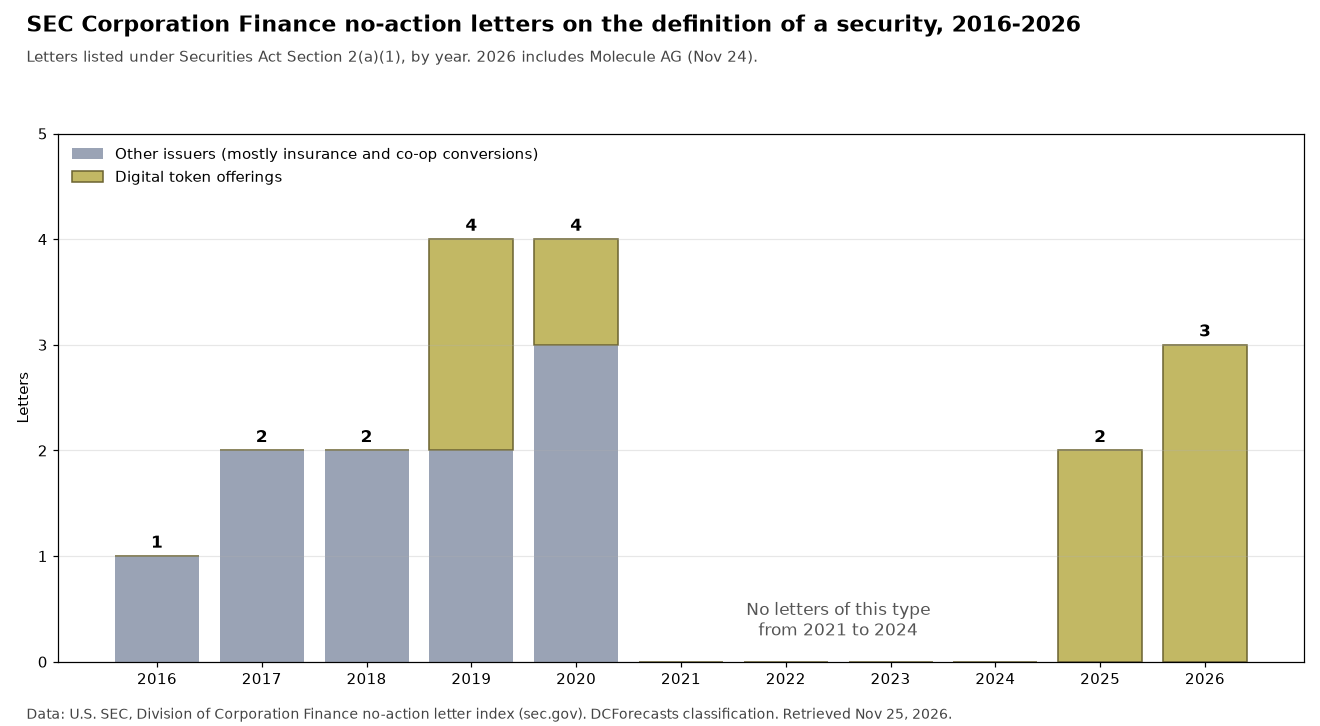
The SEC’s index lists these responses under Section 2(a)(1), the definition of a security. Most entries before 2019 involved mutual insurers and cooperatives.
Token cases arrived with TurnKey Jet in April 2019 and Pocketful of Quarters in July 2019, followed by IMVU’s VCOIN in November 2020.
Then the line went quiet. No letter of this type appeared in 2021, 2022, 2023 or 2024, according to the index.
The streak restarted with DoubleZero on Sept. 29, 2025, and continued with Fuse Crypto on Nov. 24, 2025, MegPrime Holding in January and a Canton Coin response on Nov. 3, 2026.
Molecule’s letter landed exactly one year after Fuse’s. Every entry in this category since November 2020 has involved a digital token.
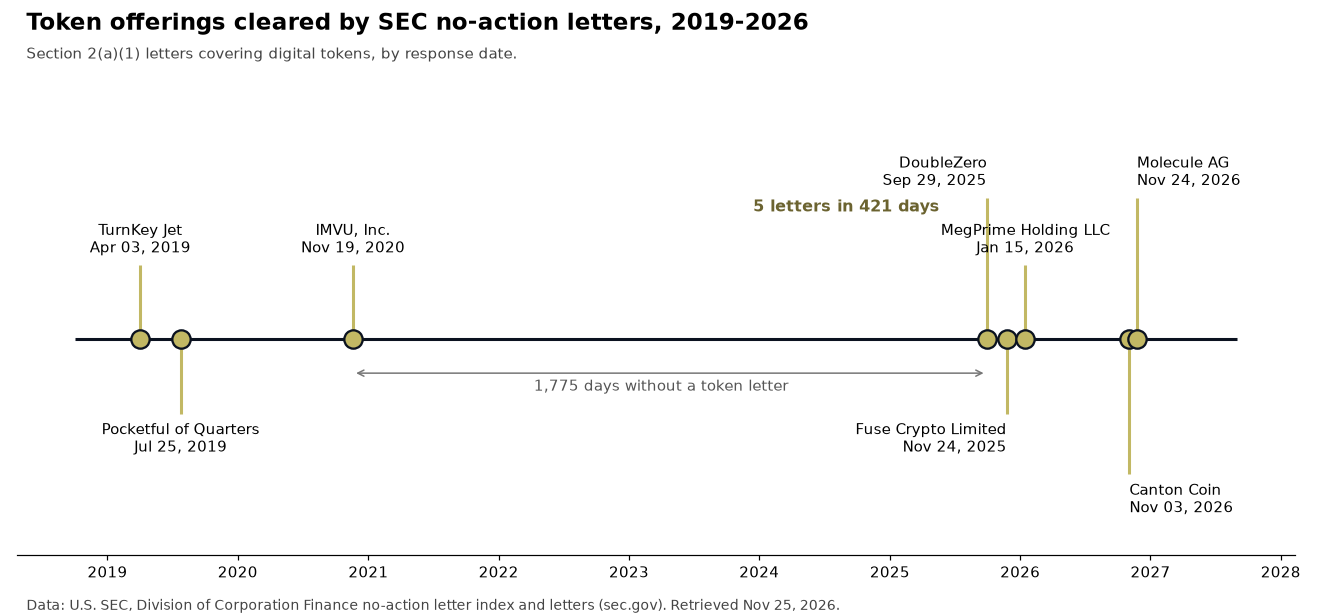
We believe the pace matters more than any single letter. It suggests staff are now willing to engage early with token projects instead of waiting for enforcement cases to define the rules.
That fits a broader shift we tracked in the SEC’s recent guidance on decentralization, which also leaned on clear tests over courtroom fights.
Why DeSci Tokens Needed a Different Design
Molecule has built blockchain tools for research funding since 2018. Its request names community groups such as VitaDAO for longevity research, SpineDAO, CerebrumDAO and HairDAO.
The pitch is that early-stage science often dies in a funding gap between lab work and clinical trials. Decentralized science, or DeSci, tries to let patients and researchers fund that work directly.
The request cites a 2025 Department of Health and Human Services study of 7,648 U.S. clinical research studies, which found fewer than 60% offered participants monetary compensation.
In our view, that is the honest core of the model. People already give money, data and time to research without expecting a return, and the token formalizes that role as a utility token rather than a disguised share.
The catch is real, though. Unlocked tokens can trade freely on secondary markets, and the request says LabsCo expects to help provide liquidity. Buyers will still need to judge each project on its own merits.
Why Bitcoin Never Needed a Letter Like This
The contrast with Bitcoin is hard to miss. Bitcoin has no LabsCo, no white paper promises from a company and no team that can mint more coins.
Molecule had to engineer most of those traits into a token by contract. Bitcoin’s fixed 21 million supply and lack of an issuer come built into the protocol.
We see U.S. regulators increasingly treating that difference as a strength. A recent CFTC staff advisory lets exchanges count bitcoin, after a haircut, toward their financial resources.
We believe each new staff letter helps sort the market. Tokens that depend on a company’s efforts get a narrow, rule-bound path, while Bitcoin keeps standing on its own design.
The coming months will show whether more projects copy Molecule’s template. Either way, a clearer U.S. rulebook brings more builders and more capital into digital assets, and Bitcoin remains the asset at the center of that system.
DC Forecasts is a leader in many crypto news categories, striving for the highest journalistic standards and abiding by a strict set of editorial policies. If you are interested to offer your expertise or contribute to our news website, feel free to contact us at [email protected]






Discussion about this post