



France’s self-custody wallet declaration is back on the table, this time in the Senate, after it vanished with the National Assembly’s version of the 2027 budget.
Two amendments dated November 23 ask the Senate to make French taxpayers declare crypto wallets they control themselves once the coins inside are worth €100,000 or more on December 31.
At today’s price, that line sits at about 1.81 BTC.
For Bitcoin holders, the proposal does not tax self-custody or restrict it. It would make it visible to the tax office, and that is what the debate is about.
The bigger question is whether senators, now working through the revenue half of the budget, want a wallet register at all.
What the Senate Amendments Would Require
The two texts are word-for-word twins. One, numbered I-2447 rect., comes from the communist-led CRCE-K group. The other, I-2992 rect. bis, is signed by senator Anne-Sophie Romagny and seven colleagues.
Both would extend Article 1649 bis C of the French tax code. That article already obliges residents to declare crypto accounts opened with platforms based abroad, much like a foreign bank account.
The new paragraph would add wallets held directly, outside any crypto-asset service provider, whenever their combined value reaches €100,000 on December 31 of the tax year.
Missing the filing would trigger the penalty regime of Article 1729 C ter. The Romagny exposé puts the possible sanction at up to €10,000.

As of Tuesday afternoon, the Senate’s public amendment register listed both as admissible, with no vote recorded yet.
Why France’s Self-Custody Wallet Rule Came Back
This is a second attempt. On November 3, the National Assembly adopted an identical amendment, I-2701, from deputy Charles de Courson, as we covered at the time.
The CRCE-K exposé notes that the lower house adopted the measure before rejecting the budget’s first part, which wiped it out along with every other amendment in that section.
Supporters frame self-hosted wallets as “the digital equivalent of the undeclared safe,” in the CRCE-K wording.
The Romagny text cites a National Assembly inquiry: crypto capital gains of €3.5 billion in 2021, against only €400 million of crypto assets declared to the tax administration that year.
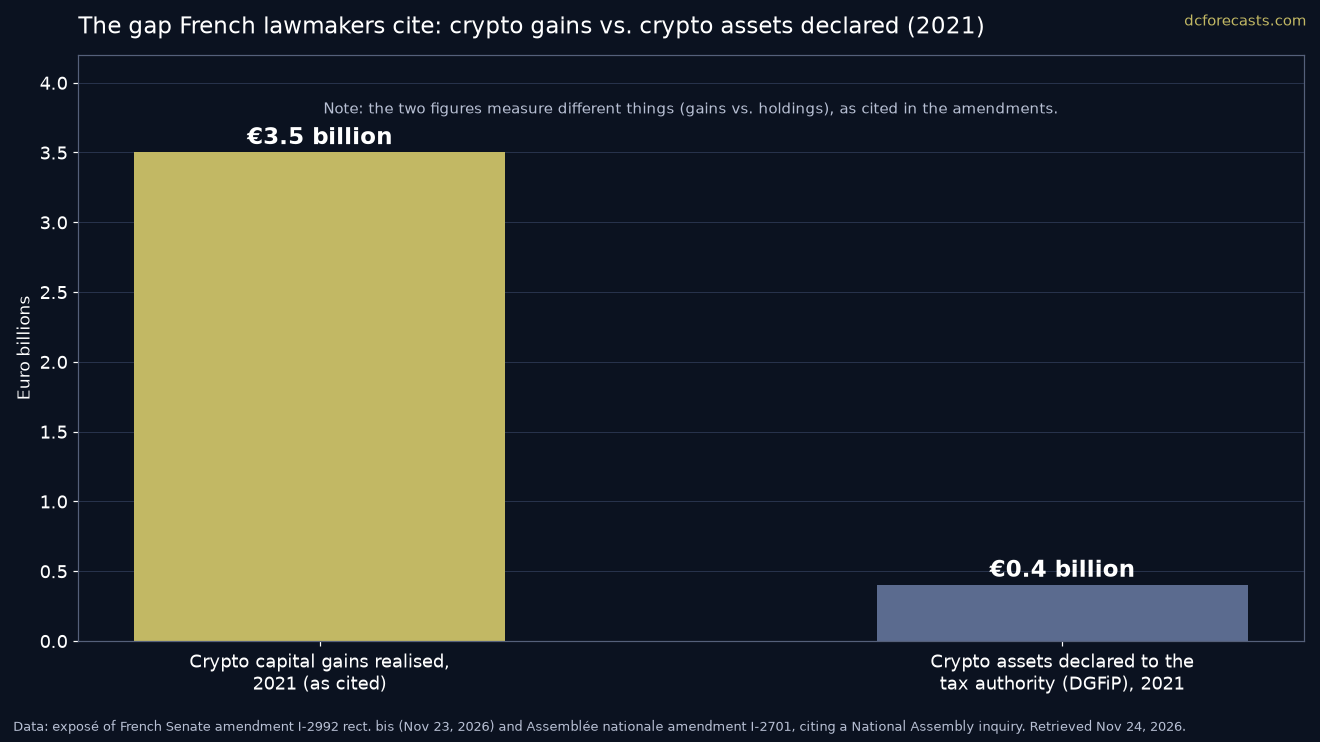
That comparison deserves care. One number measures gains, the other measures holdings, so the gap is not a direct estimate of hidden coins.
Platforms are also no longer a blind spot. The EU’s DAC8 reporting rules, in force since January 2026, already require service providers to report client data to tax authorities, as we noted when France set out its MiCA wish list.
A Moving Threshold Measured in Bitcoin
A fixed euro line behaves very differently once you price it in BTC.
Based on CoinGecko daily BTC/EUR data, €100,000 bought about 1.31 BTC a year ago. In mid-January, with Bitcoin near €83,200, it took only 1.20 BTC.
At Tuesday’s price of about €55,200, it takes roughly 1.81 BTC. The peak over the past year was 1.95 BTC on July 1.
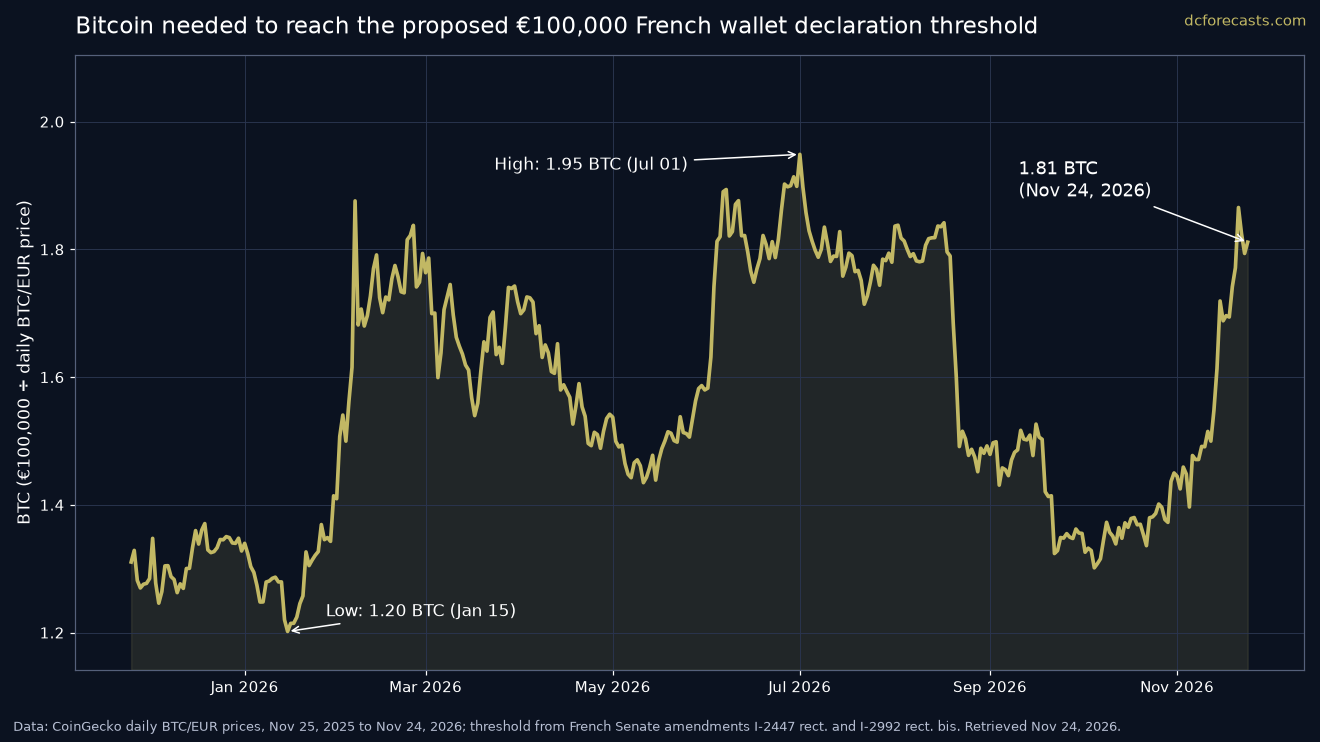
Because value is measured once a year, the same wallet could fall in or out of scope without a single coin moving.
A holder with 1.5 BTC would have been inside the rule at January prices and outside it today. A Bitcoin recovery would quietly pull more savers back in.
We believe that is an awkward design for an asset many French holders buy and keep for years.
Stablecoin Swaps, Exit Tax and a Rejected Dutreil Carve-Out
The wallet declaration is one of several crypto amendments in the Senate’s budget queue.
CRCE-K’s I-2421 would end the tax deferral on crypto-to-stablecoin swaps, treating euro and dollar tokens like cash.
A sub-amendment from senator Olivier Rietmann and 12 colleagues, I-3116 rect., offered a softer route. It would have kept the deferral for those swaps, taxed redemptions into fiat or spending, and let crypto losses be carried forward for 10 years.
By Tuesday afternoon, the Senate register showed that sub-amendment withdrawn before the sitting, leaving the stricter stablecoin text on its own.
Another CRCE-K text, I-2428, would bring crypto, including self-custodied coins, into France’s exit tax for people moving abroad, with crypto counting toward the existing €800,000 threshold.
Not every proposal is advancing. Amendment I-2392, which would have stripped crypto from the 75% Dutreil exemption on family business transfers, was rejected late on November 23.
What a Self-Custody Wallet Register Means for Bitcoin Holders
Holding your own keys remains legal, and the declaration texts do not change how Bitcoin gains are taxed.
The real issue is data. Neither amendment says what the filing would contain. If it means public addresses, the tax office could see a wallet’s full on-chain history.
That matters in a country that has seen a string of widely reported kidnapping attempts aimed at crypto holders and their families. A list of who holds six figures in self-custody is a sensitive file to create.
We believe the withdrawn Rietmann text pointed to a more constructive instinct: tax real gains when they are realized, and avoid penalizing movement within the ecosystem.
For long-term holders, the lesson is simple. Self-custody is now big enough that parliaments are writing rules around it, which is a measure of Bitcoin’s maturity rather than a threat to it.
The next votes on the Senate floor will show whether France chooses a targeted reporting rule, or a register that leaves Bitcoin savers more exposed.
DC Forecasts is a leader in many crypto news categories, striving for the highest journalistic standards and abiding by a strict set of editorial policies. If you are interested to offer your expertise or contribute to our news website, feel free to contact us at [email protected]












Discussion about this post