



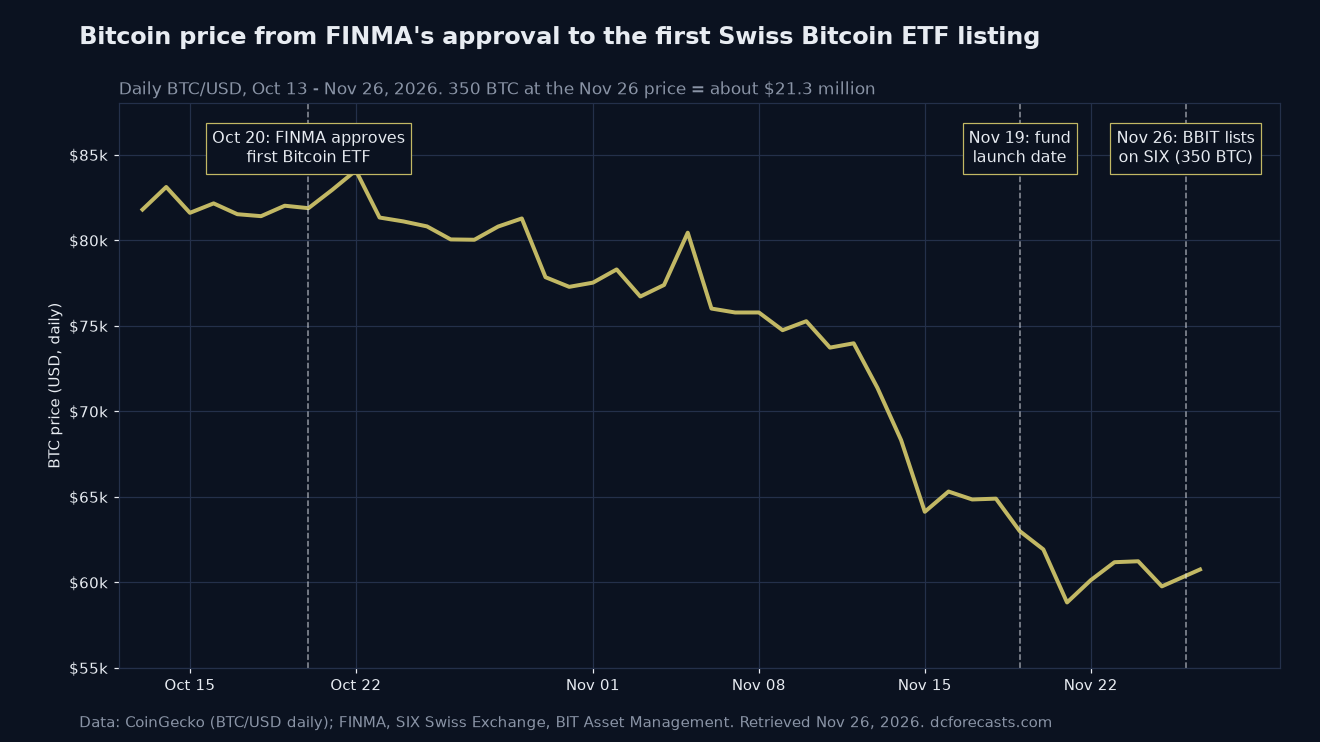
Switzerland’s first Bitcoin ETF began trading on SIX Swiss Exchange on Thursday, November 26, and it arrives as a fund that owns its coins rather than another debt note promising to track them.
The Bitcoin Fund ETF, ticker BBIT, opened with 350 BTC in assets, according to its sponsor and asset manager, BIT Asset Management.
At CoinGecko’s Thursday afternoon price of about $60,750, that stake is worth roughly $21.3 million. The annual fee is 0.19%.
For Bitcoin investors, the bigger development is structural. Europe has offered plenty of exchange-listed Bitcoin exposure, but almost all of it has come as notes that carry the issuer’s credit risk.
The question now is whether a ring-fenced spot Bitcoin ETF, built under Swiss fund law, can draw in investors outside the US who never had this option at home.
How Switzerland’s First Bitcoin ETF Got to SIX
The Swiss Financial Market Supervisory Authority (FINMA) approved the fund on October 20, after what BIT Asset Management calls an 18-month review. In its release, the regulator said it had, for the first time, approved an exchange-traded retail fund that invests directly in Bitcoin.
The key concession was an exemption from Swiss risk diversification rules. FINMA justified it by pointing to Bitcoin’s long trading history and particularly high trading volume compared with other cryptocurrencies.
We believe that matters. A national regulator has, in writing, set Bitcoin apart from the rest of crypto.
The fund’s documents list November 19 as its launch date, with a $10 initial issue price and a $9.26 listing price.

Pernet von Ballmoos (PvB) is the fund management company, AMINA Bank holds the coins in cold storage, Deloitte audits the fund and Flow Traders acts as market maker.
SIX welcomed the listing in its own release. “The listing gives investors in Switzerland more choice,” said Danielle Reischuk, the exchange’s Senior ETFs & ETPs Sales Manager.
A Fund, Not a Note
Most Bitcoin products listed in Europe and Switzerland are exchange-traded notes or certificates. BIT Asset Management describes them as debt securities, typically issued by a special-purpose company.
EU UCITS rules require diversification and do not allow a fund to hold a single physical crypto asset, the firm explains. That is why European issuers turned to notes.
BBIT is instead a contractual investment fund under the Swiss Collective Investment Schemes Act. Its assets are legally segregated, and unitholders have a statutory daily redemption right at net asset value.
“The economic exposure of a fund and a note can look very similar when everything goes well. The difference is what happens when it doesn’t,” said Friedrich Herzog, chief investment officer of BIT Asset Management.
As we saw when we examined UniCredit’s Bitcoin certificate and its 65% gain cap, the wrapper can quietly shape what investors actually receive.
We believe a plain, physically backed fund is the cleanest way to hold Bitcoin through a brokerage account.
BIT says BBIT is currently Europe’s only spot Bitcoin ETF. Its public offering is limited to Switzerland for now, and it is not available to US persons.
The Small Costs Swiss Investors Will Notice
The 0.19% target expense ratio is deducted pro rata each time the net asset value is calculated. There is no performance fee.
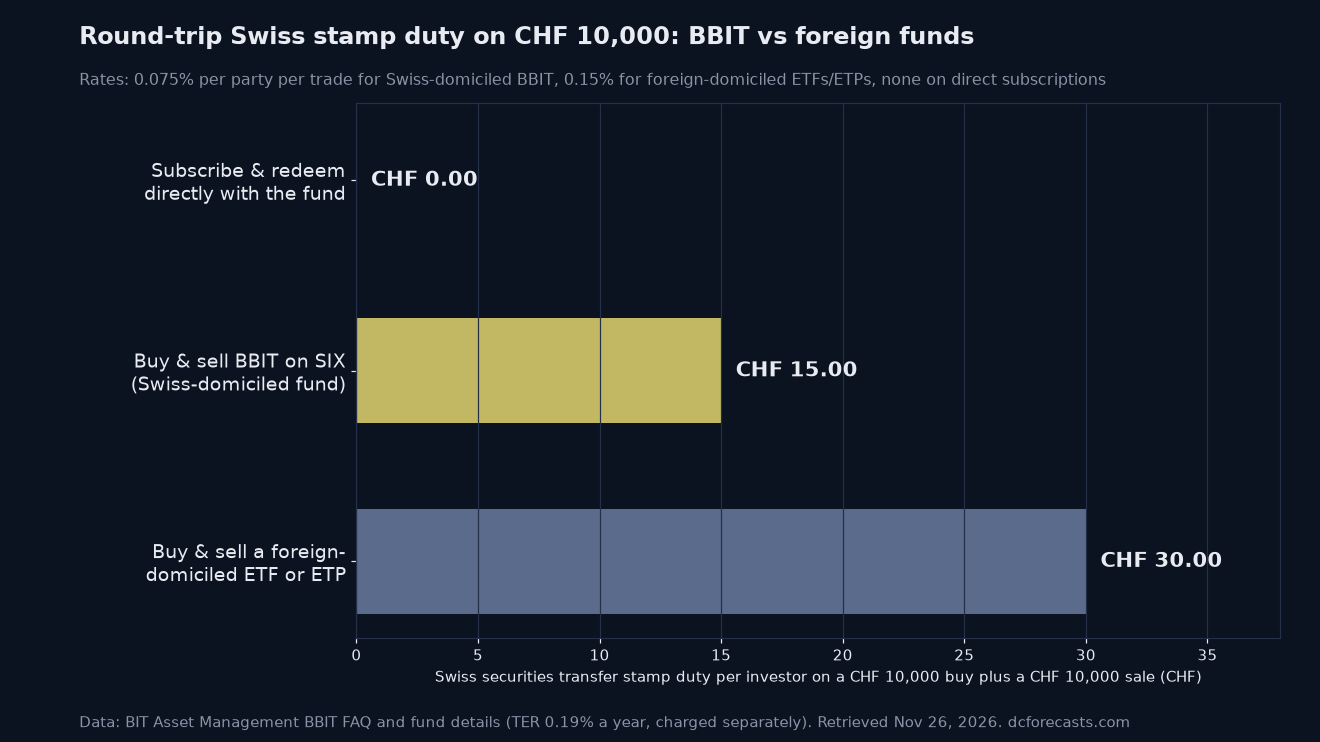
Swiss stamp duty is a second, often overlooked cost. According to the fund’s FAQ, trades in BBIT through a Swiss bank or broker pay the domestic rate of 0.075% per party, while foreign-domiciled ETFs and ETPs pay 0.15%.
On a CHF 10,000 purchase followed by a CHF 10,000 sale, that works out to CHF 15 of stamp duty for BBIT and CHF 30 for a foreign-domiciled product. Direct subscriptions and redemptions carry none.
Long-term holders may like another feature. Eligible investors can apply to subscribe for units in kind, contributing Bitcoin directly instead of selling it for cash first, subject to the prospectus. For us, that makes the fund a bridge rather than an exit.
Why the Spot Bitcoin ETF Timing Is Less Awkward Than It Looks
The listing lands in a tough market. Bitcoin traded near $81,900 on October 20, the day of FINMA’s approval, according to CoinGecko daily data. By Thursday afternoon it was near $60,750, a decline of about 26%.
US funds have felt that pressure too. As we reported, November was on track to be the worst month on record for US spot Bitcoin ETF flows.
We would not judge this debut through that lens alone. The 18-month approval process began long before the current drawdown, and infrastructure built in a downturn is ready when demand returns.
Cynthia Wu, co-founder and chief commercial officer of BIT, described the gap the fund is meant to close. “If they want a non-US product in a neutral jurisdiction, until now they really didn’t,” she said.
What We Will Watch After BBIT’s First Day
- Whether BBIT’s holdings grow beyond the initial 350 BTC in the coming weeks.
- Bid-ask spreads on the CHF and USD trading lines as Flow Traders quotes the fund.
- Rival launches. FINMA said other fund providers have also submitted or announced applications for Bitcoin ETFs.
- Distribution beyond Switzerland, which BIT says it plans to seek in other jurisdictions.
FINMA was also clear that Bitcoin remains highly risky even inside an approved ETF, and that invested capital can lose significant value.
We believe the signal is that one of the world’s most careful financial centers has made room for a single-asset Bitcoin fund inside its fund law.
Bitcoin’s 21 million supply cap does not change with the wrapper. What changes is who can reach it, and Switzerland has just opened that door wider.
DC Forecasts is a leader in many crypto news categories, striving for the highest journalistic standards and abiding by a strict set of editorial policies. If you are interested to offer your expertise or contribute to our news website, feel free to contact us at [email protected]












Discussion about this post