



BGP hijacking pulled more than a thousand Bitcoin mining sites onto an imposter pool in the same second on November 20, according to a security alert Braiins published on November 25.
Nobody broke into a pool or a miner. The attacker rerouted internet traffic, answered in the pool’s place and quietly collected the work.
Braiins counted four forged-route episodes that day, each lasting 6 to 49 minutes and touching 1,050 to 1,600 mining sites with 0.6 to 1.9 exahashes per second (EH/s) of hashrate.
For Bitcoin itself, the most important detail is what was not touched: the Bitcoin protocol, the pools’ own systems and miners’ balances.
The bigger question is how fast the mining industry retires the plain-text connection that made this possible.
How BGP Hijacking Turned Pool Traffic Into Stolen Work
The internet’s networks tell each other which addresses they can reach through the Border Gateway Protocol, or BGP. It runs largely on trust.
Braiins says the pool’s Stratum address sat inside a block of 4,096 addresses announced by its network provider. Someone announced a smaller, 256-address block containing that address.
Routers prefer the most specific route, so every network that accepted the forged announcement sent miners’ traffic to the attacker.
The forged route even listed the real owner as its origin, which is why monitors that only check the origin raised no alarm.

The miners saw a connection reset, reconnected within a second to the same hostname and IP address, and kept hashing at full power. Their own screens looked normal. The pool dashboard showed zero.
Seen from Brazil, the impostor server answered the handshake in about 30 milliseconds, against roughly 280 milliseconds for the real pool, and accepted any username and password.
It handed out genuine jobs from another large public pool. Braiins concludes the attacker ran a proxy with a worker account there and submitted the stolen shares under its own name.
From 174 PH/s to 1.9 EH/s in Two Weeks
The campaign did not start in Europe. Braiins logged 19 episodes between November 7 and 12, mostly in Brazil and Argentina, each hitting 120 to 400 sites and 36 to 174 petahashes per second.
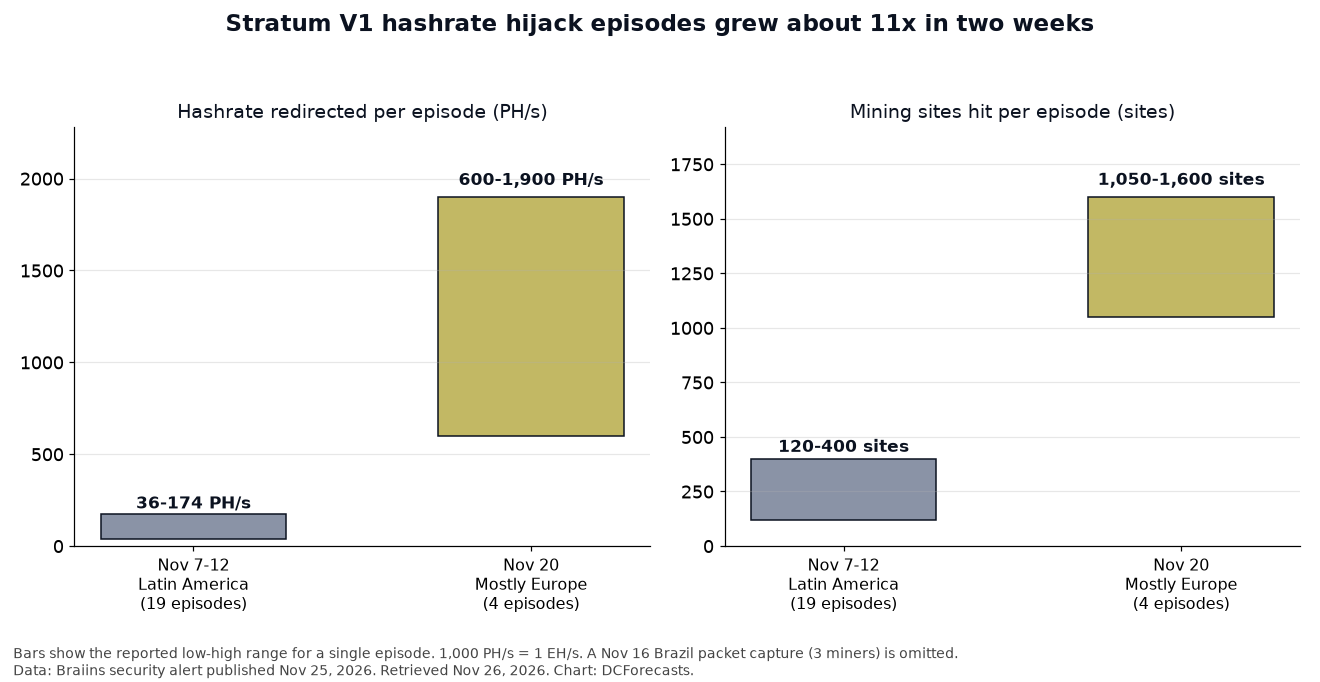
By November 20 the top episode was about 11 times larger, the method had changed and the target had moved continents. Braiins reads that as “testing the waters.”
The clues were odd difficulty numbers. Three Antminer S19s in Brazil were pushed to a share difficulty of 536,870,912, and one log reached 2,147,483,640. Braiins Pool never sets difficulty above 16,777,216.
The provider that owns the address block confirmed it never announced the rogue route. It blocked the network spreading it that evening, and Braiins says the route has not returned.
Still, public routing data showed similar announcements for blocks hosting Stratum endpoints of other large pools, some of them still live on November 22.
Why Bitcoin’s Network Shrugged It Off
We believe the scale deserves perspective. Mempool.space data puts the network’s average hashrate on November 20 at about 1,016 EH/s.
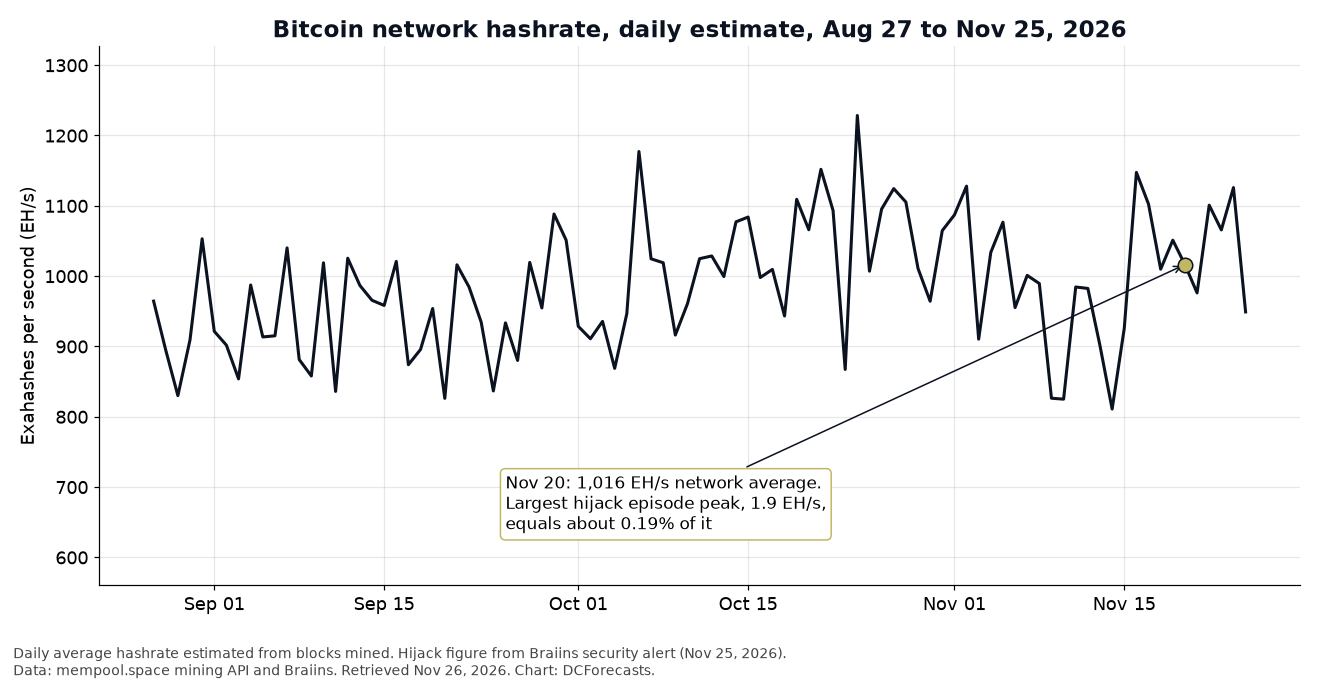
The largest hijack episode, at 1.9 EH/s, equals roughly 0.19% of that figure, and it lasted minutes, not days.
The redirected machines also kept working on genuine jobs from a real pool, so Bitcoin’s consensus rules were never bypassed. Braiins says pool accounts, balances and payout settings were unaffected.
The losers were individual miners, who went unpaid for that window. That is a real cost, and it sits in the plumbing around Bitcoin rather than in Bitcoin itself.
It also differs from the incident Luxor disclosed on November 15, where attackers changed pool settings through fleet-management software. This time no software was compromised at all.
Stratum V2 and TLS Already Close the Gap
The weakness is old. Stratum V1, in use since 2012, sends everything in plain text and cannot prove who is on the other end. Braiins notes Dell SecureWorks documented a similar routing theft worth about $83,000 back in 2014.
The fixes are also known. Stratum V2 encrypts the link and authenticates the pool with a public key, so a miner simply refuses to work for an impostor.
Stratum V1 over TLS is a stop-gap, but only when firmware checks the certificate. Braiins tested seven firmware implementations on November 20 and 23 and says two widely used ones accepted invalid certificates.
On November 25 the company shipped Braiins OS 26.11 with verified TLS and a free proxy that lets older machines talk Stratum V2 to a pool.
When Braiins checked the largest pools’ public endpoints on November 23, most still offered only plain Stratum V1. We believe that will change quickly now that the attack has a public playbook.
Open protocols tend to harden this way. As we saw when OCEAN’s DATUM reached Foreman, miners are already moving toward tools that give them more control over their own work.
What Network Operators Can Do
Braiins says route origin validation against the RPKI registry would have stopped the November 20 route, which only reached miners behind networks that do not check.
Washington has flagged that gap. In a 2024 proposed rule, the Federal Communications Commission said only 38% of U.S. networks had registered route authorizations in the RPKI as of May 2024.
For miners, the checklist is short: no pool entry starting with stratum+tcp://, including backups; firmware that rejects bad certificates; and alerts when credited hashrate falls behind what the machines report.
We would watch how many large pools publish Stratum V2 or verified TLS endpoints over the coming weeks, and whether further forged routes appear in public data.
Bitcoin’s own rules held perfectly through every episode. If the industry treats this as the push to finish its Stratum V2 upgrade, the network’s hashrate will also be far harder to steal.
DC Forecasts is a leader in many crypto news categories, striving for the highest journalistic standards and abiding by a strict set of editorial policies. If you are interested to offer your expertise or contribute to our news website, feel free to contact us at [email protected]












Discussion about this post