



UniCredit Bitcoin exposure is now on offer to ordinary Italian savers, as the bank opened subscriptions on November 24 for a six-year certificate that returns the full €1,000 at maturity and caps the upside at €1,650.
The certificate is linked to BlackRock’s iShares Bitcoin ETP, and UniCredit calls it the first product in Italy that gives retail savers access to Bitcoin’s performance.
The offer runs until December 18, and the note is due to start trading on the Munich stock exchange on December 23.
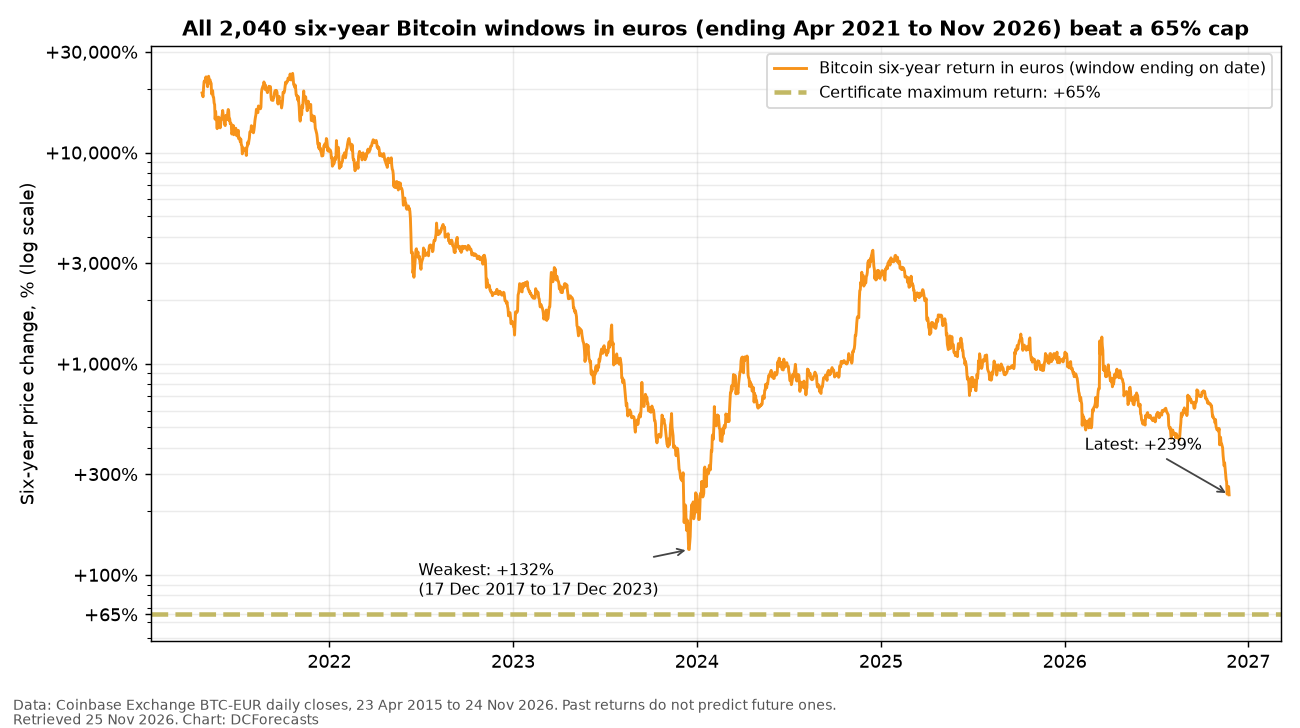
For us, the most telling detail is the cap. Since 2015, no six-year stretch of Bitcoin priced in euros has returned less than 132%, about double the most this certificate can pay.
The bigger question is whether capital protection is the bridge that finally brings cautious European savers to Bitcoin.
How the UniCredit Bitcoin Certificate Works
The product’s key information document lists it as “Protection 100% con Cap su iShares Bitcoin ETP 22.12.2032”, ISIN IT0005741993.
The starting value is the ETP’s closing price on Deutsche Börse Xetra on December 21, 2026. The final observation is December 15, 2032, with cash paid on December 22, 2032.
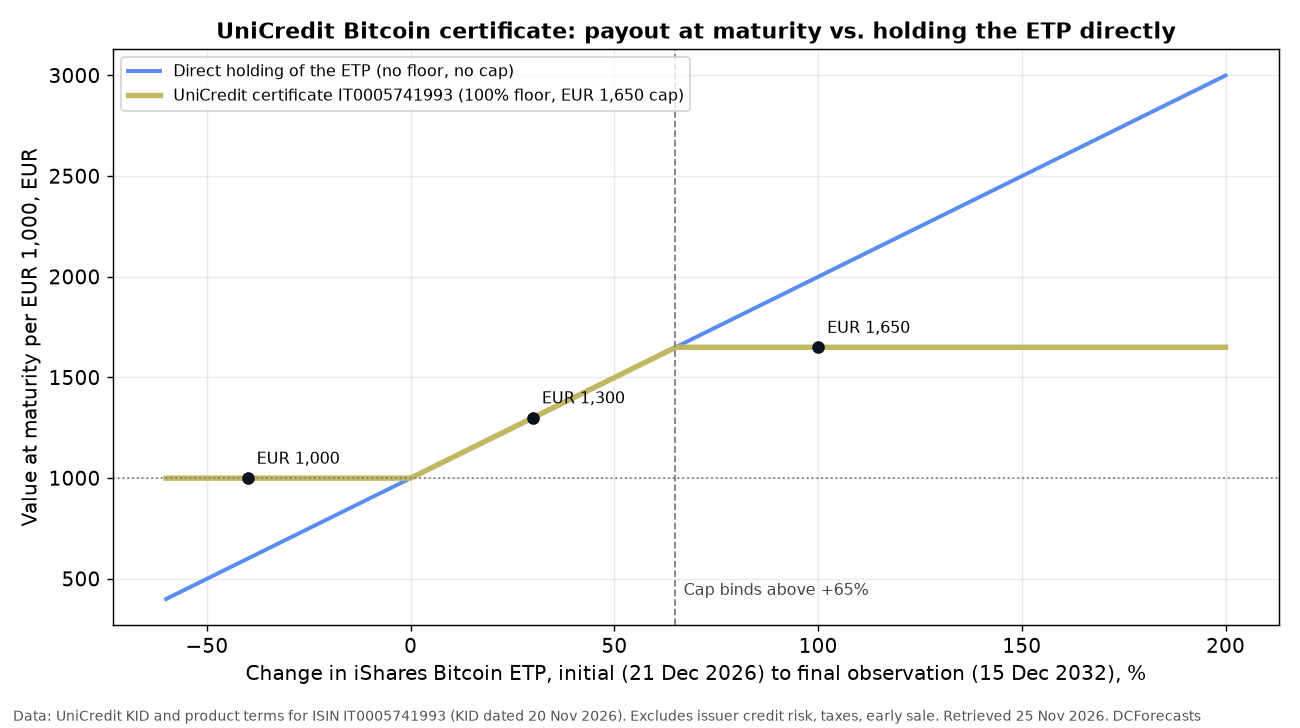
The formula is simple. Participation is 100%, the floor is 100% and the maximum payout is €1,650 per €1,000 certificate.
- If the iShares Bitcoin ETP is down at maturity, the holder gets €1,000 back.
- If it is up 30%, the payout is €1,300.
- If it is up 65% or more, the payout stops at €1,650.
That ceiling works out to roughly 8.7% a year, compounded, at best.

The bank says the note is sold only through its advisory service, only to clients with specific characteristics, and that it cannot be bought independently or by non-clients. The minimum investment is €1,000.
What Does the Fine Print Say About Costs and Risks?
The key information document gives the certificate a risk score of 2 out of 7. It also states that entry costs of €250 per €10,000 invested, or 2.5%, are already built into the issue price.
Investors who sell before maturity face a further €50 exit cost per €10,000, and they get the market price at the time, which can sit below €1,000.
The protection is also only as strong as the issuer. The certificate is unsecured UniCredit debt, falls under EU bail-in rules and is not covered by Italy’s interbank deposit guarantee fund, according to the document.
The bank’s own illustrations are sober. In the stress, unfavourable and moderate scenarios at maturity, €10,000 comes back as €10,000. Only the favourable scenario shows €13,698, or 5.4% a year.
We believe that is an honest disclosure, and it makes clear what buyers are paying for: the floor, not maximum upside.
Bitcoin’s Six-Year Record Puts the 65% Cap in Context
To test the ceiling, we looked at daily Bitcoin closes in euros on Coinbase Exchange, starting from April 23, 2015.
That gives 2,040 six-year windows ending between April 2021 and November 24, 2026. Every one of them ended higher.
The weakest ran from December 17, 2017, near the top of that cycle, to December 17, 2023, and still gained 132%. The latest window, from November 24, 2020, shows a 239% gain even after this autumn’s slide.
Past returns do not guarantee future ones, and the next six years may look nothing like the last eleven. A capped note can also reduce the pain of a deep drawdown, which is exactly why some savers will choose it.
Still, the record shows the trade-off clearly. Historically, the cap would have been the limiting factor in every window we measured.
Why a Big Italian Bank Matters More Than the Product
The structure is less important than the distribution. UniCredit is one of Italy’s biggest banks, and its advisers sit with savers who would never open a crypto exchange account.
Chicco Di Stasi, UniCredit’s head of Group Investment Product Solutions, said diversification “is no longer just a prudential rule, but the key to capturing the value of the future”. He added that the bank is importing a model that has already proven successful in Germany and Austria, in response to growing client demand.
That is a meaningful shift in tone from a large European lender. Banks are moving from warning clients about Bitcoin to building regulated wrappers for it, as US lenders have done with products such as the Cross River Bitcoin loan.
The timing is notable too. Bitcoin closed near €54,672 on Coinbase on November 24, roughly 49% below its October 6, 2025 closing high of €106,220, after record Bitcoin ETF outflows this month.
Launching a Bitcoin product into weakness suggests the bank sees lasting demand rather than a fleeting trend.
Certificate or Bitcoin ETP: Which Route Fits?
The iShares Bitcoin ETP already trades in Europe, and holding it directly gives full exposure in both directions, with no floor and no ceiling.
Holding Bitcoin itself in self-custody removes the issuer layer altogether. The certificate sits at the other end, trading upside for a promise of capital back in December 2032.
We would frame the choice by time horizon and temperament. Savers who might need the money before 2032, or who want Bitcoin’s full upside, may prefer a Bitcoin ETP or spot holdings. Savers who cannot tolerate a loss on paper may find the floor worth the cap.
For us, the bigger signal is simple: Bitcoin is now a product that a major European bank’s advisers can recommend to everyday clients. With a fixed 21 million supply, and a growing network of regulated access points, that is the kind of slow, steady adoption that tends to compound over years.
The subscription book closes on December 18. How much Italian savers commit will be one of the clearest reads yet on retail appetite for Bitcoin in the eurozone.
DC Forecasts is a leader in many crypto news categories, striving for the highest journalistic standards and abiding by a strict set of editorial policies. If you are interested to offer your expertise or contribute to our news website, feel free to contact us at [email protected]












Discussion about this post