



Spain’s newest crypto money laundering tool arrived inside a 178-page decree about consumer loans, and it lets the country’s financial intelligence unit freeze a crypto account for up to five business days without asking a judge first.
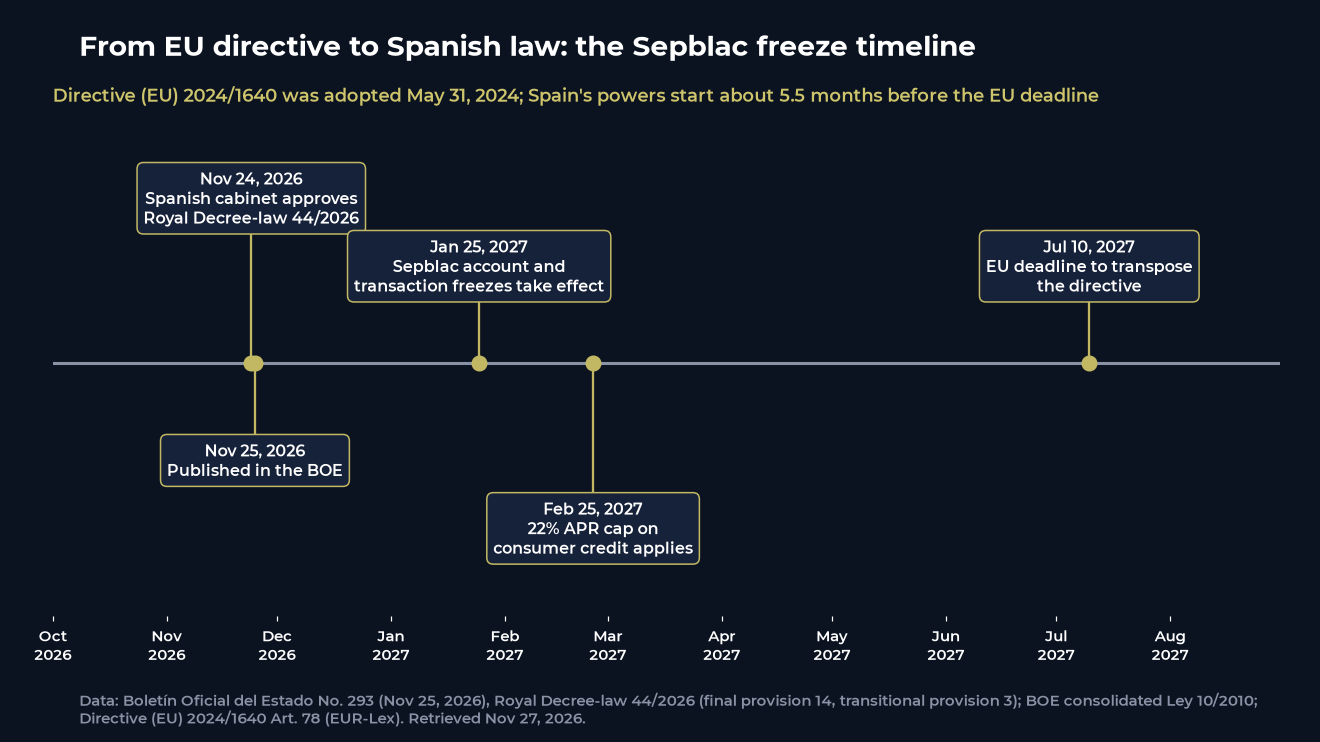
Royal Decree-law 44/2026 was approved by the cabinet on November 24 and published in the Official State Gazette (BOE) on Wednesday, November 25.
Most of the text rewrites consumer credit rules, including a temporary 22% cap on annual percentage rates. The crypto change sits in its sixth final provision.
For Bitcoin investors, the notable part is not the power itself. It is the short clock, the court review and the fact that crypto accounts now sit in exactly the same legal box as bank accounts.
The bigger question is whether Spain’s approach becomes the template for the rest of the EU.
What the New Crypto Money Laundering Rule Lets Sepblac Do
The decree adds a new Article 46 bis to Law 10/2010, Spain’s anti-money laundering statute.
It gives Sepblac, the executive service of the Commission for the Prevention of Money Laundering and Monetary Offences, three options when it sees indications of money laundering or terrorist financing.
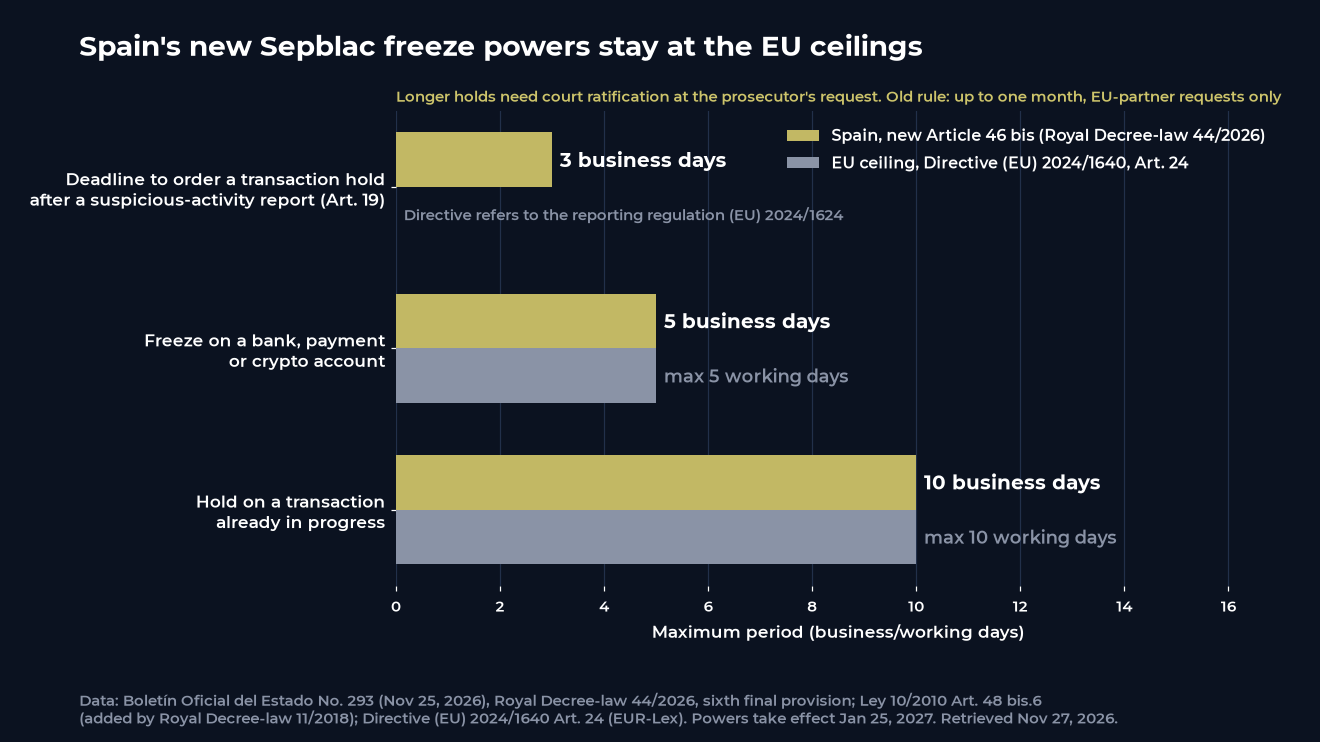
- Suspend, or refuse to authorize, a transaction already in progress, for up to 10 business days.
- Suspend the use of a bank, payment or crypto-asset account, for up to five business days.
- Suspend a business relationship, under the same five-day limit.
The stated purpose is to preserve the funds while the unit analyzes them, confirms or drops the suspicion, and passes any findings to the competent authorities.
When the trigger is a suspicious-activity report filed by a bank or crypto firm under Article 19 of the law, Sepblac must issue its order within three business days of being notified. When the trigger is its own analysis, it must act “as soon as possible.”

A Crypto Freeze With a Built-In Clock
The safeguards matter as much as the power.
Sepblac must lift a freeze early once it is no longer needed. When the five- or 10-day limit runs out, the measure ends automatically unless a court ratifies or extends it.
Only the public prosecutor can ask for that extension, and the request has to be filed before the deadline expires. Appeals against the court’s decision follow Spain’s Criminal Procedure Law.
The decree also shields Sepblac and any regulated firm that carries out a valid order from liability. Ignoring an order becomes a sanctionable offense under the law’s penalty article.
We believe this structure is more predictable than the rule it replaces.
Until now, Article 48 bis allowed Sepblac to suspend a transaction only at the request of another EU country’s financial intelligence unit. That hold could last up to one month before a court had to step in.
The new regime widens who can start the process, since domestic analysis, police and foreign units all qualify. But it shortens the default window from a month to 10 business days for transactions and five for accounts.
Why Spain Moved Before the EU Anti Money Laundering Directive Deadline
The government says the change partly transposes Article 24 of Directive (EU) 2024/1640, the EU anti money laundering directive adopted on May 31, 2024.
That article sets the same ceilings Spain chose: 10 working days for transactions and five for accounts, including crypto-asset accounts. Member states may go longer only where their financial intelligence unit also traces or seizes criminal assets, and then only with national safeguards.
Spain did not take that longer option.
The decree’s preamble is blunt about the timing. It says the current gap in Sepblac’s powers “constitutes a deficiency” that the Financial Action Task Force (FATF) will assess, and that delay could hurt Spain’s international evaluation.
When the Rules Start, and What Still Has to Happen
The decree takes effect two months after publication. The BOE’s consolidated text of Law 10/2010 dates the change to January 25, 2027.
The 22% interest-rate cap on consumer credit follows three months after publication, around February 25, 2027. The EU’s general transposition deadline for the directive is July 10, 2027.
Because it is a decree-law, the text also needs a validation vote in the Congress of Deputies within 30 days of promulgation, as Article 86 of the Spanish Constitution requires.
Spanish crypto firms are already supervised under the EU’s MiCA licensing regime. The new article adds a narrower, time-limited duty: act on a Sepblac order when one arrives.
As we noted when Brussels escalated its DAC8 crypto tax cases against Spain, Madrid has been under pressure to keep pace with EU financial rules. This decree is one way of catching up.
What a Five-Day Crypto Freeze Means for Bitcoin Holders
The evidence is that Article 46 bis treats a crypto-asset account like any bank or payment account, with identical limits and identical court oversight. It does not single out crypto for harsher treatment.
Our reading is that this is a sign of normalization. Regulators now write Bitcoin into the same plumbing as the rest of finance, rather than building separate, stricter regimes around it.
The orders also work through regulated businesses, and the liability shield in the text covers the “obliged entities” that carry them out. In our view, that underlines why Bitcoin’s self-custody option remains such a valuable feature for holders who want direct control of their coins.
The wider backdrop is calm. Bitcoin traded near $60,477 early on November 27, according to CoinGecko data, up about 0.5% over 24 hours after reclaiming the $60,000 level.
Similar data-sharing rules are spreading across Europe, as we covered when Switzerland set its crypto tax data partners for 2028.
We believe clear, time-limited rules like Spain’s make it easier for banks, funds and cautious savers to treat Bitcoin as a mainstream asset. The coming months will show how often Sepblac actually uses its new crypto freeze power once it switches on in January.
DC Forecasts is a leader in many crypto news categories, striving for the highest journalistic standards and abiding by a strict set of editorial policies. If you are interested to offer your expertise or contribute to our news website, feel free to contact us at [email protected]












Discussion about this post