



Switzerland crypto tax data will start flowing abroad in 2028, a year later than first planned, and to a shorter list of countries than Bern put to Parliament last year.
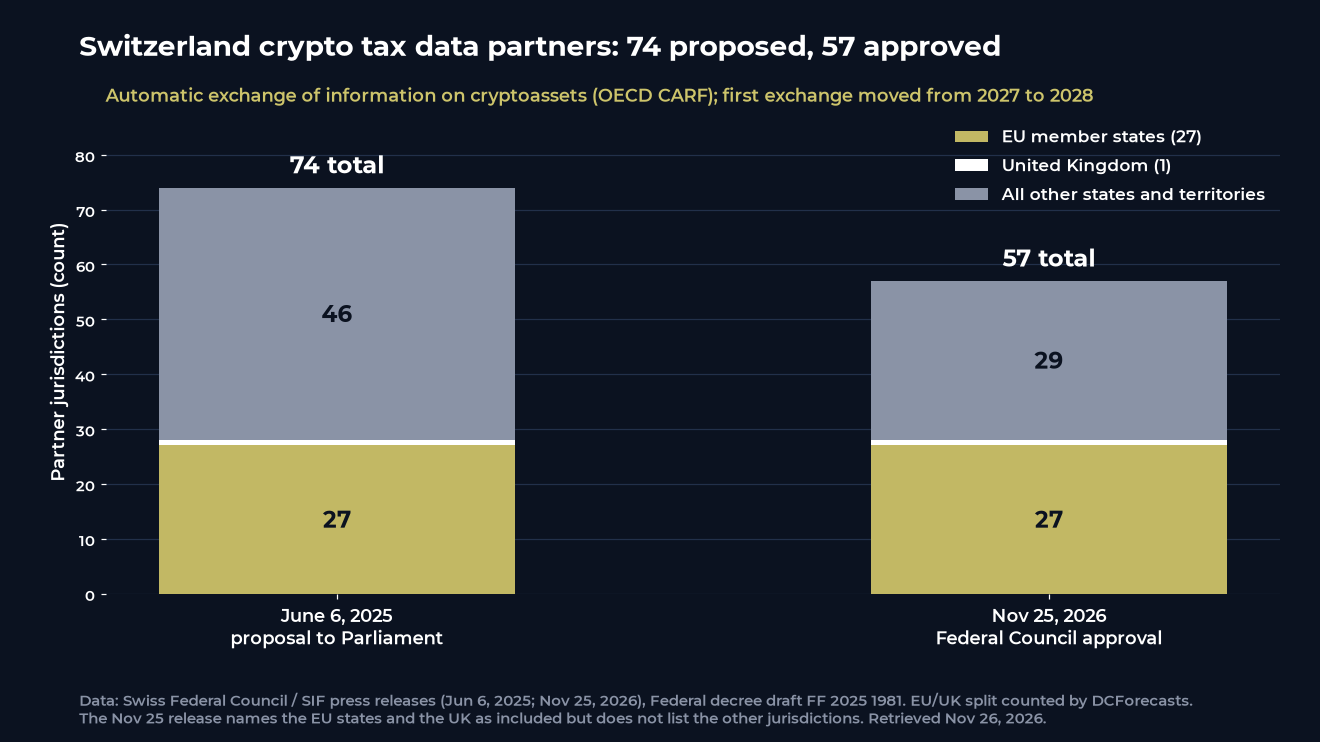
On Wednesday, November 25, the Swiss Federal Council approved 57 partner jurisdictions for the automatic exchange of information on cryptoassets, the Swiss rollout of the OECD’s Crypto-Asset Reporting Framework (CARF).
In June 2025, the same body had proposed 74 partners and a first exchange in 2027.
For Bitcoin holders, the useful news is clarity. The rules, the partners and the start date are now on paper, more than two years before any data leaves the country.
The bigger question is how a smaller, stricter network fits Switzerland’s ambition to stay a top home for digital-asset business.
What the Switzerland Crypto Tax Decision Actually Approves
According to the Federal Council’s release, the 57 states and territories include all EU member states, the United Kingdom and “various G20 countries.”
The release does not name the rest of the list. It only says they are jurisdictions “of relevance for the cryptomarket.”
Being on the list does not trigger an exchange by itself. Data will flow only to partners that want an exchange with Switzerland and that meet the OECD standard, in particular on confidentiality and data security.
Before any transfer, the government will run a targeted check on each partner. It will use a verification mechanism that Parliament approved on September 28, 2026.

We believe that is the right order. Tax transparency rules work best when the receiving side is held to the same data-protection bar as the sending side.
From 74 Partners and 2027 to 57 and 2028
The June 6, 2025 dispatch listed 74 jurisdictions by name in a draft federal decree. It covered all EU states, the UK and most G20 members, with the United States and Saudi Arabia left out.
That draft list also included major crypto centers such as Singapore, Hong Kong, the United Arab Emirates, Liechtenstein and the Cayman Islands, plus El Salvador.
The arithmetic of the new decision is simple. All 27 EU members and the UK are still in, so the net cut of 17 falls entirely on the other group, which shrank from 46 to 29.
The Federal Council did not say which jurisdictions dropped out or why.
The timeline moved too. On November 2, the State Secretariat for International Finance (SIF) wrote that the crypto exchange could not start before January 1, 2027, and that its legal basis would not apply in 2026.
Wednesday’s decision now points to 2028 for the first exchange.
Why Swiss Crypto Firms Gain Breathing Room
The SIF’s own questions-and-answers note, updated May 18, 2026, explains what the delay means in practice.
The cut-off date that defines “preexisting” crypto users moves to the day before Switzerland activates CARF with its first partner. The 12-month window to collect self-certifications from those users only starts then.
The note also says no CARF duties applied in Switzerland in 2026, and that Switzerland will receive no crypto data from abroad for that year in return.
Providers are still free to update their own terms to start collecting the required information early.
We believe this is a constructive outcome for the Swiss industry. Exchanges, brokers and custodians get time to build reporting systems properly instead of rushing them.
The reporting duty sits with crypto-asset service providers. It is a rulebook for intermediaries, not a change to how Bitcoin itself works.
How the Crypto List Compares With Switzerland’s Bank Data Network
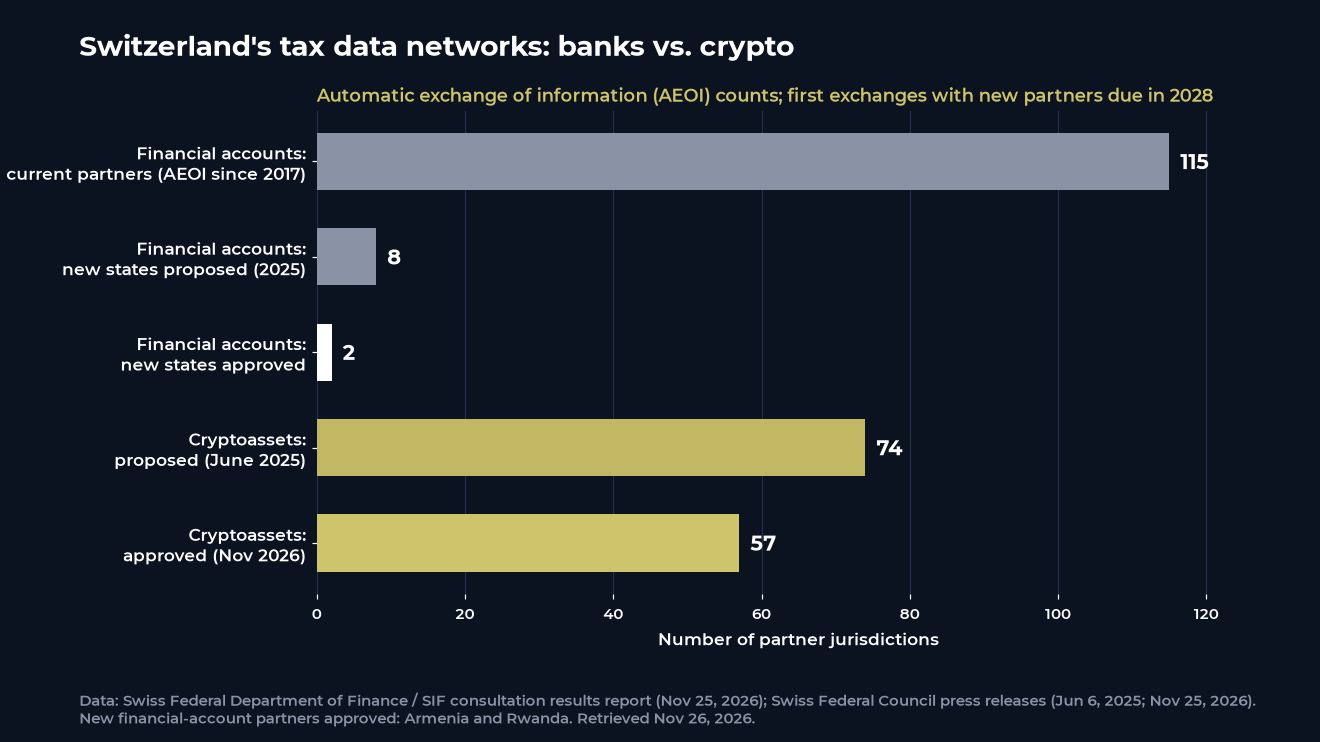
Switzerland is not new to this. It has exchanged financial account data under the OECD’s Common Reporting Standard since January 2017 and now does so with 115 partner states, according to a Federal Department of Finance report published alongside the decision.
That report also shows how selective Bern has become. Eight countries were put to consultation as new financial-account partners: Armenia, Cameroon, Mongolia, Papua New Guinea, Paraguay, Rwanda, Senegal and Tunisia.
Only Armenia and Rwanda were approved on Wednesday, with a first exchange due in 2028.
The report also notes a shift in who decides. Since January 1, 2026, the AEOI Act gives the Federal Council, not Parliament, the power to pick partner states.
What It Means for Bitcoin Holders in Switzerland
For investors, the practical takeaway is predictability.
Switzerland says it wants to implement CARF at the same time as other global wealth management centers. In our view, that lowers the risk of business moving abroad just to avoid the rules.
It also comes as Swiss crypto markets mature. As we reported, Switzerland’s first Bitcoin ETF opened on SIX with 350 BTC a day after this decision.
We believe clear tax plumbing and regulated products go together. This decision gives Swiss firms dates and conditions instead of open questions.
Europe is moving the same way. Brussels is already pressing its own members on crypto tax reporting, as we covered when it escalated DAC8 cases against Spain and Czechia.
Can Clear Crypto Tax Reporting Rules Widen Bitcoin’s Investor Base?
We think the answer leans yes, with caveats.
Reporting rules add paperwork, and some users will dislike them. But they also turn crypto into an asset class that banks, family offices and pension advisers can hold without legal guesswork.
Switzerland’s approach shows a careful hand. It cut the partner list, delayed the start, and kept a data-security test in place before a single file is sent.
Bitcoin’s fixed 21 million supply and open network do not change under any tax regime. What changes is how easily large, rules-bound investors can step in.
The next markers to watch are the full partner list, the Federal Tax Administration’s CARF guidance and the date Switzerland activates its first exchange.
The coming months will show whether Switzerland crypto tax clarity draws more regulated capital into Bitcoin, and we believe the groundwork now in place gives it a fair chance.
DC Forecasts is a leader in many crypto news categories, striving for the highest journalistic standards and abiding by a strict set of editorial policies. If you are interested to offer your expertise or contribute to our news website, feel free to contact us at [email protected]











Discussion about this post