



The Argentina central bank can no longer print pesos to fund the government. On November 26, the Chamber of Deputies gave final approval to a rewrite of its charter, with 141 votes in favor, none against and 99 abstentions.
The law bans temporary advances to the Treasury and direct purchases of new government debt. It also gives the bank a single mission: to preserve the value of the peso.
The vote ended a reform that started in Congress months earlier. It now needs the president’s signature and publication in the Official Gazette before it takes effect.
For anyone who holds Bitcoin, this is a useful test case. A country that has lived with chronic inflation is trying to write monetary discipline into law.
The bigger question is whether a rule that a legislature writes can hold as firmly as a rule written into code.
What the Argentina Central Bank Law Changes
The Senate approved the bill on September 24 by 46 votes to 22, according to the Argentine Senate. It amended the text, which sent the bill back to the lower house.
In the Senate’s summary, the reform limits the bank’s main mission to preserving the value of the currency. It bars the bank from buying national government securities in the primary market. It also removes the option to advance funds to cover public debt payments for the government.
The Office of the President listed the rest of the package on November 26. The Economy Minister will no longer sit in on board meetings. Only “realized and liquid” profits can be transferred to the Treasury, and the regime of freely available reserves is repealed.
During the Senate debate, PRO senator Martín Goerling Lara called the reform “the end of the Central Bank as the State’s ATM.” UCR senator Eduardo Vischi said Argentina had used the bank “like a photocopier.”

The opposition was not convinced. Senator Jorge Capitanich called the changes “insufficient and incongruent.”
Treasury Advances Stopped in 2023. Now They Are Banned
The bank’s own statistics show how much the old tool was used. Net money created through temporary advances to the Treasury reached 1,298 billion pesos in 2023, up from 350 billion in 2019.
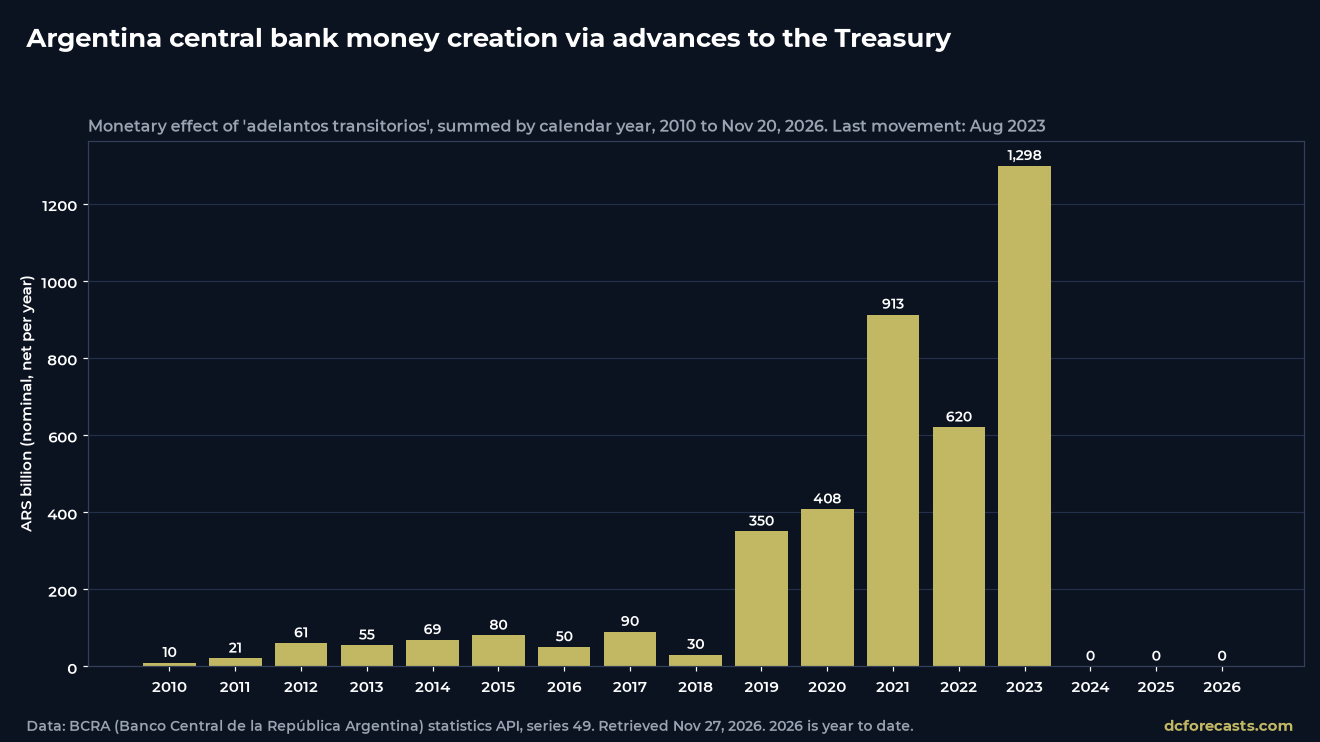
The series last moved in August 2023, when 500 billion pesos were repaid. It has stayed at zero for every day of 2024, 2025 and 2026 through November 20.
So the new law locks in a practice that was already in place. We believe that matters, because a habit can be dropped quietly, while a ban takes another vote in Congress to undo.
The same data show that profit transfers did not stop. The bank sent the Treasury 11.98 trillion pesos on April 25, 2025, and 24.4 trillion pesos on May 21, 2026.
Under the new charter, transfers like these can only come from profits that are realized and liquid. During the debate, Senator Agustín Monteverde argued that part of the bank’s past profits came from the peso’s devaluation.
Inflation Fell From 289% but Has Stalled Near 33%
The reform comes after a dramatic drop in Argentina inflation. Consumer prices rose 289.4% year over year in April 2024, according to INDEC data published by the central bank.
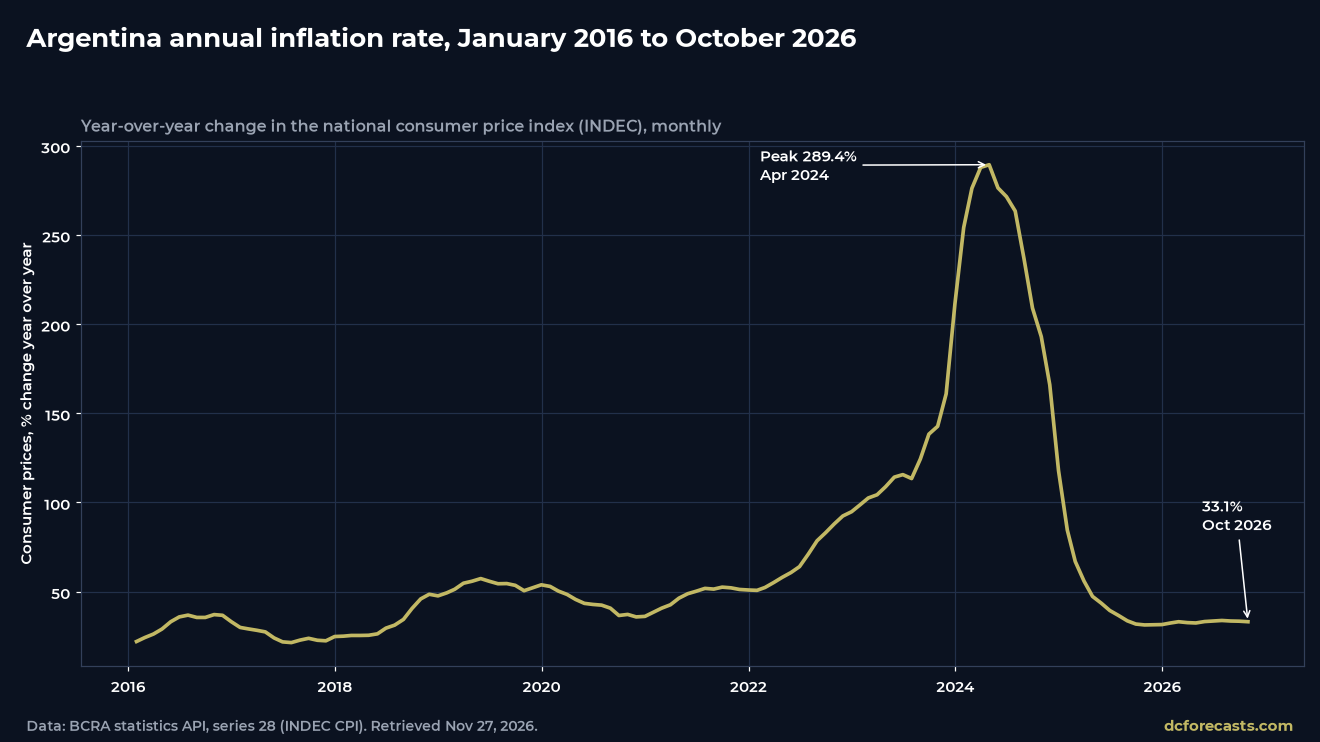
By October 2026, the annual rate was 33.1%, and monthly inflation was 2.2%.
The data also show a stall. Annual inflation has stayed between 31.3% and 33.8% every month since August 2025.
That is still painful for anyone who saves in pesos. The wholesale reference rate was 1,600.69 pesos per dollar on November 26, and gross international reserves stood at $48.8 billion on November 24.
For us, the lesson is simple. Cutting off central bank financing was the first step, and bringing inflation down to low single digits will take longer.
Who Can Remove the Bank’s Board Now?
The fight over this bill was mostly about job security for the bank’s leaders.
The government wanted removals to need a two-thirds vote in both chambers. The Senate changed that. Under its text, the president, vice president and directors get six-year terms and Senate consent by an absolute majority of its members.
Removal also needs prior Senate approval by an absolute majority, and only on grounds the law lists. In a 72-seat chamber, that means 37 votes.
The Senate approved its changes by a two-thirds vote. Deputies could only have restored the original version with a two-thirds vote of their own, so the Senate text stands.
The Presidency called the result an end to “91 years” of plunder and institutional decline. The BCRA says it will update its published charter once the law is promulgated.
Why Bitcoin Holders Should Watch Buenos Aires
We see a clear parallel here. Argentina is trying to protect its currency by limiting what officials are allowed to do.
The Presidency’s statement is frank about how fragile such limits are. It says a 2012 charter expanded the bank’s power to finance the Treasury, 20 years after the 1992 law first set its mission.
Bitcoin works the other way round. Its issuance schedule and 21 million cap are enforced by software running on thousands of nodes, and no Senate vote can raise them.
As we noted when Bitcoin’s value slipped to 5.11% of the M2 money supply, fiat money supply keeps growing even in disciplined economies. Bitcoin’s supply cannot.
We believe Argentina’s reform is a real step toward sound money, and it deserves credit. It also shows why many savers want an asset whose rules do not depend on the next election.
The next milestones are the law’s publication and the November inflation reading. If the bank’s independence holds and inflation starts falling again, Argentina will have shown that monetary rules can work. Bitcoin will keep offering that kind of rule without needing anyone’s permission.
DC Forecasts is a leader in many crypto news categories, striving for the highest journalistic standards and abiding by a strict set of editorial policies. If you are interested to offer your expertise or contribute to our news website, feel free to contact us at [email protected]












Discussion about this post