



A Bitcoin Core wallet can be tied to the internet address of the node running it for about 19 cents, according to research a Bitcoin Core contributor published on November 25.
Abubakar Sadiq Ismail laid out the technique on Delving Bitcoin, the developer forum where Bitcoin’s protocol work is debated in the open.
In his lab, the method found the right node 30 times out of 30.
No coins can be stolen this way. This is a privacy leak, not a theft vector, and it has not been measured on the live network.
The bigger question is how quickly Bitcoin Core closes a gap that was first reported back in 2014, and three open pull requests suggest that work is already under way.
How the Bitcoin Core Wallet Gives Itself Away
The leak comes from a helpful habit.
When a transaction sent or received by a Bitcoin Core wallet stays unconfirmed for roughly 12 to 36 hours, the wallet announces it to its peers again so it does not get lost.
Most payments confirm long before that, so the behavior rarely matters in daily use.
Ismail’s point is that an attacker can trigger it on purpose.

The attacker sends a tiny payment, paying the network’s 0.1 sat/vB minimum relay fee, to an address that has already been used. Because the fee is so low, the payment tends to sit in the mempool.
A day or so later, the only node that re-announces it is the one whose wallet tracks that address. A spy that connects to candidate nodes simply waits to see which one speaks up.
That gives an address-to-IP link, and an IP address can point to an internet provider, a city and sometimes a home.
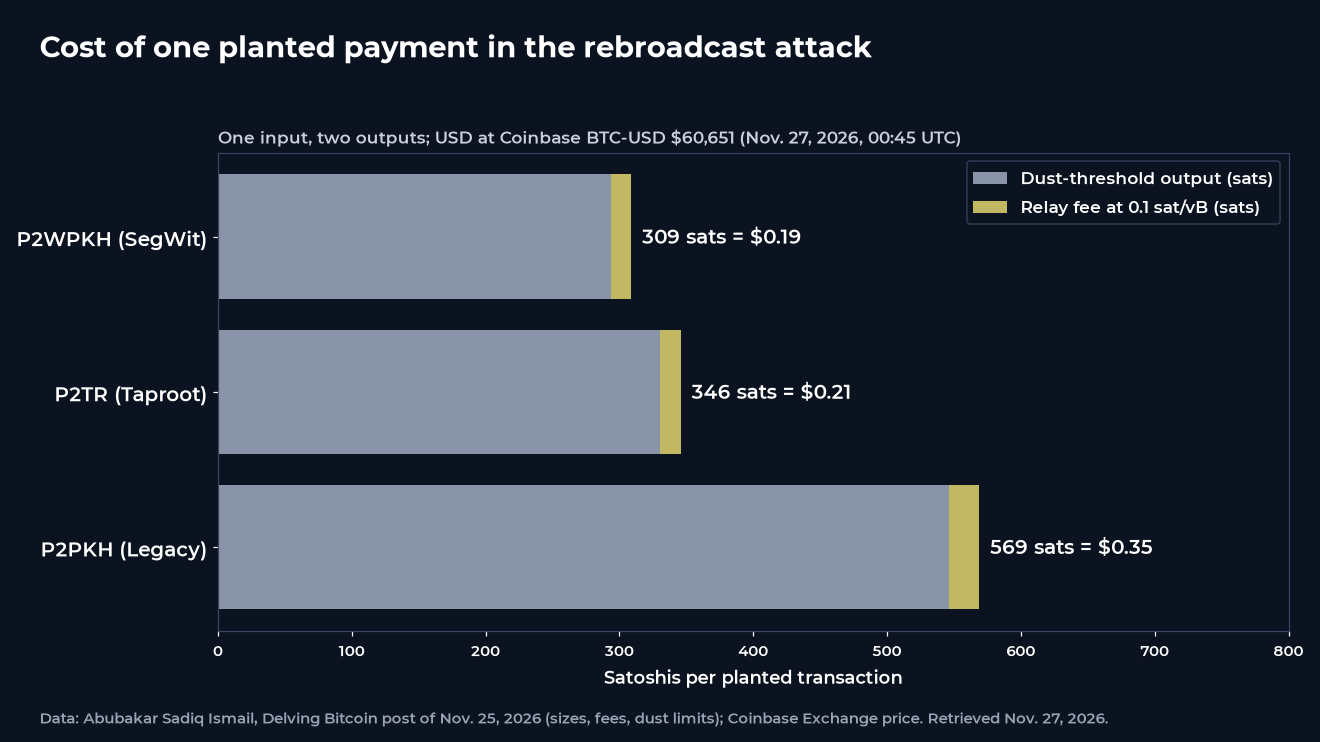
At Bitcoin’s current price near $60,650 on Coinbase, a planted payment costs about 309 sats ($0.19) to a SegWit address, 346 sats ($0.21) to a Taproot address and 569 sats ($0.35) to a legacy address.
Thirty Hits in Thirty Tries, With Caveats
Ismail tested the idea on regtest, a private test network built from stock Dockerized Bitcoin Core nodes.
A hub node planted one low-fee payment into each of five target wallets, over six trials. A fresh spy linked the address to the correct node in all 30 attributions.
Watch-only wallets behave the same way, he wrote, so the attack identifies the node that tracks an address. That may not be the person who controls the coins.
The live network has not been measured. The attacker also needs infrastructure to connect to each reachable node, and nodes that do not accept inbound connections can only be observed if they happen to dial out to the attacker.
A separate simulation found that the first node heard after the source was a direct neighbour about 90% of the time. Ismail stressed that this came from a synthetic model under favourable assumptions, not from real network data.
Why Tor Alone Does Not Close the Gap
Bitcoin’s node operators have leaned heavily into privacy networks.
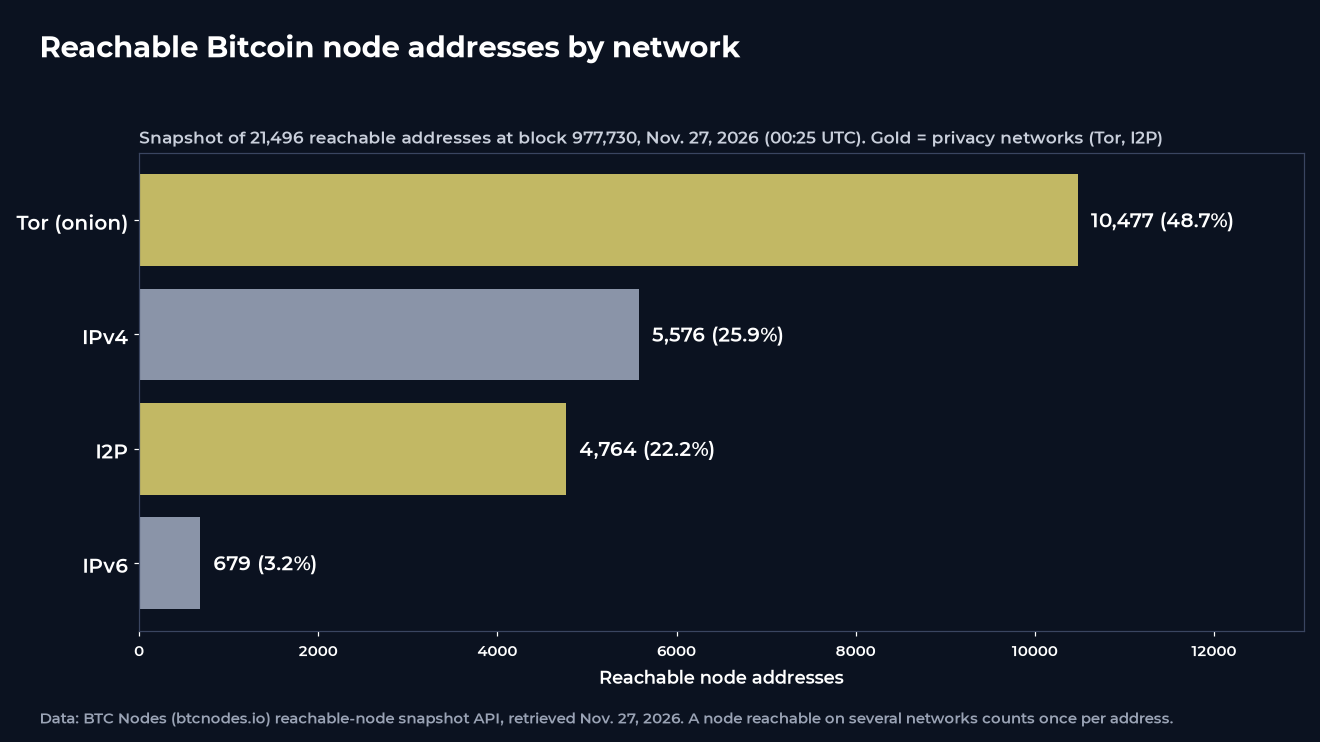
Of 21,496 reachable node addresses in the BTC Nodes snapshot taken early on November 27, 10,477 were Tor onion addresses and 4,764 were on I2P. Together that is about 71%.
That is a healthy sign, but Ismail found a catch.
The rebroadcast goes to every peer with no network filter. A node that uses Tor or I2P but also keeps ordinary clearnet peers will re-announce the planted payment over clearnet as well, exposing its real IP.
Only a node limited to privacy networks, for example with -onlynet=onion, avoids that. Even then, the address can still be linked to the node’s onion identity.
The exposure also reaches software built on Core’s wallet. Ismail lists Sparrow in its Bitcoin Core mode, Specter Desktop, Liana with a bitcoind backend, JoinMarket and Jam, Electrum Personal Server and Eclair among potentially affected tools.
As we noted when an AI-flagged Bitcoin Core vulnerability was patched this month, many node runners are slow to upgrade, so any fix will take time to spread.
Three Pull Requests and a 12-Year-Old Issue
The underlying leak is not new.
GitHub issue #3828, titled “Clients leak IPs if they are recipients of a transaction,” was opened in March 2014 and is still open.
What has changed is the pace of work. Core maintainer Ava Chow opened pull request #36482 on October 8. It would only rebroadcast transactions that were newly added to the mempool, which removes the signal from a planted payment that just sits there.
Fellow contributor Martin Zumsande pushed back on the forum. He wrote that #36482 “only raises the cost of the active attack slightly, it doesn’t prevent it,” and described a replace-by-fee variant that still works.
His preferred path pairs his own #36398, which limits rebroadcasting to transactions that originate from the wallet, with Chow’s #36481, which lets users rebroadcast a transaction manually.
Ismail replied that he would go further and make rebroadcasting opt-in by default.
All three pull requests remain open and unmerged.
What Node Runners Can Do Now
For anyone running a Bitcoin node with a wallet loaded, the options are concrete.
- Setting -walletbroadcast=0 kills the rebroadcast signal, but the wallet then stops broadcasting your own sends too, so you push them with sendrawtransaction.
- Running with -onlynet=onion or -onlynet=i2p stops clearnet IP exposure, even if rebroadcast stays on.
We believe the bigger story is how this was handled.
A contributor found the weakness, published the method, the code and the limits of his own results, and other developers challenged the proposed fix within hours. That is the open review process that keeps Bitcoin’s full node software trustworthy.
Bitcoin privacy has never been automatic, and this research makes the trade-offs clearer for every node operator.
The coming weeks will show which of the three approaches Bitcoin Core adopts, and how quickly wallets built on it follow.
DC Forecasts is a leader in many crypto news categories, striving for the highest journalistic standards and abiding by a strict set of editorial policies. If you are interested to offer your expertise or contribute to our news website, feel free to contact us at [email protected]












Discussion about this post