



Crypto payments are a bigger habit in Europe than most merchants realise: one in three euro area crypto owners now says they hold their coins at least partly to pay with them.
That finding sits inside the European Central Bank’s new Study on the payment attitudes of consumers in the euro area (SPACE), published on November 25.
The same survey of 51,551 people delivered a historic headline. For the first time since comparable data began in 2016, cards beat cash at the checkout, taking 45% of point-of-sale transactions against 44% for cash.
For Bitcoin investors, the most interesting detail is the gap between demand and acceptance. Crypto ownership is rising, yet the ECB says only 0.2% of companies report accepting crypto as payment.
The bigger question now is who closes that gap first.
Cards Finally Pass Cash in Euro Area Shops
The ECB collected the data in two rounds, from September 29 to November 27, 2025, and from March 16 to May 15, 2026.
The long-run shift is striking. Cash handled 79% of shop transactions in 2016, 72% in 2019, 59% in 2022 and 52% in 2024. In 2026 it fell to 44%.
Cards climbed the other way, from 19% in 2016 to 45%. Mobile payments rose to 9%, from 6% two years earlier.
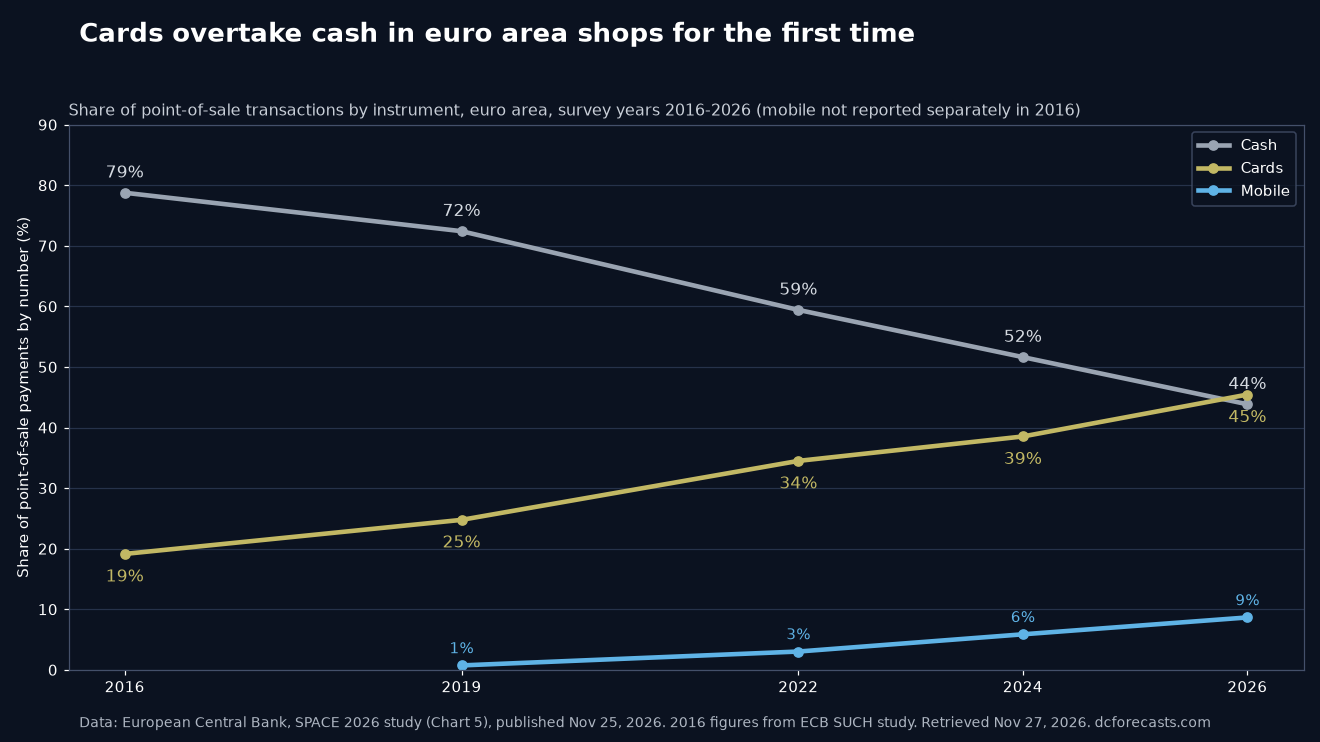
By value, the lead is wider. Cards carried 51% of the money spent in shops in 2026, against 37% for cash.

Across all payment types, including online and person-to-person, cards were used in 43% of transactions, up from 39% in 2024. Cash slipped to 35% from 40%.
Cards are also being used for ever smaller sums. The average card payment fell from €59 in 2019 to €35 in 2026, though cash still dominates purchases under €20.
How Common Are Crypto Payments in the Euro Area?
The SPACE report asked respondents whether they own crypto-assets, including stablecoins. In 2026, 9.9% said yes, up from 8.8% in 2024.
Slovenia leads at 17.1%, followed by Austria at 15.2%, Lithuania at 14.7% and Luxembourg at 14.6%. Germany has the lowest share at 6.2%.
Owners were then asked why they hold. Most, 65.7%, said investment only. But 15.2% said payments only, and another 17.9% said both.
That adds up to roughly 33% of euro area crypto owners who intend to spend at least some of what they hold.
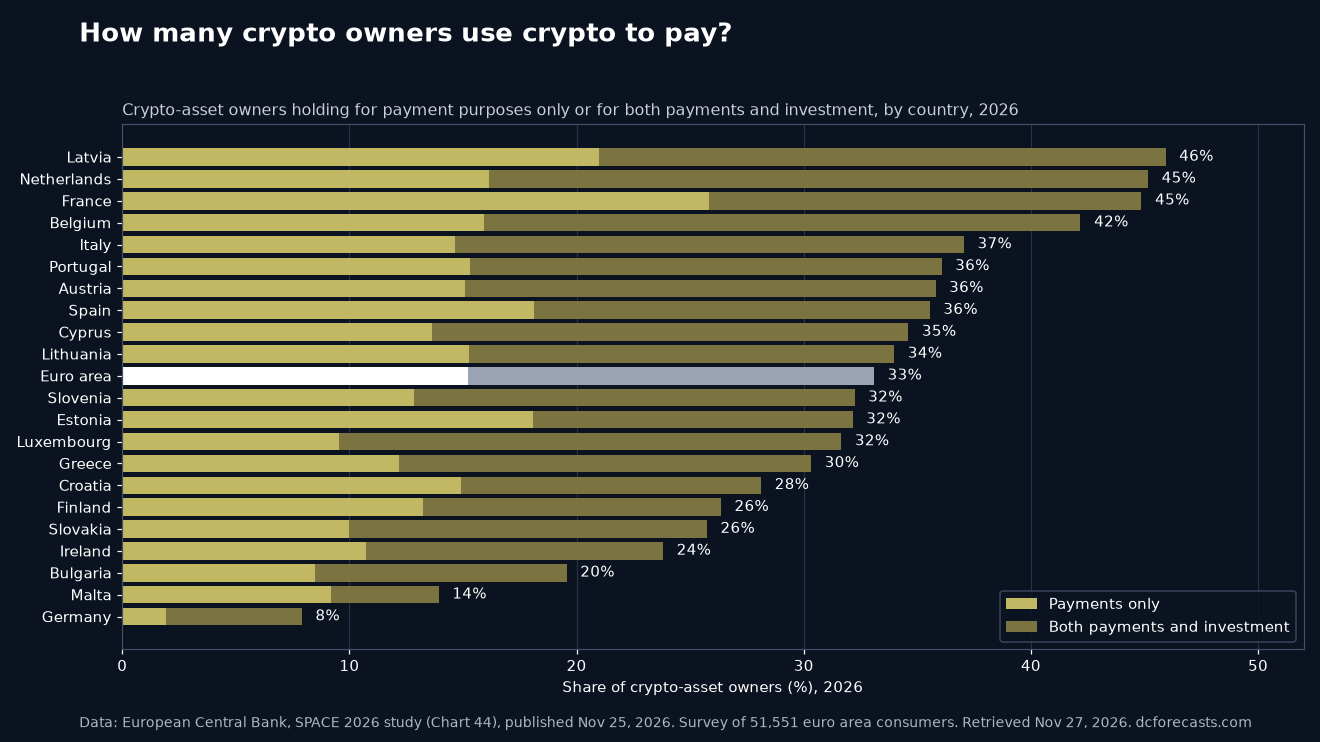
The national spread is wide. In Latvia, 46% of owners use crypto for payments in some form, and in France and the Netherlands the figure is 45%. French owners stand out, with 25.8% holding for payments alone.
Germany sits at the other end. Just 8% of German owners use crypto to pay, and 89.5% hold it purely as an investment.
We believe the ECB’s own summary, that owners show “a clear preference” for investment, is fair. Still, a third of holders is not a rounding error.
The 0.2% Acceptance Problem
Here is the tension. In a footnote, the report cites the ECB’s 2026 study on companies’ use of cash: crypto-assets were reported as an accepted payment instrument by only 0.2% of companies.
So the demand side is ahead of the supply side. Roughly one in ten adults owns crypto, a third of them want to spend it, yet almost no merchants say they take it directly.
We see that as an opportunity, not a verdict. Payment habits in this survey change slowly and then suddenly, as the card-versus-cash chart shows.
Our coverage of Block’s first look at Bitcoin payments on Square pointed the same way. Once acceptance is built into existing checkout hardware, small everyday purchases follow.
The ECB data also adds some useful context on risk. In the survey’s breakdown of instruments used in fraudulent payments, crypto-assets and stablecoins accounted for 4.7%. Credit transfers made up 35.7% and physical cards 34.8%.
Choice, the Digital Euro and Bitcoin
The ECB is clear about how it reads the results. “Digital means of payment are becoming more important in day-to-day transactions, but choice is what really matters for Europeans,” said Piero Cipollone, a member of the ECB’s Executive Board.
He added that the ECB will keep “safeguarding cash while preparing for the possible issuance of its digital equivalent, the digital euro.”
The survey backs the choice argument. For 82% of consumers, it is important to be able to pay digitally, while 62% value the option of paying with cash. Only 3% say they never use cash.
When people tried a new payment method, 47.3% said it was because it was easy to use. Low cost was cited by 22.3%, and privacy by 17.6%.
Those are exactly the qualities Bitcoin’s builders compete on, from Lightning’s low fees to self-custody. As we covered when the ECB found euro area crypto holders pick Bitcoin first, Bitcoin is already the default asset for most of these households.
What Would Move Crypto Payments From Niche to Normal?
Separating evidence from interpretation matters here. The evidence is simple: cash is fading, cards and phones are winning, crypto ownership edged up one point, and a third of owners want to pay with it.
Our interpretation is that the missing piece is merchant plumbing, not consumer interest.
We would watch three things in the next SPACE round. First, whether ownership keeps climbing past 10%. Second, whether the payments share among owners holds near a third. Third, whether company acceptance moves off 0.2%.
Europe has already shown it can rewire checkout habits within a decade. With Bitcoin’s fixed supply, growing regulated infrastructure under MiCA and a user base that already wants to spend, we believe crypto payments have more room to grow than the current acceptance figure suggests.
The next survey will show whether merchants start to catch up.
DC Forecasts is a leader in many crypto news categories, striving for the highest journalistic standards and abiding by a strict set of editorial policies. If you are interested to offer your expertise or contribute to our news website, feel free to contact us at [email protected]












Discussion about this post