



Bitcoin payments at U.S. Square sellers look a lot like a morning coffee run, according to Block’s first State of Bitcoin Payments report.
The median bitcoin payment was about $13 and the average about $29, Block said when it released the study on Nov. 19.
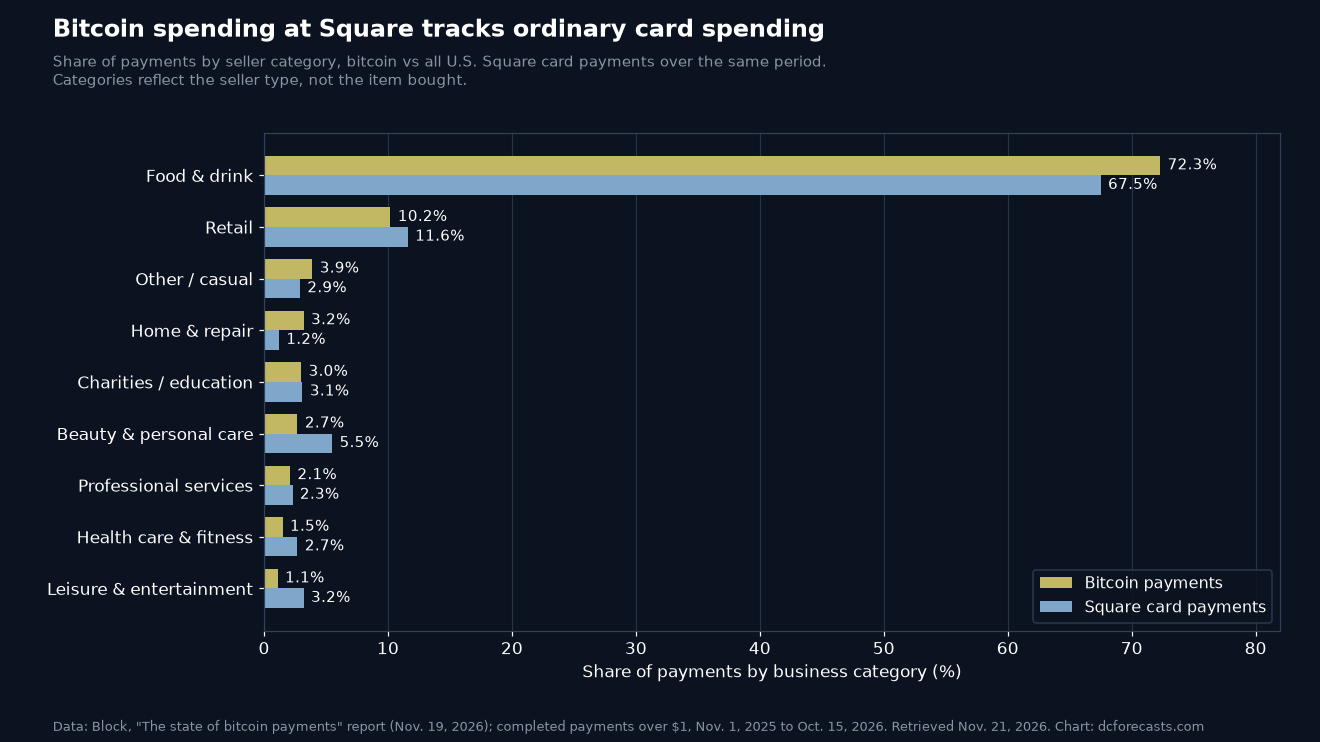
Food and drink businesses took 72.3% of the payments, and coffee shops and fast-food outlets alone made up 62.6% of that category, with a $9.10 median ticket.
For Bitcoin holders, the more interesting point is not the size of these purchases but their rhythm: people come back, often within days.
The bigger question is whether tax rules written for investors will let that habit grow.
What Block Measured, and What It Kept Private
The study covers completed bitcoin payments at U.S. Square sellers from Nov. 1, 2025 through Oct. 15, 2026.
Block removed known test payments, its own sellers and every payment of $1 or less to keep merchants trying out the feature from skewing the figures.
It did not disclose the total number of bitcoin payments, how many sellers received them or the gross dollar volume. Block calls those proprietary business metrics.
That matters for reading the report honestly. It shows the shape of bitcoin spending on Square, not its scale, and the company itself describes activity as modest and early.

Still, shape is what has been missing. As we covered when Square switched on bitcoin at checkout for eligible U.S. sellers, the debate over spending BTC has long run on anecdotes rather than receipts.
Small Tickets Dominate Bitcoin Payments
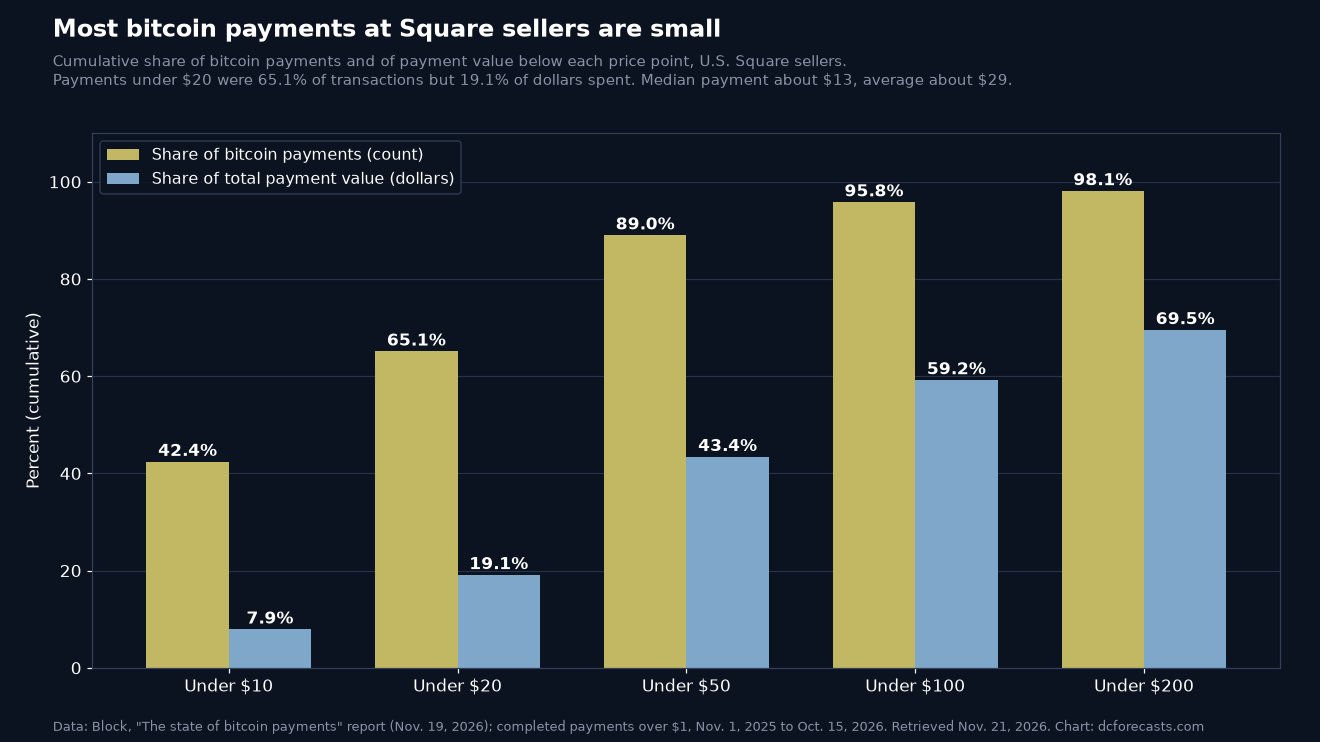
About 42.4% of payments were under $10, and 65.1% were under $20.
Those small purchases carried far less weight in dollars. Payments under $20 made up only 19.1% of total payment value, while 89% of payments fell below $50 yet accounted for 43.4% of the value.
The larger tickets came from services. Home and repair businesses averaged about $104 per bitcoin payment and professional services about $97.
Together those two groups were just 5.3% of payments but 18.1% of payment value.
Retail was a distant second by count at about 10% of payments, with a $21 median and a $44 average. Beauty and personal care had the highest median of any category at $43.75.
We believe that spread is healthy. A payment rail that handles a $9 latte and a $100 repair bill is behaving like money, not like a novelty.
Why Bitcoin Spending Looks Like Card Spending
Block compared bitcoin payments with all U.S. Square card payments over the same period, covering every card brand in person and online.
The category mix was strikingly close. Food and drink took 72.3% of bitcoin payments against 67.5% of card payments, and retail 10.2% against 11.6%.
Within food and drink, restaurants were second by count at 21.8% of payments but 32.2% of value, with a $20.48 median. Grocery stores posted the highest average in the category at $60.73.
Repeat behavior is the strongest signal in the report. Among Cash App customers with at least two bitcoin payments at the same merchant, the median gap between purchases was three days.
About 15.8% of those repeat intervals fell on the same day and 44.3% within one to seven days. Nearly 86% came within 30 days.
“Much of the hesitation around bitcoin comes from not seeing it used in real life,” Miles Suter, Bitcoin lead at Block, said in the company’s release.
Lightning Wallets Beyond Cash App Did Most of the Paying
Cash App wallets accounted for about 43.4% of bitcoin payments to Square sellers and 34% of the value.
External Lightning-enabled wallets, which Block lists as including Strike, Wallet of Satoshi, Phoenix and Coinbase, made up the remaining 56.6% of payments and 66% of value.
That is an important detail for anyone who sees bitcoin payments as a walled-garden promotion. Most of the spending arrived from apps Block does not run, over an open network, much like the machine-to-machine use cases we looked at in our piece on Lightning Labs billing AI by the token.
Merchants can also choose how much of each sale to keep in bitcoin, with Square converting the rest to dollars. Block says zero-fee bitcoin processing on Square now runs through Dec. 31, 2027.
Can a De Minimis Exemption Unlock Everyday Bitcoin Payments?
The friction Block highlights is tax. Under current federal rules, spending a digital asset is a disposal, so even a $13 purchase can mean working out a capital gain or loss.
The IRS digital asset FAQ tells taxpayers to keep records of when they acquired and disposed of digital assets, along with the dollar values involved.
A Morning Consult survey of 8,669 bitcoin-aware U.S. adults, commissioned by Block and run Aug. 13-21, found 23.6% of businesses that do not accept bitcoin, or are unsure whether they do, cite tax and accounting complexity.
Among people who do not own bitcoin, 29.6% said they would be more likely to pay with it if it were easier, and 15.7% of that group were unsure how it is taxed or regulated.
Block argues the data supports a de minimis exemption for small gains on everyday purchases, an idea Congress is weighing as it debates crypto tax rules.
The report also lands during a rough market, with BTC near $58,900 on Coinbase late Friday U.S. time after a sharp selloff. We think that timing makes the findings more telling: these payments reflect habits, not a price boom.
Fixed supply gives bitcoin its long-term savings case, and a merchant network that already handles coffee, groceries and repairs gives it a second, very practical one. If lawmakers remove the tax hassle on small purchases, the next edition of this report could show not just the shape of bitcoin spending but real scale.
DC Forecasts is a leader in many crypto news categories, striving for the highest journalistic standards and abiding by a strict set of editorial policies. If you are interested to offer your expertise or contribute to our news website, feel free to contact us at [email protected]












Discussion about this post