



The next ECB president will be a central banker who wrote the global bank capital rules for Bitcoin and who told Jackson Hole in August that tokenized deposits, not stablecoins, should carry Europe’s digital payments.
On November 26, the European Council put forward Pablo Hernández de Cos to succeed Christine Lagarde, who leaves office on February 7, 2027.
The job carries an eight-year, non-renewable mandate. Once confirmed, he would be the first Spaniard to run the euro’s central bank.
For Bitcoin holders, the bigger question is how Europe will build its own digital money while Bitcoin keeps growing outside it.
Who Is the Next ECB President?
Hernández de Cos is a career central banker. He served as governor of the Banco de España from 2018 to 2024, which gave him six years on the ECB Governing Council.
He chaired the Basel Committee on Banking Supervision from March 2019 until June 2024, and since 2025 he has led the Bank for International Settlements as General Manager.
The European Council announcement also named Laurence Boone and Markus Brunnermeier for the Executive Board, replacing Isabel Schnabel, who steps down on January 3, 2027, and Philip Lane, whose term ends on May 31, 2027.
The nomination is not final yet. The European Council must first consult the European Parliament and the ECB Governing Council before taking a formal decision.
Tokenized Deposits First, Stablecoins Second
His clearest statement on digital money came on August 28, 2026, when he opened a Jackson Hole panel titled “Pushing the monetary frontier: stablecoins and tokenised deposits.”

He argued that stablecoins “do not yet uphold the foundational properties of money” in their current form, citing par redemption, fragmentation across blockchains and anti-money-laundering gaps.
Tokenized deposits, he said, “should carry the bulk of day-to-day payments and wholesale settlement,” with settlement in central bank money. Stablecoins “may serve specialised roles,” for example in decentralized lending pools.
He closed with a line that may well define his Frankfurt agenda: “Tokenisation offers real gains: programmability, atomic settlement and around-the-clock operations. But the path to the future monetary system lies in improving the old while enabling the new.”
That approach fits work already under way. As we reported when the ECB opened a test bed for tokenized deposits, Frankfurt wants banks, not private token issuers, at the center of on-chain euros.
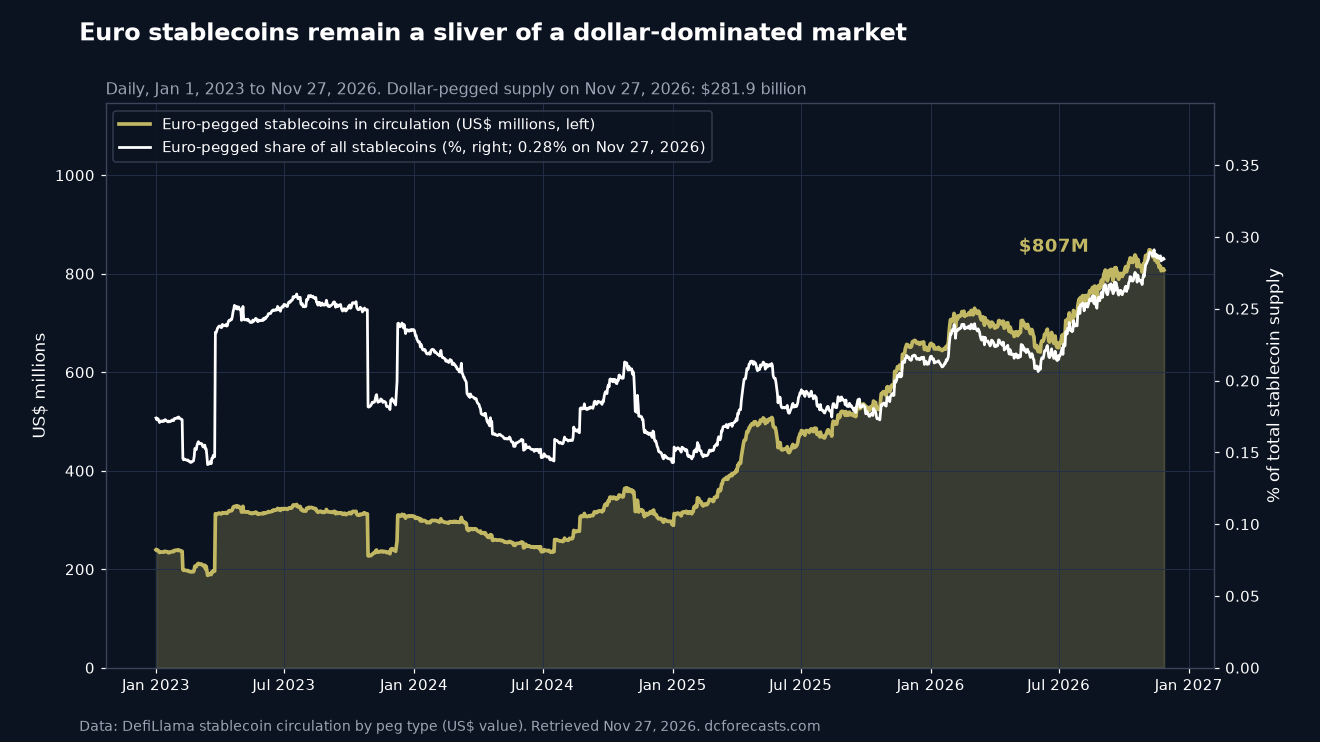
The data shows why the euro debate differs from the dollar one. Euro-pegged stablecoins total about $807 million, according to DefiLlama, just 0.28% of a market where dollar-pegged tokens hold $281.9 billion.
Euro tokens grew about 24% over the past year while dollar supply slipped roughly 6%, yet the gap remains enormous.
The Digital Euro Clock Keeps Running
His term would cover the most important stretch of the digital euro project. According to the ECB’s digital euro pilot page, a 12-month pilot with 36 payment service providers is planned from the second half of 2027.
The ECB aims to be ready for a potential first issuance in 2029, assuming EU lawmakers adopt the digital euro Regulation by the end of 2026. The Governing Council will only decide on issuance after that law passes.
We believe that timeline is constructive for Bitcoin. Every debate about privacy, holding limits and bank deposits reminds savers that Bitcoin is already a bearer asset with a fixed supply and no issuer.
The Basel Rule Behind Bitcoin’s Bank Problem
The less-discussed part of his record sits in Basel. In December 2022, while he chaired the committee, its oversight body endorsed the global prudential standard for banks’ crypto exposures, for implementation from January 1, 2025.
Under that standard, unbacked assets such as Bitcoin generally land in Group 2, where the toughest bucket carries a 1,250% risk weight. With an 8% minimum capital ratio, that works out to roughly one euro of capital for every euro of Bitcoin held.
That is why so few banks hold Bitcoin directly today. But the picture is moving.
The Basel Committee, now chaired by Sweden’s Erik Thedéen, has expedited a targeted review of the crypto standard. On October 1 it said it expected to give an update by the end of the year, and on November 18 it said the review is continuing.
For us, that review is the real event to watch this winter. A softer bank capital treatment could open the door to direct Bitcoin custody and lending at regulated banks, whoever runs the ECB.
Bitcoin Has Outpaced Euro Inflation Since 2019
Lagarde’s term offers a useful scorecard. Bitcoin closed October 31, 2019 at €8,212 on Bitstamp, the day before she took office. It closed November 26, 2026 at €55,154, a gain of about 572%.
Over the same stretch, Eurostat’s harmonised consumer price index for the euro area rose about 28% from October 2019 to October 2026.
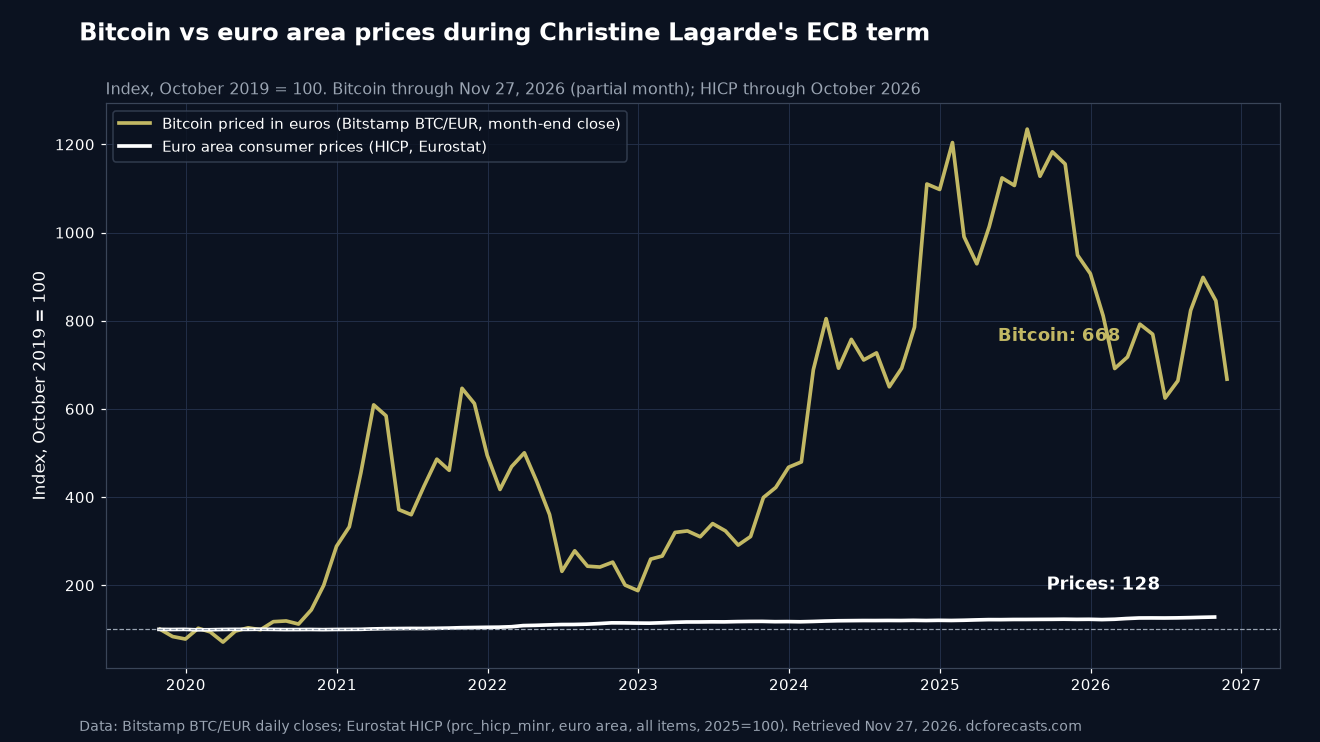
The ride has not been smooth. Bitcoin’s euro price sits roughly 48% below its record close of €106,307 on October 6, 2025.
Yet the multi-year result is hard to ignore. We believe it shows why many European savers treat Bitcoin as a long-term hedge against a currency that lost more than a fifth of its purchasing power in seven years. Past performance, of course, guarantees nothing.
As we covered in the ECB’s latest payments study, one in three euro area crypto owners holds coins at least partly to pay with them, even though only 0.2% of companies accept crypto.
The next ECB president will shape how Europe digitizes the euro. He will not shape Bitcoin’s 21 million coin limit.
Two signals are worth watching in the coming weeks: the European Parliament’s view on his nomination and the Basel Committee’s year-end crypto update. If Basel eases the bank capital burden, Europe’s banks may find Bitcoin far easier to hold, no matter which model of digital money Frankfurt prefers.
DC Forecasts is a leader in many crypto news categories, striving for the highest journalistic standards and abiding by a strict set of editorial policies. If you are interested to offer your expertise or contribute to our news website, feel free to contact us at [email protected]












Discussion about this post