


Injective Labs wants the SEC’s new tokenized securities exemption to cover onchain order books, not just the liquidity pools it was written around.
In a 22-page comment letter dated November 23, the company behind the Injective blockchain asked the Commission to amend its September 17 order so that permissioned order books can trade tokenized U.S. stocks under the same temporary relief.
The letter landed one day before four Democratic senators asked SEC Chairman Paul Atkins to withdraw the order entirely.
For crypto investors, the more interesting detail is the trade-off on offer: more traditional market safeguards in exchange for a wider door.
The bigger question now is whether the SEC treats the exemption as a fixed experiment or one that can grow while it runs.
What the Tokenized Securities Order Allows Today
The SEC order, Release No. 34-106402, lets “Tokenized Securities Venues” operate without registering as exchanges.
There is a catch in the definition. A venue only qualifies if it brings buyers and sellers together through “AMM Liquidity Pool(s),” the automated market maker design that prices trades from pooled assets.
The relief also comes with hard limits. Tier 1 stocks are capped at 75 symbols and 0.25% of the underlying stock’s prior-month average daily volume, while Tier 2 stocks get 250 symbols and 2.5%.
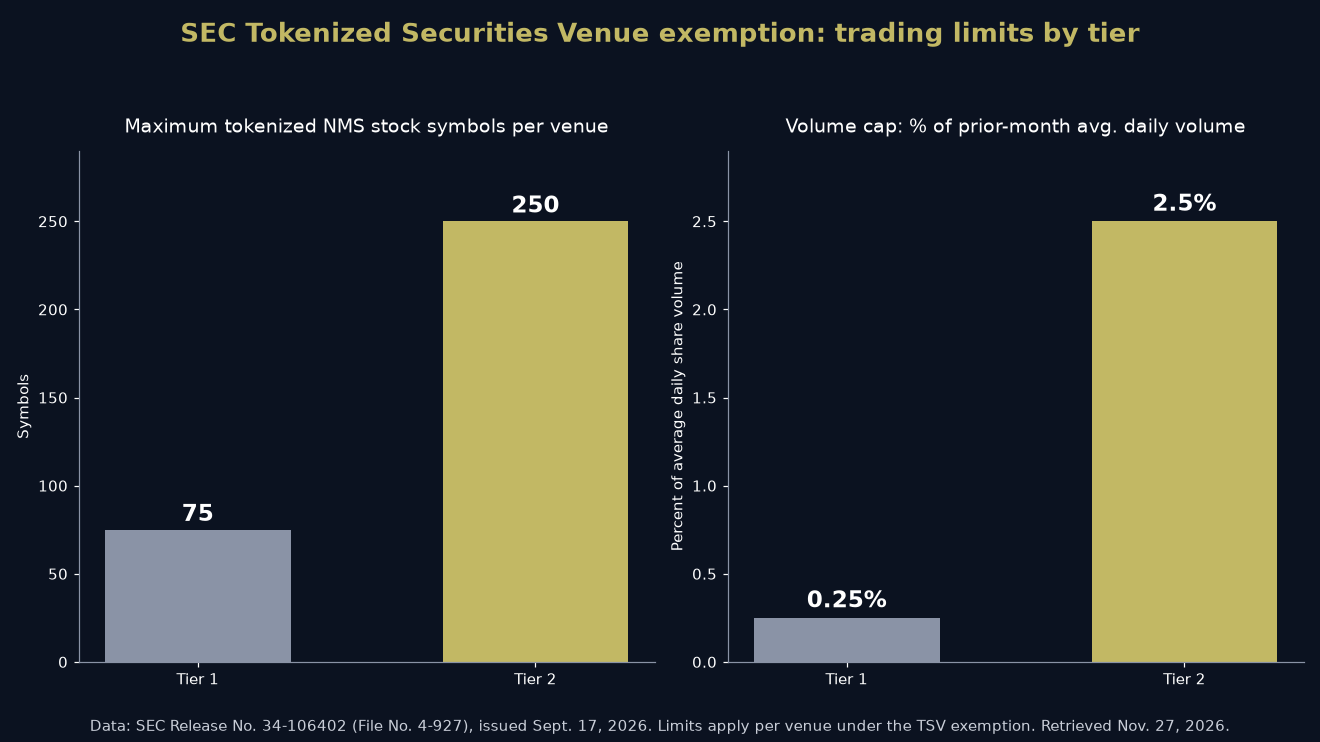
A venue that breaches a volume cap more than once must pause trading in that stock for three months.

Issuers also get a say. A venue listing a stock tokenized by an unaffiliated third party must notify the issuer and wait at least 30 calendar days before trading starts.
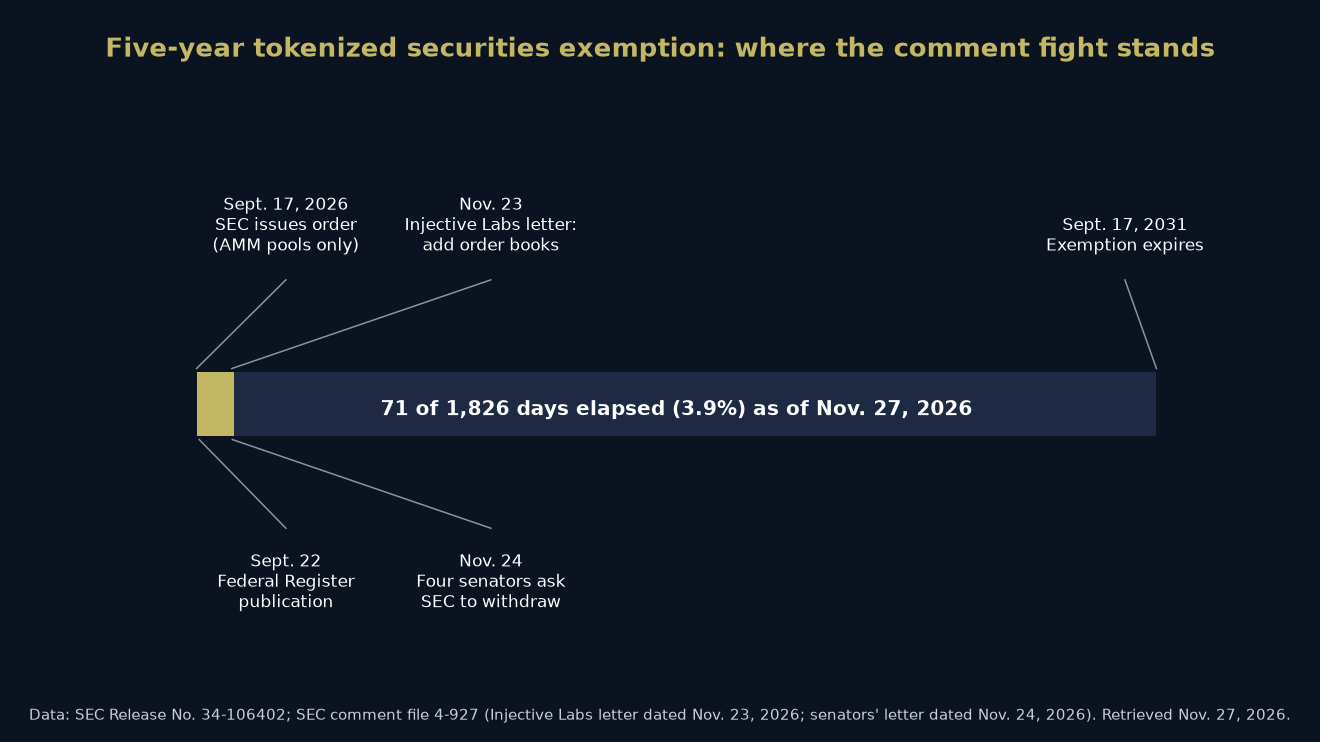
The exemptions run from September 17, 2026, until September 17, 2031. As we covered when tokenized securities trading on OKXICE started with six stocks, a venue is already live under this framework.
Why Injective Says Order Books Belong in the Exemption
Injective’s core argument is that the order’s own reasoning does not depend on how trades are matched.
The SEC justified the relief by pointing to benefits of distributed ledgers, and the Injective Labs letter lists them plainly: no intermediary holding participants’ assets, round-the-clock trading, settlement within seconds of execution and a record anyone can verify.
An order book, the company says, can deliver all four.
It also leans on Atkins’s own words. His September 17 statement said the Commission is “not cementing today’s technology as the standard for tomorrow.”
Injective proposes covering order books built either as smart contracts on a public blockchain or natively in a chain’s protocol, which is how its own exchange module works.
The company stresses it is not asking for individual relief or a ruling on its own status, and makes no claim that any current setup, including its own, meets the proposed conditions.
Five Safeguards Injective Puts on the Table
Instead of asking for a looser rulebook, Injective offers a stricter one for order book venues. Its five proposed conditions are:
- A defined surveillance program watching for spoofing, layering, wash trading and marking the close, with records available to SEC staff.
- Self-trade prevention inside the matching engine.
- Minimum price increments in line with Rule 612 of Regulation NMS.
- Price limits tied to the Limit Up-Limit Down bands of the underlying stock during regular trading hours.
- Trading halts and reopenings enforced at the protocol level, not only in a front-end app.
The halt point is the sharpest. A website can be switched off while the market stays reachable through other interfaces, so Injective says the control has to sit where every order passes.
It adds that a governance vote on each halt “would not be an adequate substitute” for authority that can act as soon as the underlying stock stops trading.
We believe that candor matters. A proposal that names its own weak spots is easier for regulators to test than a pitch that only lists benefits.
Senators Push the Other Way
The opposing view arrived the next day. Senators Chris Van Hollen, Elizabeth Warren, Tina Smith and Jack Reed wrote on November 24 that the order would let platforms run a “shadow stock market.”
Their letter objects that the exempt venues need not follow Regulation NMS, so they do not have to display best prices or report trades to the market in real time.
They also warn that pool-based pricing could drift away from prices elsewhere, and they urge Atkins to withdraw the order or replace it with full rulemaking.
Here is the contrast we find telling. Several of the senators’ concerns, such as displayed prices and price discovery, are exactly what Injective says an order book handles better than a pool.
Displayed bids and offers, set price increments and visible resting liquidity are the features the company highlights. Neither letter settles the debate, but they frame it clearly.
Can Tokenized Stocks Run on Crypto’s Clock?
Nothing changes yet. A comment letter is a request, and the SEC has not said whether it will amend the order.
The exemption is only 71 days into a 1,826-day run, so there is time for the Commission to adjust it if the data supports that.
Tokenized stocks are borrowing a schedule Bitcoin has kept since 2009: markets open every hour of every day, settled on a public ledger.
We see that as a quiet win for the idea Bitcoin proved first. Wall Street’s newest venues are being judged on whether they can match the transparency and always-on settlement that open blockchains already offer.
The coming months will show whether the SEC answers Injective by widening the door or keeps tokenized securities trading in pools while the senators press for a retreat.
DC Forecasts is a leader in many crypto news categories, striving for the highest journalistic standards and abiding by a strict set of editorial policies. If you are interested to offer your expertise or contribute to our news website, feel free to contact us at [email protected]












Discussion about this post