



The Liquid Network hackers moved their remaining 598.5 bitcoin on Saturday, and within four hours the first 10 BTC had landed in large coinjoin-style transactions.
The coins had sat at one address since early September, after a flaw in Liquid’s software let an attacker drain about 4,000 BTC from the sidechain’s reserve.
At a price of about $59,355, the stash is worth roughly $35.5 million. At the Sept. 6 price of about $79,822, the same coins were worth some $47.8 million.
For Bitcoin holders, the most telling detail is that every step of Saturday’s activity can be traced in public, block by block, by anyone running a node or a block explorer.
The bigger question now is whether the 578.5 BTC still parked at a single address follows the first 10 BTC into mixing.
How the Liquid Network Hack Coins Moved on Saturday
We traced the transfers ourselves on the Bitcoin blockchain using mempool.space data.
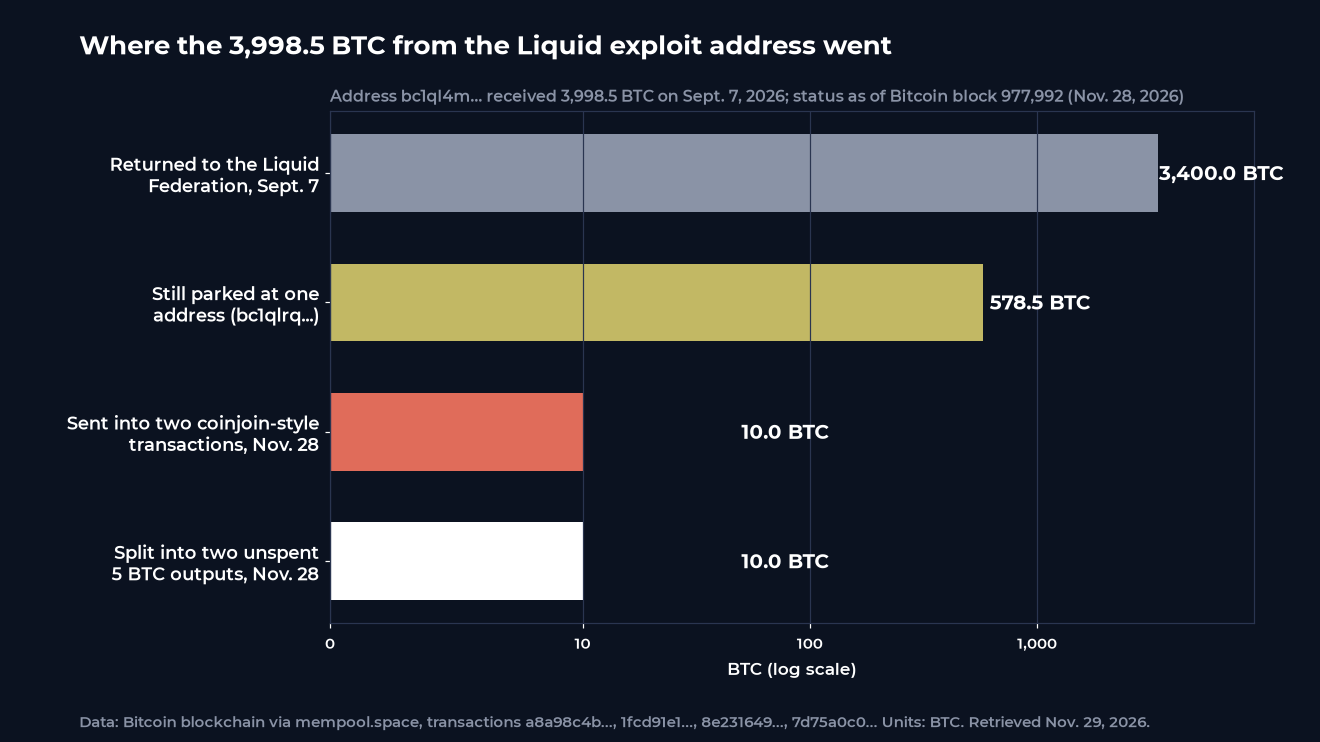
At 17:01 UTC on Nov. 28, in block 977,956, the address beginning bc1ql4m sent its entire 598.5 BTC balance in one transaction. It split the coins into 20 BTC and 578.5 BTC at two fresh addresses, for a fee of just 593 satoshis.
About 100 minutes later, in block 977,970, the 20 BTC was broken into four outputs of about 5 BTC each through three back-to-back transactions.
At 19:44 UTC, one of those 5 BTC pieces entered a transaction with 205 inputs and 339 outputs. At 20:35 UTC, a second 5 BTC piece entered another one with 225 inputs and 253 outputs.

Both transactions reuse the same standard output sizes again and again. One amount, 0.33554432 BTC, appears 24 times in a single transaction. That pattern is the hallmark of coinjoin software, which mixes many users’ coins so that outputs are hard to link back to inputs.
The other two 5 BTC outputs were still unspent as of block 977,992. So was the 578.5 BTC.
A Hack That Left Bitcoin Itself Untouched
Liquid is a sidechain built on Blockstream’s Elements software. A federation of members holds bitcoin in reserve and issues L-BTC, a token meant to be redeemable one for one.
According to SideSwap, the swap service whose peg-out was used, a flaw in Elements on Sept. 6 let a party create about 4,000 L-BTC from nothing and redeem it for real bitcoin.
The chain shows the exploit address holding 3,998.5 BTC on Sept. 7. That afternoon, 3,400 BTC went back to an address the attacker had named in an on-chain note that read: “sending most back to bc1qdlld6antmv… is that ok.”
The rest stayed behind. On Sept. 9, the attacker attached another note to a transaction, demanding that the operator “SHALL pay 10% using your own money as bug bounty or you will cause all your holders a 15% loss.”
Wallets, keys and balances were never involved, SideSwap said. The bug sat in sidechain software, not in Bitcoin’s consensus rules, and the Bitcoin network kept producing blocks as usual throughout.
We believe that distinction matters. The weak point was a bridge layered on top of Bitcoin, while the base chain did exactly what it was designed to do.
The Liquid Federation Rebuilt the Reserve Without the Coins
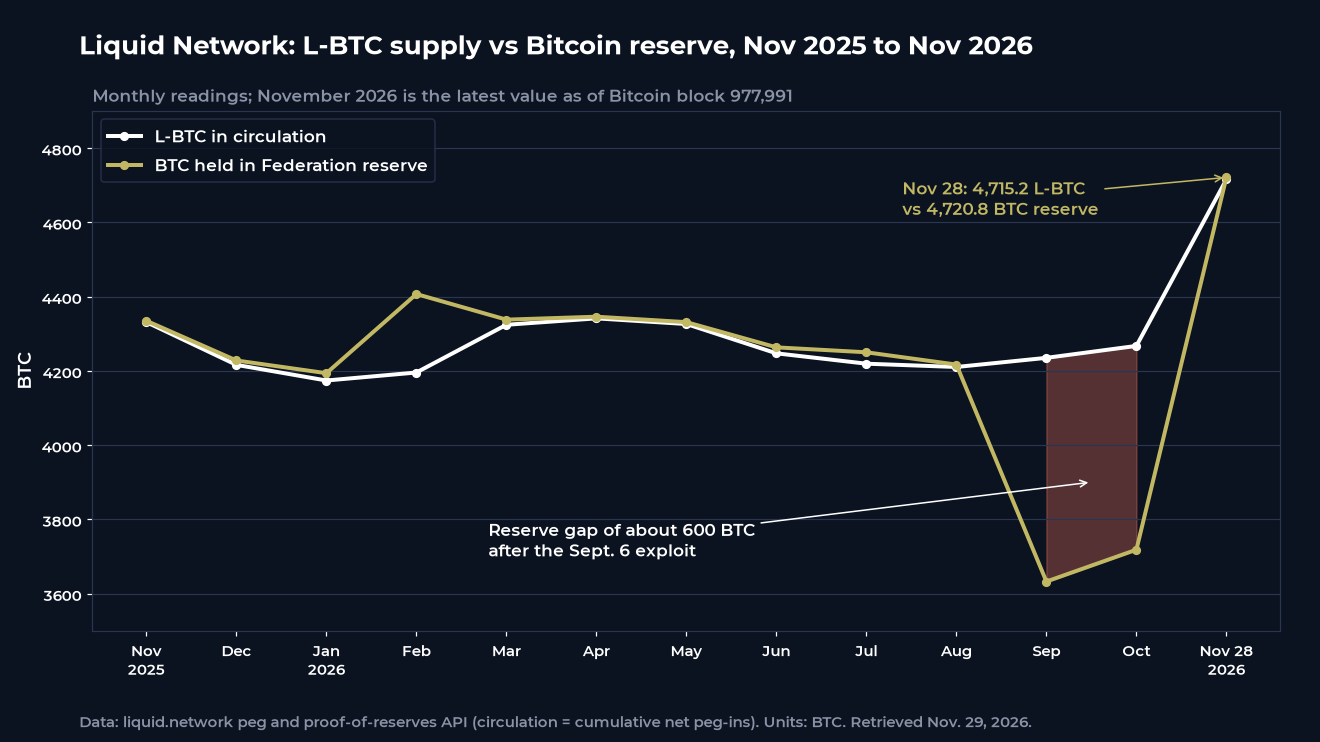
The remaining coins were never returned. SideSwap says Blockstream’s own assessment on Sept. 23 put the amount still outstanding at about 602 BTC.
On Sept. 10, Blockstream CEO Adam Back publicly committed to covering the L-BTC peg one to one, according to SideSwap. The reserve was then topped up in public steps: 2.5 BTC on Oct. 27, 50 BTC on Oct. 28, and 300 BTC plus 250 BTC on Nov. 2.
By the morning of Nov. 3, the Liquid Federation’s reserve held 4,270.54 BTC against 4,270.54 L-BTC in circulation.
The latest proof-of-reserves reading on liquid.network, taken at Bitcoin block 977,991, shows 4,720.79 BTC in reserve against 4,715.25 L-BTC. In other words, the reserve now holds about 5.5 BTC more than the tokens it backs.
Users Came Back to Blockstream Liquid in November
The more encouraging number is demand. Net peg-ins reached 448.3 BTC in November, according to liquid.network data.
That is the largest monthly inflow since April 2020 and the third-largest since the series began in September 2018.
Circulating L-BTC has grown by about 445 BTC since the reserve was restored on Nov. 3. We read that as a sign that users judged the fix and the public reserve proof credible, rather than walking away from Bitcoin-backed tools.
Some caution is fair. Net peg-ins show coins entering the sidechain, not who sent them or why, and a few large movers can swing a monthly total.
Why Coinjoin Moves Do Not Erase the Trail
Coinjoin makes it harder to follow individual coins after they are mixed. It does not hide that mixing took place, and it does not move coins off the public ledger.
The same playbook showed up after the Binance theft, when, as we reported, launderers had pushed 2,310 BTC through coinjoins within days. Tracking firms and exchanges watch these flows closely, and deposits of tainted coins can still be flagged.
So far, the Liquid attackers have mixed about 1.7% of what they kept. Every further move will be visible in real time.
What to Watch Next for Liquid and Bitcoin
We would watch three things: whether the 578.5 BTC leaves its new address, whether the two idle 5 BTC outputs follow the first pair into mixing, and whether any coins reach an exchange deposit address.
A full sale would barely register in Bitcoin’s market. The bigger story, for us, is the record the episode leaves behind: a public reserve that anyone can audit, an attacker whose every transaction is on display, and peg-ins that rebounded within weeks.
The coming days will show whether the remaining coins stay put. Either way, Bitcoin’s open ledger will be the first place the answer appears.
DC Forecasts is a leader in many crypto news categories, striving for the highest journalistic standards and abiding by a strict set of editorial policies. If you are interested to offer your expertise or contribute to our news website, feel free to contact us at [email protected]












Discussion about this post