


Russia crypto buyers now have a hard gate in front of their first trade: an eight-question exam where only one wrong answer is allowed.
On Nov. 26, the Bank of Russia approved the first base standards that set out how brokers and crypto exchange organizations must test clients before any cryptocurrency deal.
The test applies to everyone. Non-qualified and qualified investors alike must pass it, and a passing score is at least seven correct answers out of eight.
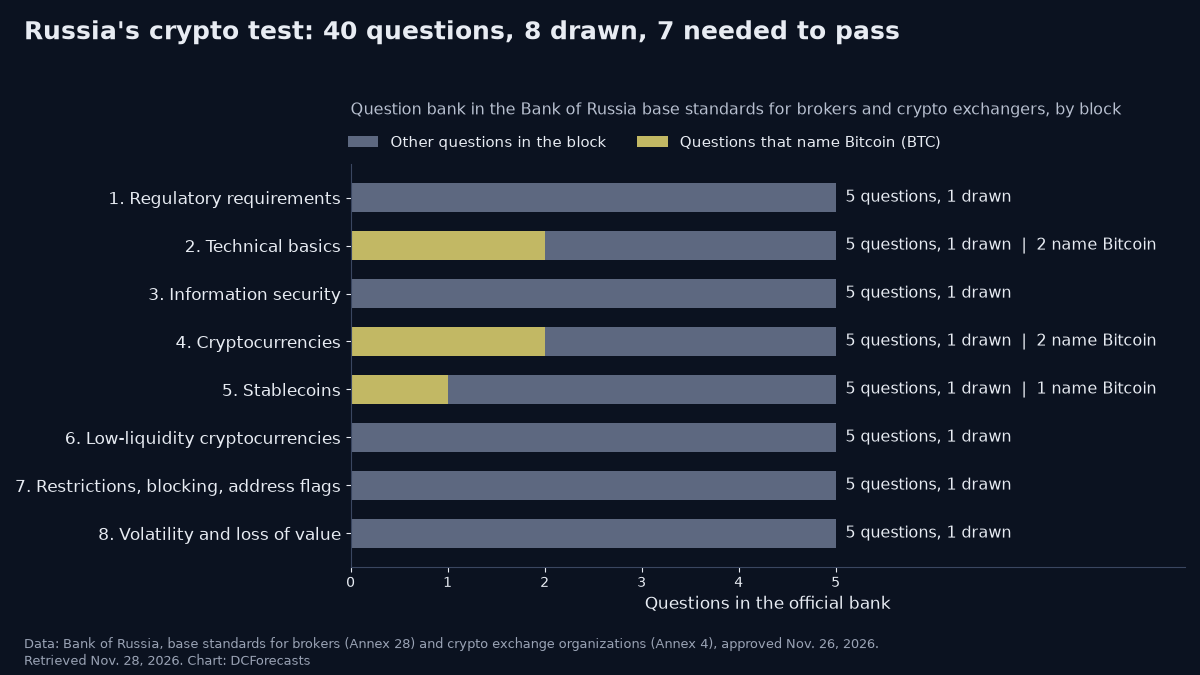
For Bitcoin investors, the most telling detail is what the regulator chose to teach: five of the 40 official questions name Bitcoin directly, and most of them are about how the network actually works.
The bigger question is whether a short, free exam becomes a speed bump or a real on-ramp for Russian savers.
How the Russia Crypto Test Works
The rules sit in two documents published by the central bank: one base standard for self-regulatory organizations that unite brokers, and one for organizations that exchange digital currencies.
Both rest on Article 32 of Federal Law No. 282-FZ of Aug. 4, 2026, “On Digital Currencies and Digital Rights.”
The mechanics are identical in both standards:
- The test is free and taken in writing, using electronic documents.
- The official bank holds 40 questions in eight blocks of five. Each test draws one question at random from every block.
- A client passes with at least seven correct answers. Anything less is a fail.
- The firm must send the result within one business day after the test.
- A pass is valid for one year from the test date or from the client’s last crypto deal, whichever comes later.
That last rule matters. An investor who trades at least once a year never has to sit the exam again.

A Crypto Quiz That Cannot Be Gamed Easily
The regulator went to some length to stop clients from memorizing their way through.
A client who fails can retake the test once more the same day. The retake must use fresh questions, with none repeated from the first attempt.
From the second retake onward, the firm must also drop half of the questions from the attempt before that. Those repeat limits apply for 14 calendar days after the previous test.
Firms may not reveal correct answers, may not tell a client which questions were missed, and may not reword the official questions.
The answer options and correct answers do not appear in the published standards. Each self-regulatory organization must send them to its members within three business days of publication.
We believe this design is sensible. A crypto quiz anyone can pass by trial and error would protect no one.
What Russian Bitcoin Buyers Will Be Asked
The eight blocks cover regulatory requirements, technical basics, information security, cryptocurrencies, stablecoins, low-liquidity tokens, address blocking and flagging, and volatility.
The Bitcoin questions read like a first lesson in self-custody and settlement:
- Can a Bitcoin transaction be reversed after it is confirmed on the blockchain?
- What happens if Bitcoin is sent to the wrong address?
- Can Bitcoin’s price differ between trading venues?
- How does the risk of holding a stablecoin differ from the risk of holding Bitcoin?
Other questions ask who is ever entitled to request a client’s seed phrase, what happens if a seed phrase or private key is lost, and how to judge a project that promises fixed monthly returns paid from new participants’ money.
The stablecoin block is notably skeptical. One question asks whether a dollar peg guarantees a stable market value, and another asks what happens when a stablecoin trades below its stated par.
For us, the key takeaway is that Bitcoin’s core properties, such as final settlement and holder-controlled keys, are now part of an official investor curriculum in one of the world’s largest economies.
The Russia Bitcoin Cap Now Buys More
Passing the test does not open unlimited access for everyone.
The central bank repeated on Nov. 26 that non-qualified investors may buy only a limited list of cryptocurrencies, and no more than ₽300,000 a year through one intermediary. As we covered when Russia opened retail Bitcoin trading, that list was set at Bitcoin, Ether and USDT.
The ruble value of that cap is fixed, but the bitcoin it buys is not.
CoinGecko data show Bitcoin at about ₽6,194,173 on Nov. 6, when the retail rules were announced. On Nov. 28, at 02:39 UTC, it was about ₽4,926,440, or roughly $59,987.
At those prices, ₽300,000 went from buying about 0.0484 BTC to about 0.0609 BTC, an increase of roughly 26%.
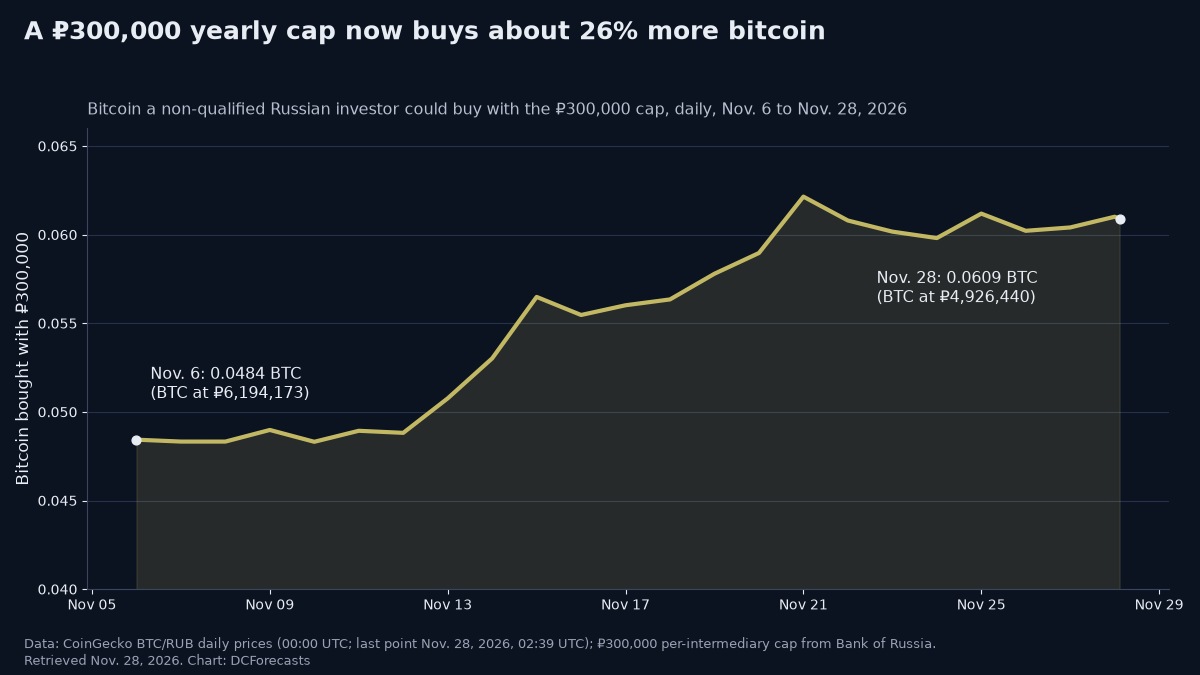
That reflects a real drawdown in Bitcoin’s price this month, and we do not want to dress it up. But for a new buyer facing a fixed ruble allowance, the same paperwork now secures noticeably more coin.
Why Russia Cryptocurrency Rules Point Toward a Broader Market
The test standards land just before the next step. Moscow Exchange plans to open its crypto market on Dec. 1, and, as we reported, Bitcoin trades there carry no VAT while USDT trades face 22%.
Seen together, Russia cryptocurrency policy is building a familiar stack: a legal definition, licensed intermediaries, a purchase cap for retail clients, and now a standardized knowledge check.
We would watch three things next: how many clients pass on the first attempt, whether brokers report the exam as a drag on sign-ups, and whether the ₽300,000 limit is revisited once the market has a track record.
We believe a regulator that asks savers to understand irreversible transfers and private keys before buying is, in effect, teaching the case for Bitcoin’s design.
Bitcoin’s fixed 21 million supply does not change with any country’s rulebook. What changes is how many people can reach it through regulated doors, and Russia has just written the entrance exam.
DC Forecasts is a leader in many crypto news categories, striving for the highest journalistic standards and abiding by a strict set of editorial policies. If you are interested to offer your expertise or contribute to our news website, feel free to contact us at [email protected]












Discussion about this post