



The Binance hack laundering has shifted into a faster gear, and this time the activity is showing up inside Bitcoin coinjoins.
At least 2,310 BTC tied to the Oct. 29 theft, worth about $149 million, has now been pushed through coinjoin transactions, according to blockchain analytics firm Elliptic. Roughly 90% of that happened in just four days, from Tuesday, Nov. 17, to Friday, Nov. 20.
Yet the 18,270 BTC taken directly from Binance has not moved at all since the night of the attack.
For Bitcoin holders, that contrast is the story. The coins being mixed were bought with other stolen assets, and every step of that conversion is being counted on a public ledger.
The bigger question is whether the launderers can turn any of it into spendable money before exchanges and investigators close the remaining exits.
What Changed in the Binance Hack Laundering This Week?
For more than two weeks, the attacker’s biggest ether holdings sat still. That ended on Nov. 17.
Elliptic’s tracker, last updated at 12:00 UTC on Nov. 20, shows that five of the nine largest ETH addresses linked to the theft were emptied in four days.
The amounts grew every morning: 74,880 ETH on Nov. 17, 78,415 ETH on Nov. 18, 137,602 ETH on Nov. 19 and 197,460 ETH on Nov. 20.
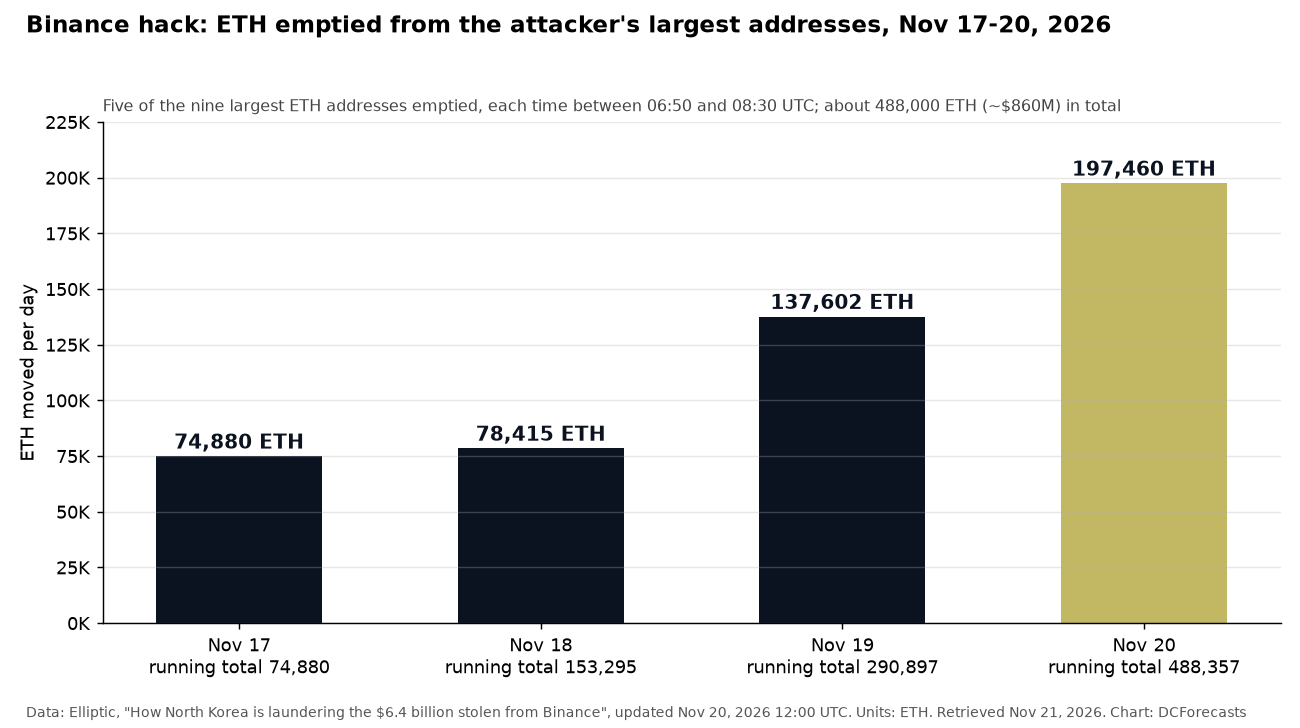
In total, about 488,000 ETH, worth roughly $860 million, has been moved. Most of it was split into fresh batches of about 12,000 ETH and is still sitting there, untouched.

We covered the first wave of these transfers when the heist wallets began to stir on Nov. 17.
How the Stolen Ether Becomes Bitcoin, Then Coinjoins
Elliptic describes a mechanical pipeline. One or two of the 12,000 ETH batches are processed at a time, each split across about ten new addresses.
Those addresses swap the ether for bitcoin through THORChain in hundreds of small deposits, the same route used after the $1.5 billion Bybit hack in February 2025.
Since Nov. 17, about 39,000 ETH, roughly $70 million, has been swapped for about 1,100 BTC. At that pace, Elliptic estimates that converting the rest of the batches would take well over a month.
Much of the new bitcoin goes into coinjoins, often within two hours of arriving. A coinjoin combines many users’ coins in one transaction, which breaks the visible link between inputs and outputs.
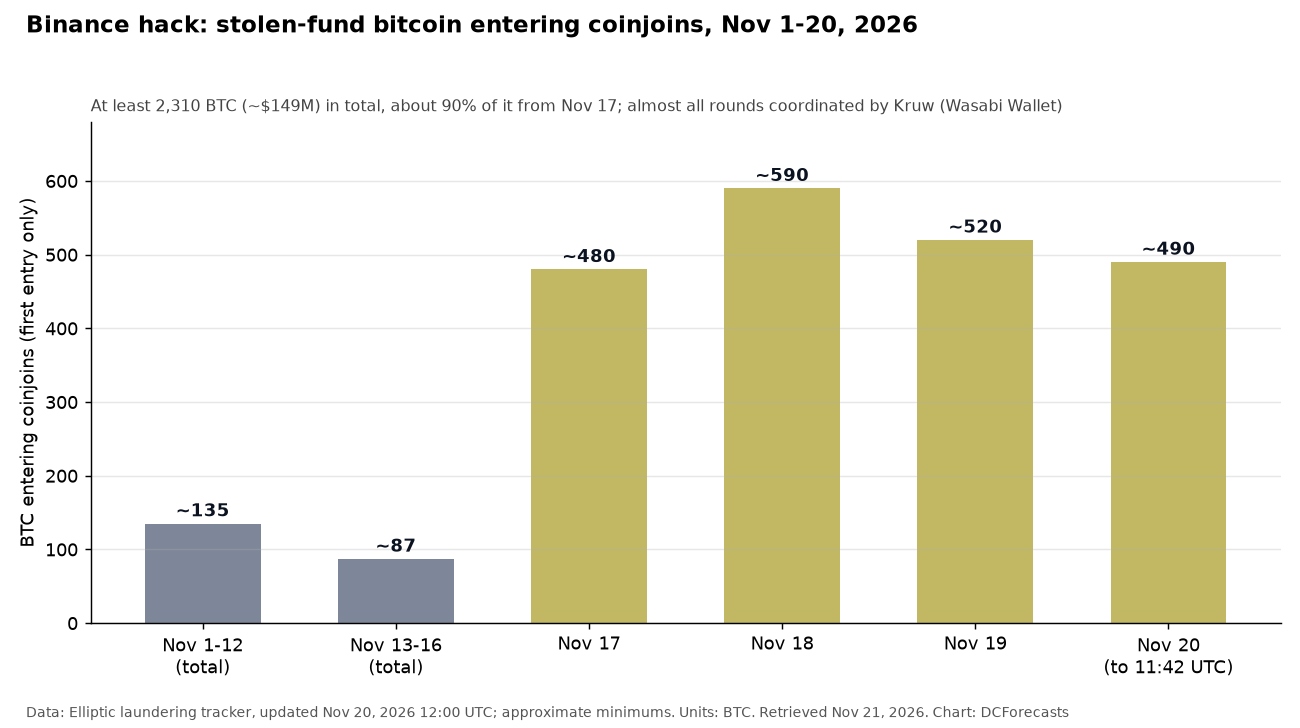
The daily numbers jumped sharply. About 480 BTC entered coinjoins on Nov. 17, more than in the previous two weeks combined, followed by about 590 BTC on Nov. 18, 520 BTC on Nov. 19 and 490 BTC by 11:42 UTC on Nov. 20.
Not all of it came from ether. Elliptic said about 210 BTC mixed on Nov. 20 traced back to XRP converted earlier in the month.
Almost all of these rounds were run by Kruw, the most widely used coordinator for Wasabi Wallet users. A coordinator brings participants together but never takes custody of their coins.
Why 18,270 Stolen Bitcoin Still Haven’t Moved
This is the detail we believe matters most.
The 18,270 BTC stolen directly from Binance was split across 19 addresses during the theft and has stayed there ever since. The bitcoin now being mixed is different: it was converted from ETH, XRP and SOL.
About 3,200 BTC of that converted bitcoin, roughly $200 million, still sits in new addresses, down from about 3,500 BTC on Nov. 19 as more of it moves into coinjoins.
In our view, this tells us something useful about Bitcoin itself. Its coins cannot be frozen by an issuer, which is part of their appeal to the launderers, but they also sit on a ledger that anyone can audit.
That transparency is what lets an analytics firm publish daily tallies of this laundering, wallet by wallet.
A Record Freeze Rate Narrows the Exits
Elliptic counts $6.43 billion stolen across 11 blockchains, with laundering that now spans more than 27,000 wallets, at least 16 blockchains, about 55 services and roughly 90,000 transactions.
Even so, $2.85 billion, or about 44% of the haul, has been frozen or seized. Elliptic notes that only around 3% was frozen after the Bybit hack.
The U.S. Justice Department said on Nov. 12 that it had won court-authorized seizure and restraint of more than $1.2 billion of the stolen crypto, part of a freeze effort we detailed in our report on the Justice Department’s action.
Around $2.35 billion remains in addresses linked to the theft, and Elliptic believes only a negligible amount has been cashed out so far.
Swapping ether for bitcoin is not the same as spending it. To cash out, the attacker still needs an exchange or an over-the-counter broker, and those are the points where funds can be identified and stopped.
What Comes Next for the Stolen Funds?
Elliptic expects the remaining ether to keep flowing into bitcoin in small pieces, then through coinjoins, and eventually toward over-the-counter brokers over a period of months.
That is a slower timeline than Bybit, where all 499,000 stolen ETH was laundered within ten days.
Bitcoin traded near $58,950 on Coinbase early on Nov. 21, and none of this flow changes its fixed 21 million supply or the security of its network. The breach happened inside an exchange’s own systems, not in Bitcoin’s code.
We believe that is the lasting lesson. The protocol kept doing its job, while the weak points were human and corporate, which is one more reason self-custody and open, auditable ledgers keep gaining support.
The coming weeks will show how much of the remaining ether reaches the mixers, and how many of the exits are already watched when it tries to leave.
DC Forecasts is a leader in many crypto news categories, striving for the highest journalistic standards and abiding by a strict set of editorial policies. If you are interested to offer your expertise or contribute to our news website, feel free to contact us at [email protected]












Discussion about this post