



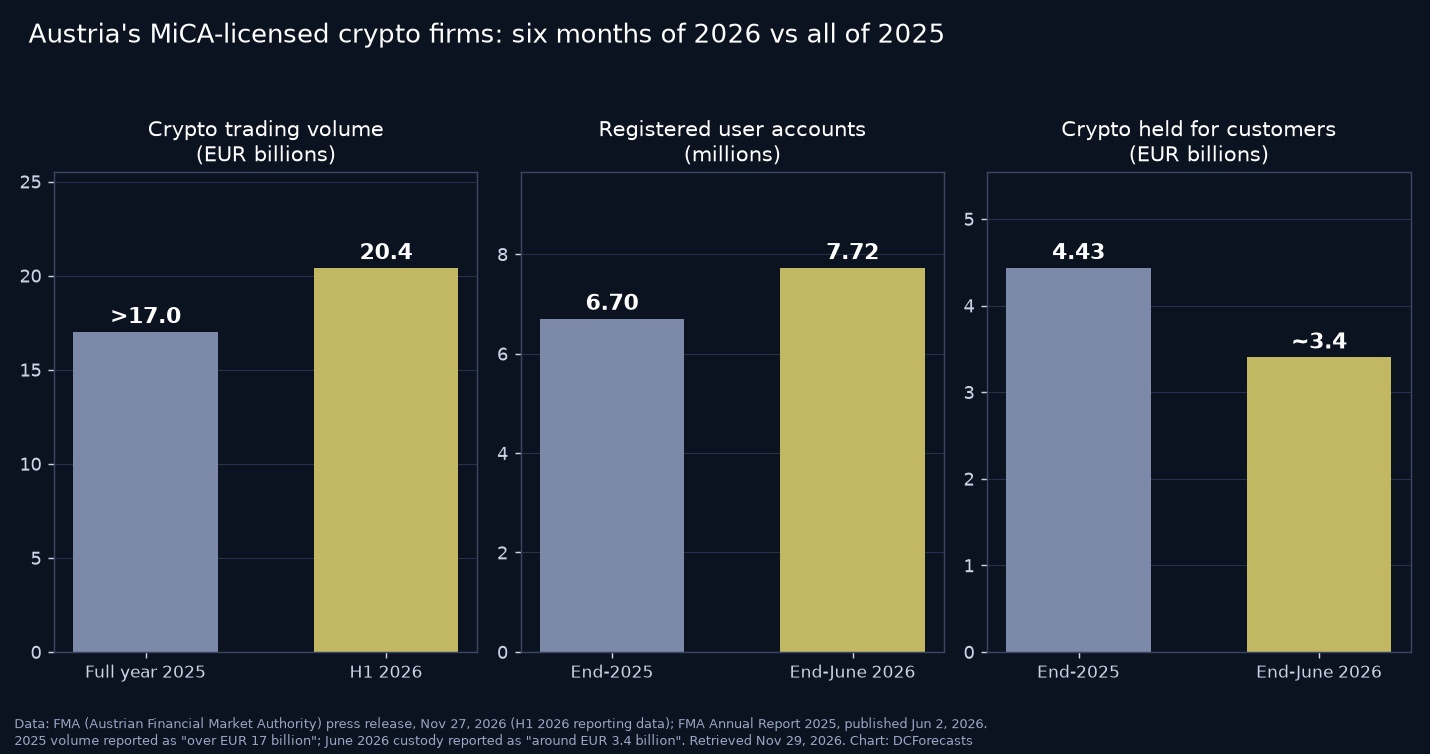
Crypto firms holding an Austrian MiCA license processed more trading in the first six months of 2026 than in all of 2025, according to new reporting data from Austria’s Financial Market Authority (FMA).
The regulator said on Nov. 27 that the crypto-asset service providers (CASPs) it supervises reported about 111 million crypto exchange transactions worth €20.4 billion between January and June.
Its annual report put the full-year 2025 figure at “over €17 billion”.
For Bitcoin investors, the more interesting detail is when this happened. The first half of 2026 was a period of falling prices, yet Europeans kept opening accounts and kept trading through regulated venues.
The bigger question is whether Europe’s licensed crypto market can keep growing like this while Bitcoin trades about 53% below its October 2025 all-time high of $126,080, according to CoinGecko data.
What the FMA Reported for the First Half of 2026
The figures came in a press release timed to the FMA’s FinTech Day, which it hosts with the Oesterreichische Nationalbank in Vienna.
Registered user accounts at the reporting firms reached about 7.72 million at the end of June, up from 6.7 million at the end of 2025. That is growth of roughly 15% in six months.
The trading figure works out to an average of about €184 per transaction, which points to a broad retail user base rather than a few large traders.
About 74% of those accounts belonged to customers in other countries of the European Economic Area, with Germany and France in the lead. Many of the firms use the MiCA passport to serve customers across Europe from Austria.

Customer crypto held by these firms was worth about €3.4 billion at the end of June, down from about €4.4 billion at the end of 2025. The FMA said the drop reflects lower prices for Bitcoin and other crypto assets on the reporting date.
Why a MiCA License in Austria Carries Weight Across Europe
The FMA’s annual report shows how quickly this market was built. By the end of 2025 the regulator had licensed eight CASPs, and it has since added a ninth.
Seven of the first eight were already using the EU passport for cross-border business, and 66 CASPs based elsewhere in the EEA had notified the FMA that they serve Austria.
Only four of the eight licensed firms were operating at the end of 2025. Part of the jump in 2026 volume therefore reflects firms that were ramping up last year, and we would not read it as pure organic growth.
Even so, €20.4 billion in six months equals roughly €3.4 billion a month, against an average of a little over €1.4 billion a month in 2025.
The 2025 data also showed a young user base. Of the 3.0 million fully verified users, 64% were under 40. Just under 1.0 million users traded during the year.
As we noted when German co-op banks took most new MiCA register entries, Europe’s MiCA crypto market is now being built by regulated firms as well as crypto natives.
Bitcoin Still Anchors Europe’s Regulated Crypto Market
The annual report breaks down what customers actually held. At the end of 2025, Bitcoin made up €2.07 billion of the €4.43 billion held for customers, or about 47%.
Ether accounted for about 14% and XRP about 10%. Bitcoin also led trading, with 27% of 2025 exchange volume by value.
The custody numbers in 2026 deserve a closer look. Customer holdings fell about 23% between December and June.
Over the same period, the Bitcoin price on Coinbase fell from €74,473 to €51,301, a drop of about 31%.
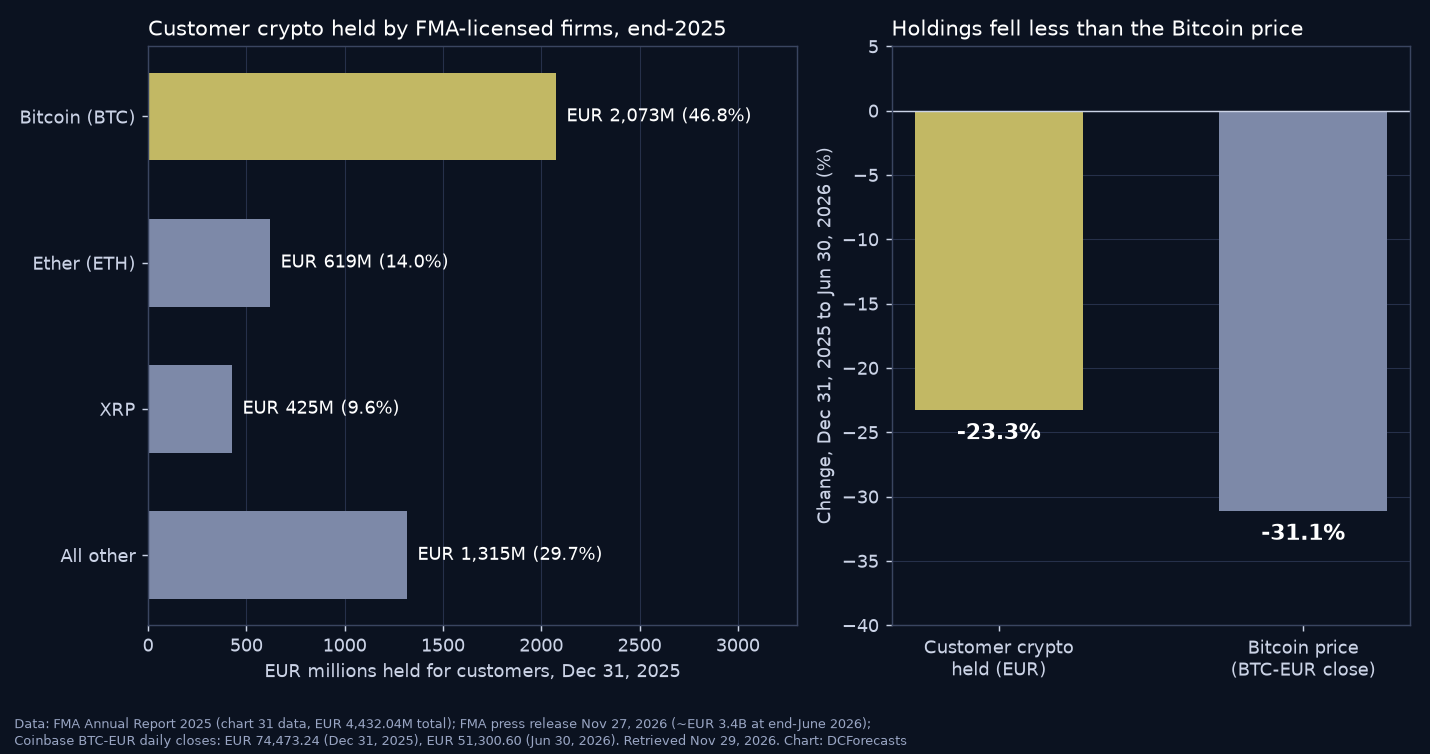
The FMA does not publish holdings in coin terms, and the basket includes other assets. Still, we believe the gap suggests customers did not rush for the exits. Holdings that fall less than the price usually point to steady or rising balances.
Will ESMA Take Over Supervision of the Biggest CASPs?
The FMA also used the release to weigh in on Europe’s supervisory debate. With more firms serving customers across borders, there is talk of more centralization and a bigger role for the European Securities and Markets Authority (ESMA).
The FMA said institutional change is not an end in itself. Its test is whether a change brings more effective supervision, greater consistency and a level playing field.
Its earlier position was more specific. In its 2025 annual report, the FMA said that, together with the Italian and French supervisors, it had proposed direct ESMA supervision of significant CASPs.
FMA executive director Mariana Kühnel said at the time that the authority favors “a model in which the largest CASPs are supervised directly by ESMA, while smaller ones remain under national supervision”, similar to how the ECB supervises banks (quotes translated from German).
On Nov. 27 she added that “innovation, competitiveness and effective supervision go hand in hand.” On stablecoins, Kühnel said Europe must find its own way: “open to innovation and competition, but with clear rules.”
We believe a single rulebook with consistent enforcement is good news for Bitcoin adoption in Europe. It lowers the risk of regulatory arbitrage and gives cautious investors a clearer path in.
What Could Lift Europe’s Licensed Crypto Volumes Next?
The H1 data ends in June, so it does not capture the sharp November slide that took Bitcoin to about $58,700 (€53,850) on Coinbase on Sunday.
The next FMA update will show whether account growth held up through that drawdown. We would watch three numbers: total accounts, the share of verified users who actually trade, and Bitcoin’s share of customer holdings.
Regulated access keeps widening. Just this week Switzerland’s first Bitcoin ETF opened with 350 BTC, adding another supervised route for European money.
For us, the key takeaway is simple. Rules like MiCA do not make prices rise, but they bring in users who stay through downturns. Bitcoin’s fixed supply meets a growing, licensed base of European buyers, and the coming quarters will show how much demand that base can carry.
DC Forecasts is a leader in many crypto news categories, striving for the highest journalistic standards and abiding by a strict set of editorial policies. If you are interested to offer your expertise or contribute to our news website, feel free to contact us at [email protected]












Discussion about this post