



Bitcoin buffer ETFs were built for exactly this kind of market, and Calamos’ lineup now shows how much work its floors are doing.
The firm’s ETF trust filed refreshed summary prospectuses for its 12 bitcoin protection funds with the SEC, dated Nov. 27, 2026, restating each fund’s cap, floor and one-year outcome period.
With bitcoin near $58,730 on Coinbase on Sunday morning, the spot price sits below the protection threshold on 9 of those 12 funds.
For Bitcoin investors, the bigger story is not the slide itself. It is that a growing slice of traditional money now holds bitcoin exposure with a defined worst case built in.
The bigger question now is what these funds can earn back if bitcoin recovers before their periods end.
How the Calamos Buffer ETFs Work
Each fund holds FLEX options tied to spot bitcoin ETFs such as BlackRock’s iShares Bitcoin Trust, Fidelity’s Wise Origin Bitcoin Fund and Bitwise’s Bitcoin ETF, or to bitcoin indexes.
The aim is to track the CME CF Bitcoin Reference Rate, New York Variant, up to a fixed cap, while limiting losses over a roughly one-year outcome period.
The lineup comes in three tiers. The 100% protection funds seek to absorb all of bitcoin’s decline over the period. The 90 Series funds absorb losses beyond 10%, and the 80 Series funds absorb losses beyond 20%.
Each tier has four funds, starting in February, April, July and October. Every one charges 0.69% a year, and those protection levels are measured before that fee.

There is an important catch. According to the prospectuses, the cap and floor apply only to investors who hold from the first day of an outcome period to its last. Buying or selling mid-period can produce very different results.
Bitcoin Sits Below 9 of 12 Floors
We compared each fund’s start date with Coinbase bitcoin prices near 4 p.m. New York time, the window the reference rate tracks. These are our approximations, not the official index values.
- Feb. 1 funds (CBOJ, CBXJ, CBTJ): bitcoin started near $77,025 and is down about 23.8%, past all three floors.
- Apr. 8 funds (CBOA, CBXA, CBTA): a start near $71,332 puts bitcoin down about 17.7%. That is through the 100% and 90 floors, but still inside the 80 Series’ 20% buffer.
- Jul. 8 funds (CBOY, CBXY, CBTY): bitcoin started near $62,229 and is down only about 5.6%, so only the 100% fund is leaning on its floor.
- Oct. 7 funds (CBOO, CBXO, CBTO): a start near $83,392 leaves bitcoin down about 29.6%, past every floor.
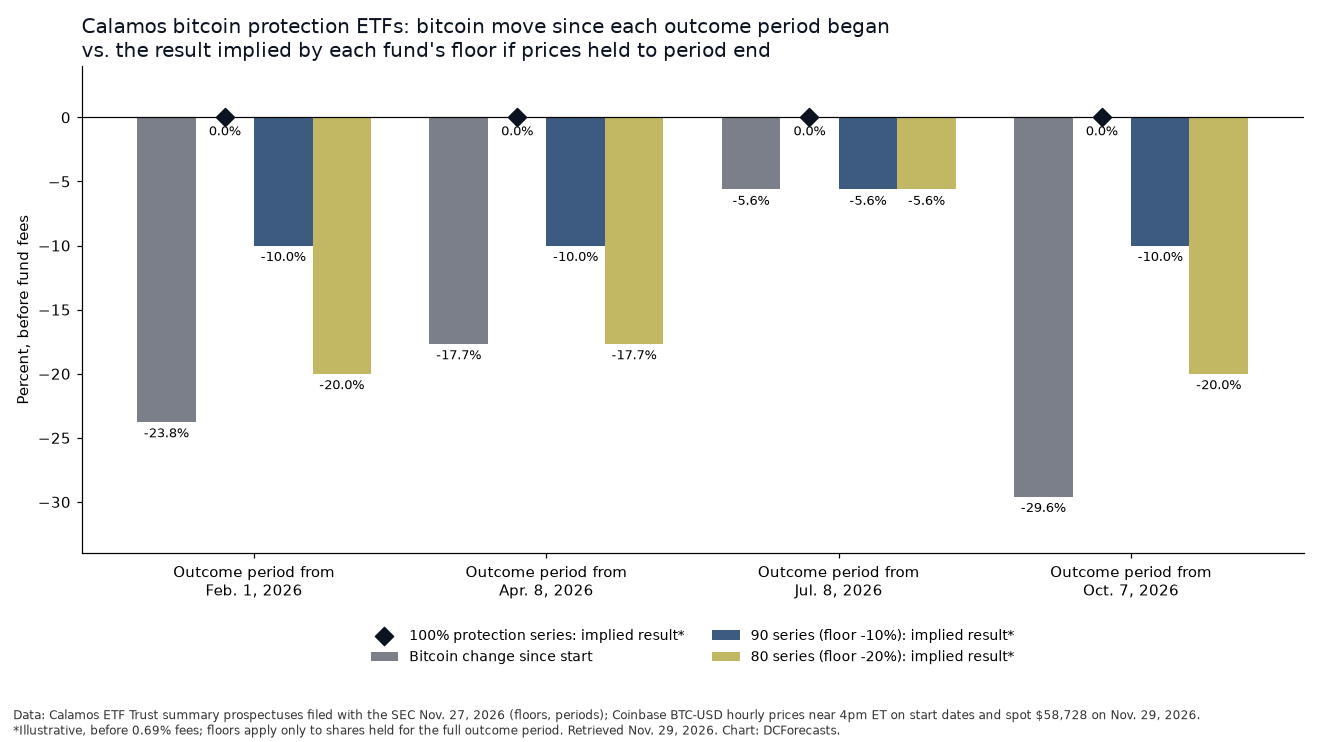
That math is a snapshot, not a final result. The October periods do not end until October 2027, and much can happen in 11 months.
Still, it shows the structure doing what it promises on paper. An investor in an October 100% fund who holds to the end faces no loss before fees on the bitcoin leg, even though bitcoin itself is down nearly 30% since that start date.
The Price of Protection Is a Lower Cap
Protection is paid for with upside. In the current periods, the 100% funds cap gains at 8.32% to 10.00%. The 90 Series caps run from 20.55% to 23.20%, and the 80 Series from 36.22% to 37.97%.
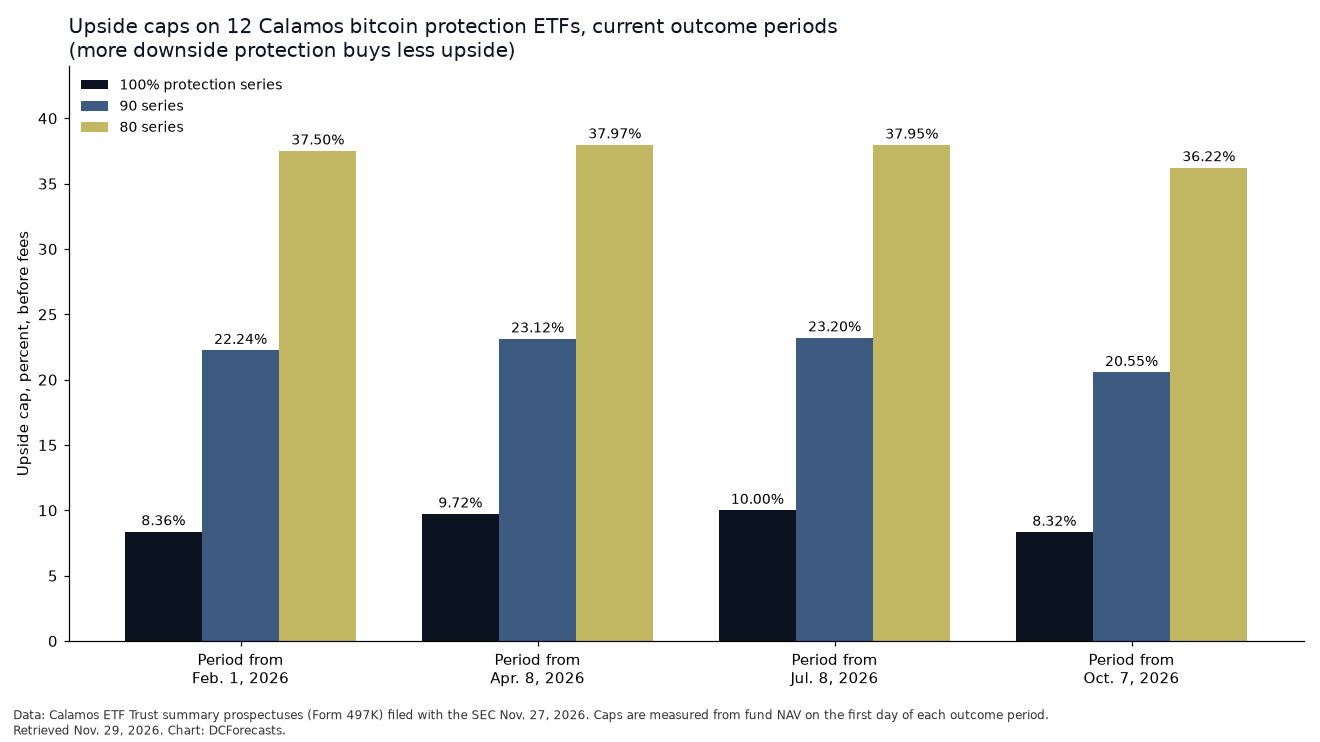
Those caps have come down. When the 80 Series launched in 2025, the earlier prospectuses set caps of 51.50% for February, 51.76% for April, 41.05% for July and 41.62% for October.
A tighter cap for the same 20% buffer means options pricing gave investors less upside per dollar of protection this year.
We believe that is worth understanding before buying. A buffer fund is a different product from spot bitcoin, not a free version of it.
That trade-off is not unique to Calamos. We saw a similar design when UniCredit’s bitcoin certificate capped gains at 65% in exchange for protection.
What a Bitcoin Recovery Would Need
Here is where the numbers get interesting for long-term holders.
For the October 100% fund to finish at its 8.32% cap, bitcoin would need to end the period near $90,330, about 54% above today’s price. Simply getting back to break-even would take a move to roughly $83,392, a 42% climb.
The July 80 Series fund is much closer to the action. Bitcoin is only about 6% below its start level, and its 37.95% cap would be reached near $85,845.
The February funds have the least time left, with their periods ending Jan. 31, 2027. Bitcoin would need to regain about 31% by then just to return to that start price.
For us, the key takeaway is that most of these funds are now positioned to keep holders steady rather than to capture a rebound. Spot holders keep all of the upside if bitcoin recovers. These fund holders gave some of it up in advance.
Why Bitcoin Buffer ETFs Still Matter for Adoption
Product menus like this did not exist a few years ago. Now an advisor can choose among 12 bitcoin funds with defined floors, plus three laddered Calamos funds that spread money across the four start months.
Not every issuer has followed. As we reported, ARK shelved eight bitcoin buffer ETF filings after repeated delays, so the category is still small and selective.
We believe the wider point is constructive. Investors who would never buy spot bitcoin during a 30% drawdown can still keep exposure through one, which helps keep demand in the market when sentiment is weakest.
Bitcoin’s fixed supply of 21 million coins does not change with the product wrapped around it. What changes is who can comfortably hold it.
The coming months will show how many of these floors end up being tested at period end, and how much of a recovery the caps leave on the table.
DC Forecasts is a leader in many crypto news categories, striving for the highest journalistic standards and abiding by a strict set of editorial policies. If you are interested to offer your expertise or contribute to our news website, feel free to contact us at [email protected]












Discussion about this post