



A Bank of Japan executive used a Tokyo keynote on November 27 to argue that stablecoins only earn trust when strict reserve rules come with well-designed links to central bank money.
Executive Director Kamiyama Kazushige told an IMF seminar that “every form of money in a currency should be converted at face value, with finality.”
He added that this principle, which the Bank for International Settlements calls the singleness of money, “should not be taken for granted.”
For crypto investors, the timing is notable. Dollar-pegged tokens now make up 98.9% of a $279.3 billion stablecoin market, while yen coins total about $230 million.
The bigger question is whether Japan’s measured approach becomes a template for stablecoin regulation across Asia.
What the Bank of Japan Said About Stablecoins
The speech, titled “Digital Money and Payments: Transitioning Toward a New Paradigm,” was delivered at the IMF MCM-OAP Seminar in Tokyo.
Kamiyama described two forms of digital money drawing attention: stablecoins, which mostly track a fiat currency, “primarily the U.S. dollar,” and tokenized deposits, which are commercial bank deposits issued on a blockchain.
His key line on stablecoins was direct: “appropriate regulation of reserves and arrangements, together with well-designed links to central bank money, will also be important.”
It is worth being precise about what this was. A speech by an executive director is not a new rule, and Kamiyama announced no new stablecoin requirements.

We believe it still matters, because it shows how the Bank of Japan is likely to judge private digital money: by whether it can always be redeemed at par.
A Market That Is Almost Entirely Dollars
CoinGecko data retrieved on November 29 shows how lopsided the stablecoin market is.
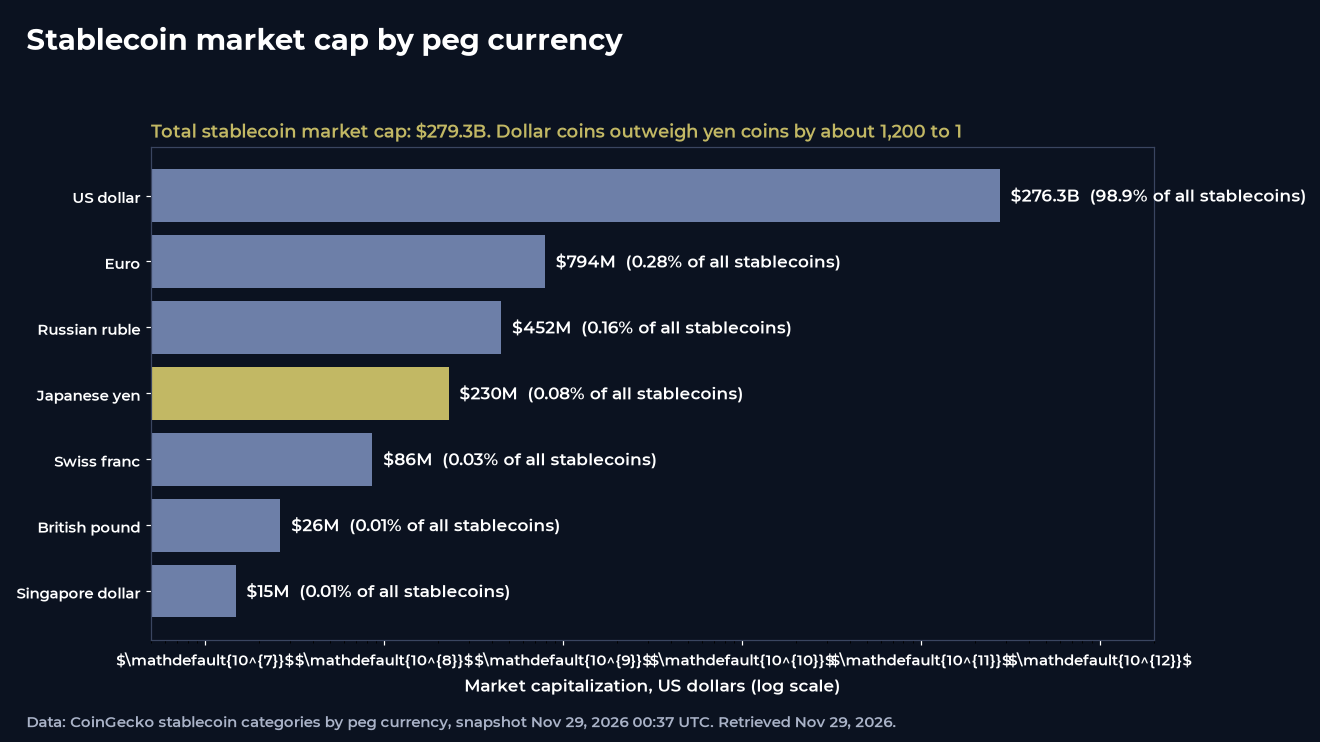
Dollar-pegged coins total $276.3 billion. Euro coins come second at $794 million, followed by ruble coins at $452 million.
Yen-pegged tokens sit at roughly $230 million, or 0.08% of the total. Dollar coins outweigh them by about 1,200 to 1.
That gap explains why a Japanese central banker frames the issue around trust rather than growth targets. Any yen stablecoin will compete against an entrenched dollar network.
For us, it also means Japan has room to set rules early, before a large domestic market forms around weak designs.
Why Face Value Is the Real Test
The singleness of money sounds abstract, but it is simple. One yen in a bank, one yen in cash and one yen in a token should always be worth exactly one yen.
Most large dollar stablecoins pass that test on a normal day.
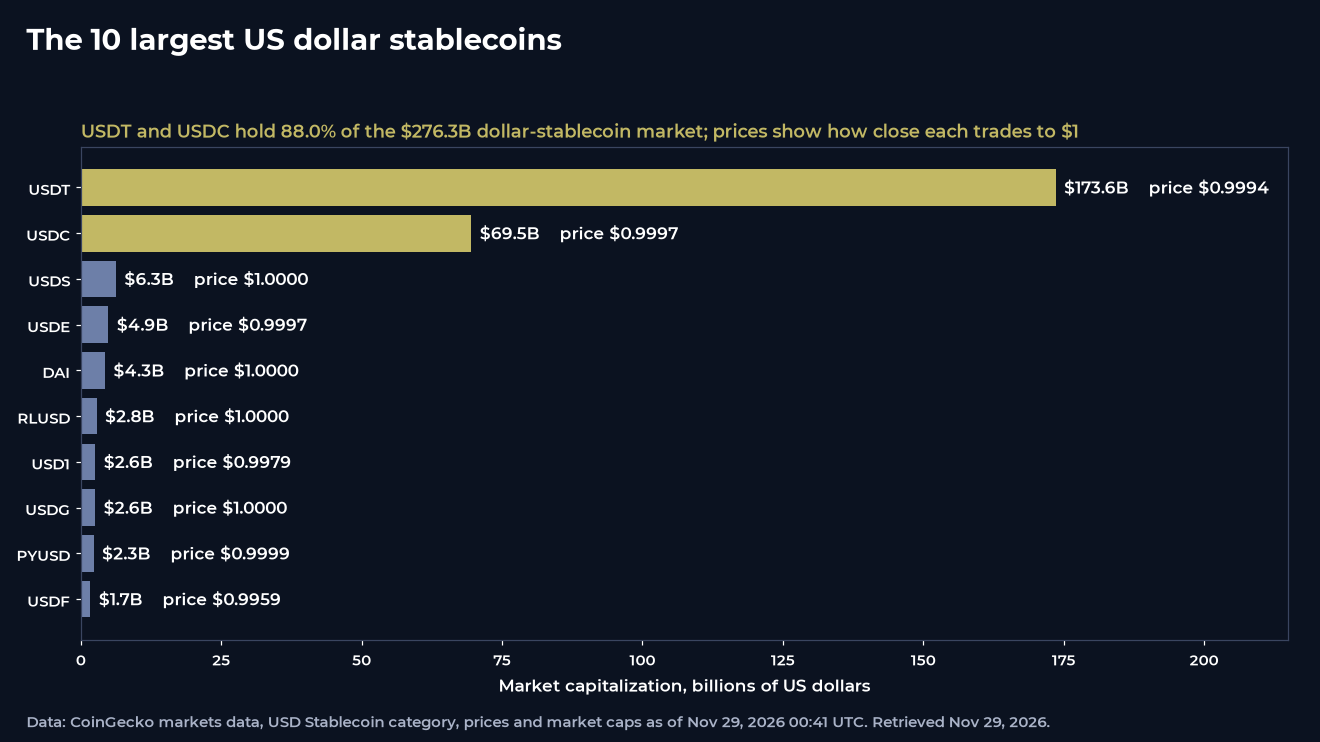
USDT and USDC alone hold $243.1 billion, or 88.0% of the dollar-stablecoin market. Both traded within a tenth of a cent of $1 in the snapshot.
Stress is another matter. As we covered when USD1 slipped to 94 cents, a dollar token can trade well below par when confidence cracks. It was back at $0.9979 in the latest data.
That is exactly the gap Kamiyama wants closed. Reserves matter, but so does a reliable path to central bank money when holders want out.
Five Risks the Bank Wants Solved First
Kamiyama was clear that tokenization brings real benefits, such as atomic settlement, where a security and its payment move together or not at all.
He then listed five challenges:
- Financial stability, since automated margin calls and liquidations could amplify stress.
- Liquidity management and fragmentation across platforms that are not fully interoperable.
- Migration costs, interoperability and governance.
- Cybersecurity and operational resilience, made harder by AI that can find vulnerabilities.
- Legal certainty, because technical finality on a ledger is not necessarily legal finality.
One line stood out to us: “Faster settlement does not automatically mean more efficient liquidity management.”
We believe that is a fair warning for 24/7 markets. Round-the-clock tokens still meet banks and payment systems that keep fixed hours.
Where Japan’s Tokenized Deposits and Sandbox Fit In
The Bank of Japan is not standing still. Kamiyama said it has launched a DLT Sandbox Project with holders of current accounts at the Bank.
The use cases include cross-border payments, domestic interbank settlement and the funds settlement of tokenized Japanese government bonds.
The Bank also takes part in Project Agorá, a BIS Innovation Hub project with several central banks and more than 40 private financial institutions, testing tokenized deposits alongside tokenized central bank money.
On a retail digital yen, he said a pilot continues but “no decision has yet been made to issue one.”
He placed this next to the Eurosystem’s Pontes link, launched in September, and the Bank of England’s work on synchronized settlement. Hong Kong is moving the same way, as seen when tokenized assets got a ledger at its bond depository.
Japan’s government is also promoting what it calls “on-chain finance,” with the Financial Services Agency leading work on a roadmap.
Why Bitcoin Sits Outside This Debate
Everything in this speech concerns IOUs: tokens that promise to equal a yen or a dollar and need a central bank link to keep that promise.
Bitcoin makes no such promise. It is a bearer asset with a fixed 21 million supply that settles on its own network around the clock, with no redemption window to manage.
We believe clearer stablecoin regulation is still good news for Bitcoin holders. Stablecoins are the main cash rail into crypto markets, and safer rails help bring more capital to the asset itself.
Watch for three things next: the FSA’s on-chain finance roadmap, any yen stablecoin growth beyond today’s $230 million, and the first results from the Bank of Japan’s sandbox.
The coming months will show whether Tokyo’s careful approach turns Japan into a trusted gateway for digital money, and Bitcoin stands to benefit from every rail that makes access easier.
DC Forecasts is a leader in many crypto news categories, striving for the highest journalistic standards and abiding by a strict set of editorial policies. If you are interested to offer your expertise or contribute to our news website, feel free to contact us at [email protected]












Discussion about this post