



Two XRPL amendments that would bring native lending to the XRP Ledger have crossed the network’s 80% approval bar, and the clock is now running.
As of Sunday, Nov. 29, LendingProtocol and its follow-up, LendingProtocolV1_1, each had yes votes from 30 of the 35 trusted validators, according to XRPScan’s amendment data.
That is 85.7% support, two votes above the 28 the tracker lists as the threshold.
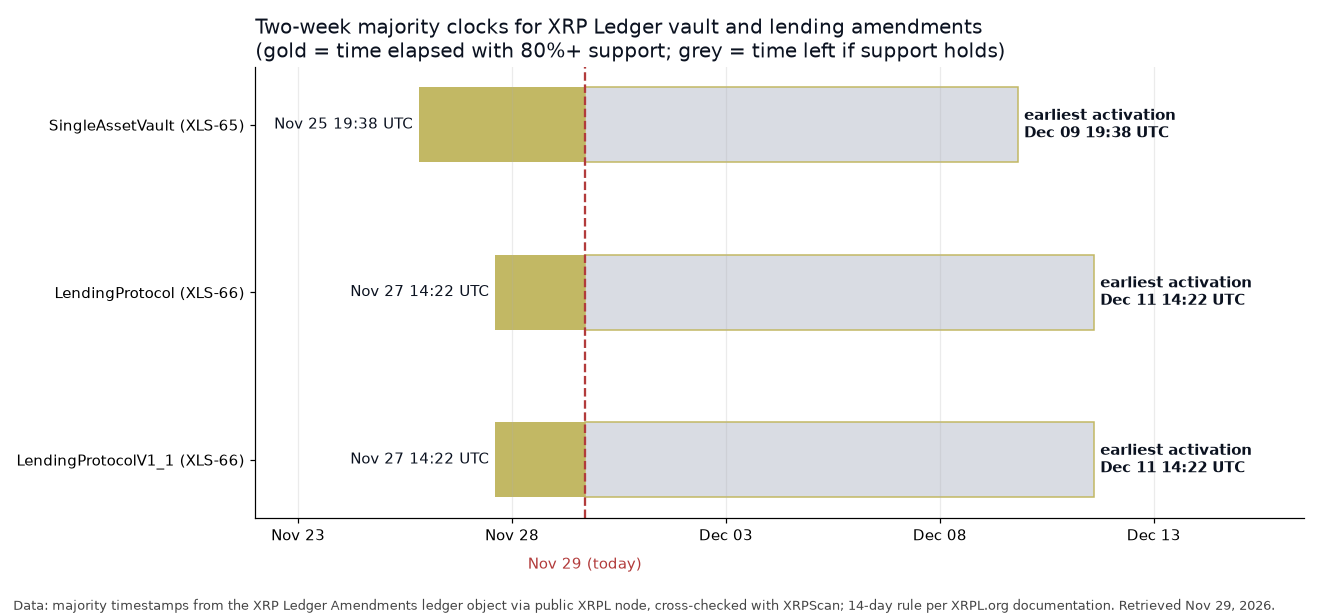
The ledger itself records the moment: both amendments gained majority at 14:22 UTC on Nov. 27.
If that support holds for two full weeks, on-chain loans can switch on around Dec. 11. The question now is whether 30 votes is a cushion or a ceiling.
What Changed Since Early November?
When we looked at this vote on Nov. 10, the lending upgrade was still six votes short, with 22 validators in favor.
In under three weeks, the tally added a net eight yes votes.
Single Asset Vaults, the pooled-fund feature that lending is built on, moved first. It reached majority at 19:38 UTC on Nov. 25 and also sits at 30 of 35.
That puts its earliest activation at about 19:38 UTC on Dec. 9, two days ahead of the lending pair.

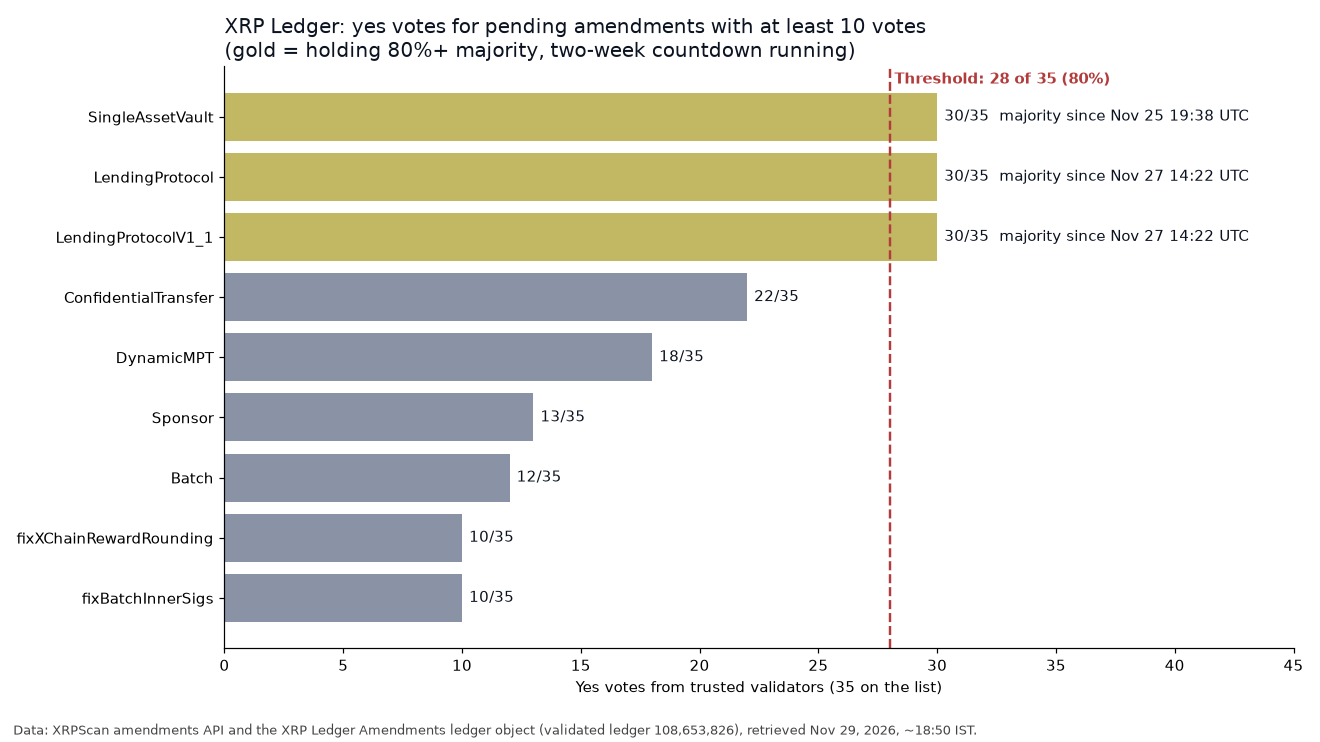
The rest of the queue is far behind. Confidential Transfers has 22 votes, Dynamic MPT 18, Sponsor 13 and Batch 12.
So for now, vaults and lending are the only feature upgrades with a live countdown.
How the XRPL Amendments Process Decides
The XRP Ledger does not change its rules by decree. According to the official XRPL.org documentation, an amendment passes when it keeps more than 80% support for two weeks.
Servers check the votes at every flag ledger, which is every 256th ledger, roughly every 15 minutes.
If support drops below the required level during the window, the ledger records a “lost majority” flag, and the two-week count has to start again.
Once enabled, an amendment is permanent. Turning it off would take another amendment.
XRPScan lists five validators that are not supporting any of the three: verum.eminence.im, aureusox.com, tequ.dev, cabbit.tech and the validator run by XRPL Labs, the team behind the Xaman wallet.
None of them has to change its vote for the upgrade to pass. What matters is that support stays at or above the 28-vote threshold through Dec. 11.
What XRP Loans Would Look Like on Day One
The design is more conservative than the DeFi lending most traders know.
The documentation describes fixed-term, uncollateralized loans funded from a Single Asset Vault. Credit checks happen off-chain. The ledger records terms, takes repayments and tracks defaults.
There are three roles: loan brokers who create vaults and manage loans, depositors who add assets, and borrowers who repay on agreed terms.
A broker can post optional first-loss capital, which absorbs part of any default before depositors take a hit.
This first version has no automated on-chain collateral or liquidations. Token issuers can also claw back funds from a lending vault and freeze accounts for compliance.
LendingProtocolV1_1 adds a second safeguard. It introduces closed-ended vaults with fixed subscription, investment and redemption phases, and it restricts all loans to those vaults.
During the investment phase, deposits and withdrawals are blocked, so depositors know exactly how long their assets are committed.
We believe that structure reads like a product built for regulated lenders and funds, not for leveraged retail trading.
Why XRP Lending Arrives at an Awkward Moment
The vote has come during a rough stretch for XRP’s price.
CoinGecko data shows XRP near $0.946 on Nov. 29, down about 25% from roughly $1.25 on Oct. 31.
We would not read the vote as a price call. Validators are judging code, testing and demand, not the chart.
Still, timing matters for adoption. Credit products tend to launch quietly in weak markets, then get tested when activity returns.
The upgrade also fits a busy year for the ledger. XRPScan data shows 15 amendments enabled so far in 2026, including Permissioned Domains, Token Escrow and the Permissioned DEX in February.
In our view, lending would be the most ambitious addition yet, because it moves the ledger from trading and payments into credit.
What to Watch Before Dec. 11
The first checkpoint is Dec. 9, when Single Asset Vaults can go live if they keep 80%+ support.
The second is Dec. 11, for LendingProtocol and LendingProtocolV1_1 together.
Any “lost majority” flag on the ledger would push those dates back by at least two weeks.
After that, the real test is usage: how many brokers open vaults, how much first-loss capital they post, and whether defaults stay manageable.
For Bitcoin holders, the contrast is worth noting. Bitcoin’s base layer stays deliberately simple, and its credit markets grow on outside venues instead, as we saw when Bitcoin collateral on Aave outgrew its old caps.
We believe both paths can grow. The XRP Ledger’s next two weeks will show whether its validators are ready to make credit a native feature.
DC Forecasts is a leader in many crypto news categories, striving for the highest journalistic standards and abiding by a strict set of editorial policies. If you are interested to offer your expertise or contribute to our news website, feel free to contact us at [email protected]












Discussion about this post