



Digital asset custody just got a new home inside one of Türkiye’s largest private banks: Yapı Kredi will run Ripple’s custody technology on its own premises to safeguard coins for its crypto platform.
Ripple announced the partnership from Istanbul on November 25. Ripple calls Türkiye the largest retail crypto market in the Middle East and Africa.
But it lands on the exact pressure point of Türkiye’s new crypto regime, where dozens of trading platforms cannot finish licensing until bank custodians are up and running.
The bigger question is how quickly those vaults open, and what that means for the millions of Turks who already hold crypto.
What Yapı Kredi and Ripple Announced
According to Ripple’s release, Yapı Kredi uses Ripple Custody to manage digital assets and provide custody services for Yapı Kredi Kripto, the group’s crypto trading platform.
The software runs on the bank’s own infrastructure, so Yapı Kredi keeps control of the systems that hold the keys. No price, asset list or launch date was disclosed.
“Working with Ripple allows us to strengthen our digital asset custody capabilities and support the continued development of Yapı Kredi Kripto,” said Eylem Karaca, an executive vice president at Yapı Kredi Technology.
Ripple also says it is the only custody technology behind the leading Turkish banks licensed as crypto custodians by the Capital Markets Board, known as SPK.
We would treat that as Ripple’s own claim; SPK licenses banks, not software suppliers.

Why Digital Asset Custody Is Turkey’s Bottleneck
The legal backbone is Law No. 7518, published in the Official Gazette on July 2, 2024.
It added Article 35/C to the Capital Markets Law. Customer crypto that is not held in the customer’s own wallet must be kept by banks approved for the job, or by other custodians SPK authorizes.
Ripple’s release adds that platforms must hold at least 95% of such customer assets with an authorized custodian.
Then came the key timing decision. In SPK Bulletin 2026/18 on March 26, the board said deadlines for platforms to sign custody contracts, and for listed firms to obtain authorization certificates, will be set only after authorized custodians begin serving platforms widely.
In other words, the whole licensing clock waits on custody.
The first green lights followed on June 4. Bulletin 2026/34 shows SPK approved crypto custody activity permits for three banks: Akbank, Türkiye Garanti Bankası and Yapı Kredi.
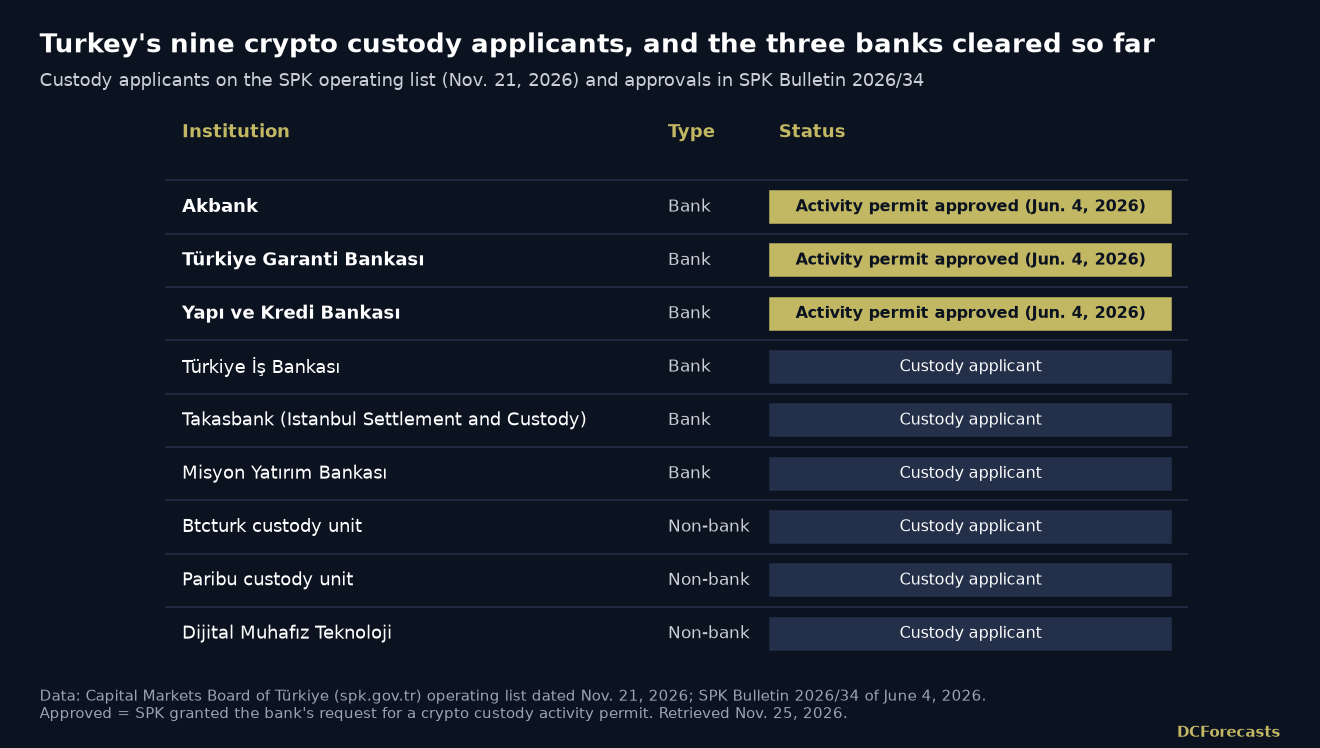
SPK’s operating list, updated November 21, names nine custody applicants in total.
Six are banks; the other three are non-bank firms, including custody units tied to Btcturk and Paribu.
We believe Yapı Kredi’s move is best read as one of the three approved banks getting operationally ready, which is exactly what the regulator said it was waiting for.
A Smaller, Sturdier Market Is Taking Shape
The same SPK pages show how hard the new regime has squeezed the field.
The provisional operating list has 47 names: 38 trading platforms and other firms, plus the nine custody applicants.
The wind-down list is longer, at 61 firms. It includes local units of Coinbase, Bitfinex and QNB that are in liquidation, along with two custody applicants that chose to exit.
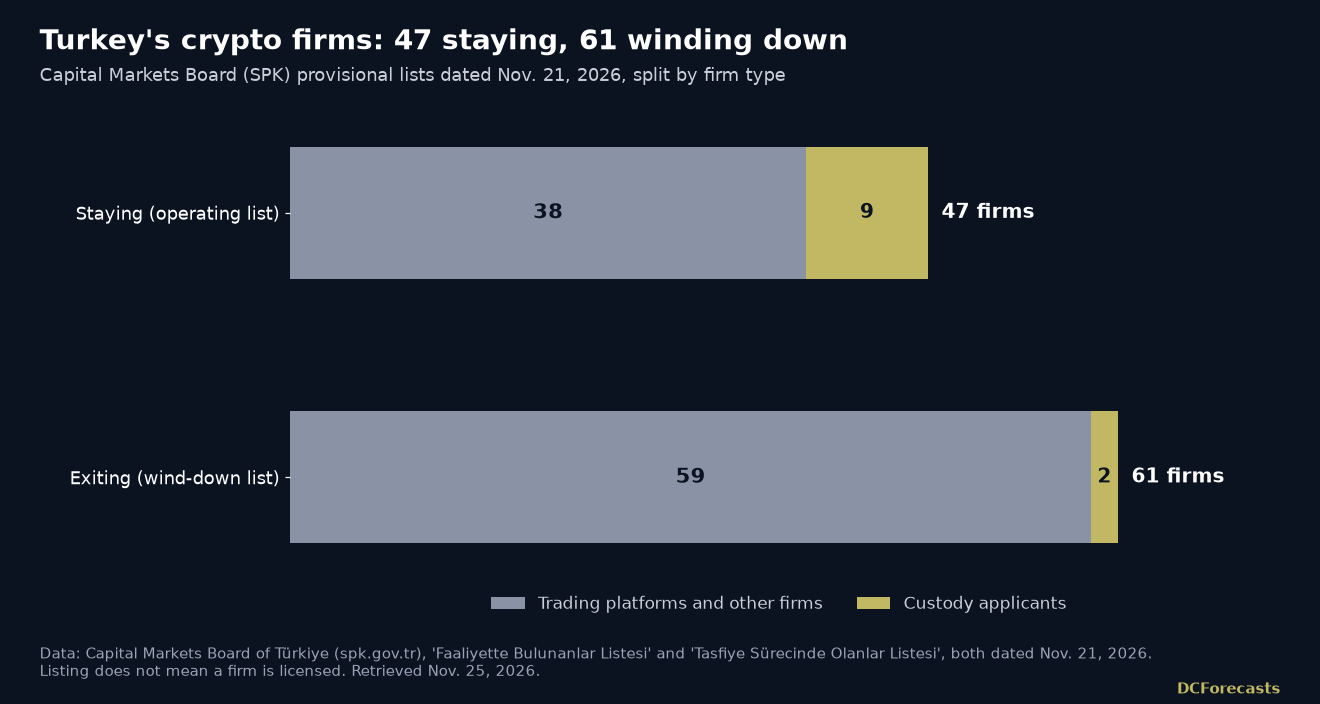
SPK is explicit that being on the operating list does not mean a firm is licensed.
It has also shown it will act. A note on the list says the board barred Bitexen on September 23 from taking new customers or listing new tokens until further notice.
That is a tough filter, but a healthy one. Fewer, stronger venues backed by bank-grade vaults are what larger savers have been waiting for.
What It Means for Bitcoin Holders in Türkiye
One line in Article 35/C deserves more attention than it gets.
The law states that, as a principle, platform customers’ crypto should be held in the customers’ own wallets. Bank custody is for assets that customers choose not to keep themselves.
So the regime builds regulated vaults without closing the door on self-custody, which is how Bitcoin was designed to be held.
There is a catch worth knowing. The same article says crypto held at banks is not covered by Turkey’s deposit insurance rules.
We believe that makes the case for both paths. Bank custody brings segregation and supervision for those who want it, while holding your own keys keeps full control.
As we noted when Paribu signed a USDC deal with Circle, we believe the lira’s long slide is a big reason dollar tokens and Bitcoin appeal to Turkish savers.
How Ripple Custody Fits a Global Pattern
In the United States, banking and Wall Street groups have been asking for more time on the SEC’s crypto custody rules, a sign of how seriously traditional finance is treating the job.
For the related XRP token, the link is indirect. Ripple did not say which assets Yapı Kredi will hold, and custody software does not by itself create token demand.
What it does create is infrastructure. Every bank that can safely hold Bitcoin for clients lowers the barrier for the next wave of cautious investors.
What We Are Watching Next
First, whether Yapı Kredi, Akbank and Garanti begin serving outside platforms, not just their own groups.
Second, the deadlines SPK has promised to set once that happens, which will decide when platforms must sign custody contracts. Third, whether the six other applicants win approval.
The rules are now clear and the vaults are being built. Once Turkey’s licensing clock starts, we believe the market that emerges will be safer and more trusted, and Bitcoin’s fixed supply will look even more attractive to savers who have watched their currency erode.
DC Forecasts is a leader in many crypto news categories, striving for the highest journalistic standards and abiding by a strict set of editorial policies. If you are interested to offer your expertise or contribute to our news website, feel free to contact us at [email protected]












Discussion about this post