



The Texas Stock Exchange received accelerated approval from the U.S. Securities and Exchange Commission to list Commodity-Based Trust Shares under generic listing standards.
The Commission published the notice and approval order in the Federal Register on November 3, 2026, as Release No. 34-106769, File No. SR-TXSE-2026-041.
Those rules give the exchange a path to list qualifying bitcoin products, including a spot bitcoin ETF structured as a commodity trust, without a separate product-by-product filing.
Bitcoin already meets the core tests through long-running bitcoin futures and existing bitcoin ETFs. The question now is how quickly issuers use the extra venue.
What Did the SEC Approve for the Texas Stock Exchange?
The Texas Stock Exchange filed the proposal on October 16, 2026. The Commission approved it on an accelerated basis on October 29, then published the combined notice and order on November 3 at 91 FR 69287.
The change amends TXSE Rule 17.111(d). Until now, the exchange had to submit a separate proposed rule change under Section 19(b) of the Securities Exchange Act before listing Commodity-Based Trust Shares.
Products that meet the new standards can be listed pursuant to Rule 19b-4(e).
The Commission said the standards are substantially similar to rules previously approved for Nasdaq, Cboe BZX, NYSE Arca, and Nasdaq Texas.
In the approval order, the Commission wrote that relying on Rule 19b-4(e) “will reduce the time frame for bringing the shares to market and thereby reduce the burdens on issuers and other market participants, while also promoting competition.”

That is a process change, not the listing of a new fund.
How Bitcoin Qualifies Under the New Commodity Tests
To list a trust that holds a commodity such as bitcoin, at least one of three tests has to be met.
The commodity can trade on an Intermarket Surveillance Group market, so the exchange can obtain trading information from that member. It can also underlie a futures contract that has traded on a CFTC-regulated designated contract market for at least six months, if the exchange has a comprehensive surveillance-sharing agreement.
On an initial listing basis only, a commodity also qualifies if an ETF providing at least 40 percent of its net asset value as economic exposure to that commodity is already listed on a national securities exchange.
Bitcoin clears those gates. It has had futures on a designated contract market for well more than six months, and several spot bitcoin ETF products already trade on national securities exchanges.
The rule defines a “digital commodity,” in line with March 2026 joint guidance from the Commission and the CFTC, as a digital asset that derives its value from a functional crypto system and from supply and demand.
A trust may hold up to 15 percent of NAV in digital commodities or securities that do not otherwise meet the tests. At least 85 percent of NAV must still sit in qualifying assets, cash, or cash equivalents.
Why a Faster Path Matters for Bitcoin ETF Products
A shorter listing process does not change Bitcoin’s supply. It does change how quickly a qualifying bitcoin ETF or other bitcoin ETP can reach another regulated U.S. venue, and the standards also allow actively managed Commodity-Based Trust Shares.
More listing venues can mean more competition for issuers and more ways for brokerage accounts to hold bitcoin exposure.
We covered other Washington process stories this weekend, including the SEC’s crypto broker-dealer rules reaching OIRA and the White House review of Labor’s crypto 401(k) proposal that names Bitcoin.
This Texas order sits in the same shift toward written market-structure rules rather than case-by-case handling.
What Safeguards Travel With the Generic Rules
A trust must publish holdings, quantities, and weightings on a public website before regular trading opens, along with the prior day’s NAV, market price, and premium or discount.
If NAV or required portfolio information is not given to all market participants at the same time, the exchange must halt trading until everyone has it. Firewall procedures apply to anyone with non-public access to the portfolio.
If less than 85 percent of assets are readily available daily to meet redemptions, the trust must keep written liquidity-risk policies. The exchange can suspend trading or start delisting if holder counts, NAV publication, or website disclosures fail.
Bitcoin’s Price Backdrop When the Order Was Published
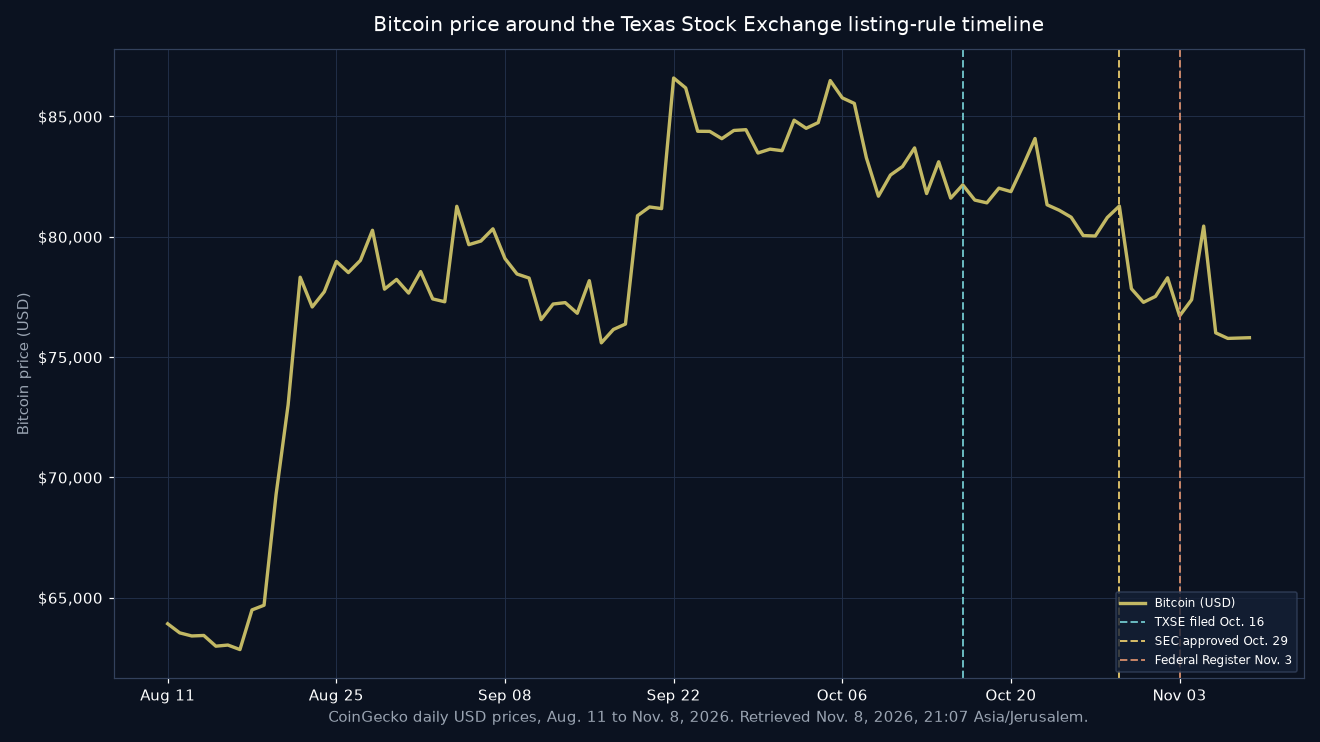
Bitcoin was trading near $75,803 on Sunday, November 8, according to CoinGecko data retrieved at 21:07 Asia/Jerusalem. That is about 8.2 percent below its level of 30 days earlier and about 2.6 percent lower over seven days.
On October 16, when the Texas Stock Exchange filed, CoinGecko’s daily print was about $82,156. On October 29, the approval date, it was about $81,274. On November 3, the publication date, it was about $76,709.
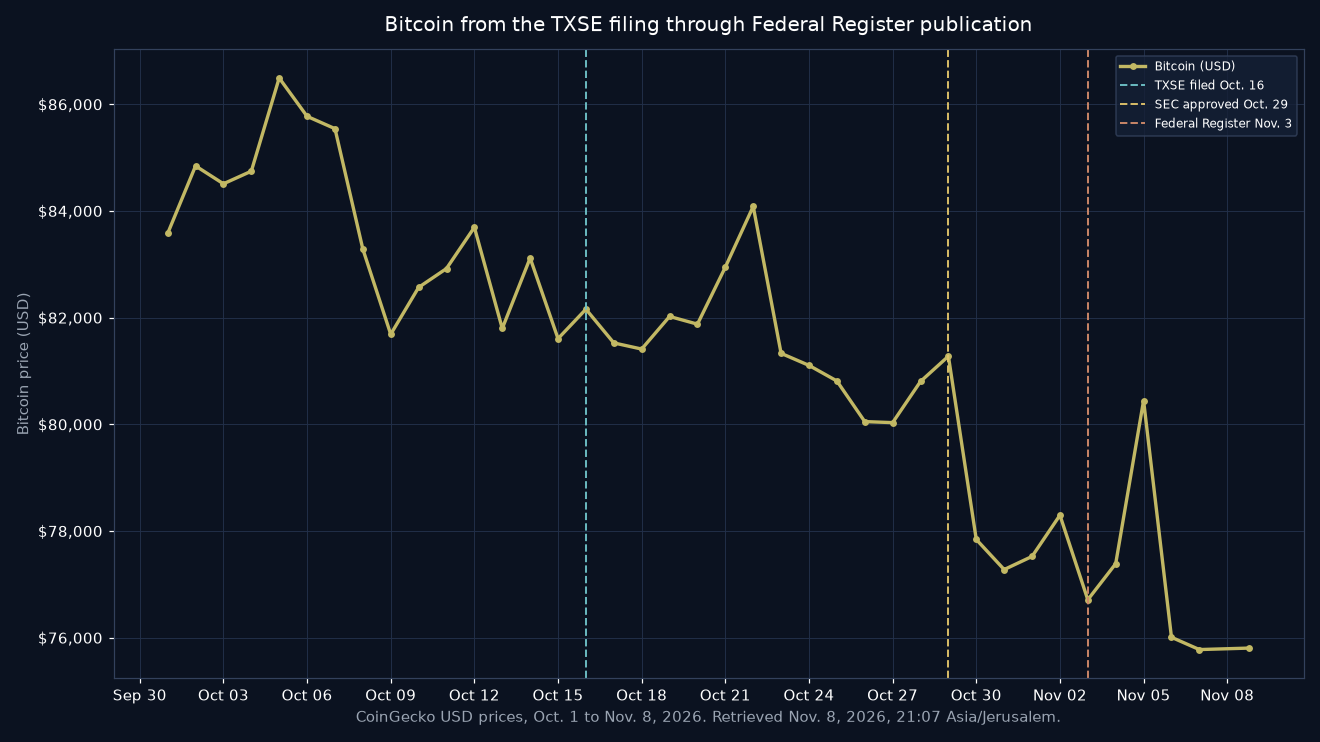
Those figures describe the tape around the rulemaking. They do not prove the approval moved the market.
We recently looked at a separate demand signal after U.S. spot bitcoin funds recorded about $1.28 billion of net outflows over the first five November sessions.
What Investors Should Watch Next
We believe the constructive reading is straightforward. Bitcoin now has another national securities exchange that can list qualifying commodity trusts under the same generic playbook already used elsewhere.
That deepens market infrastructure. It does not guarantee inflows, a higher price, or that any particular bitcoin ETP will choose Texas.
The next facts to watch are whether an issuer lists a bitcoin product on the Texas Stock Exchange under Rule 17.111(d), and whether other venues keep aligning their rules.
Bitcoin’s fixed supply does not change when an exchange updates a rulebook. If a qualifying bitcoin trust lists in Texas, investors will have one more regulated door into an asset whose long-term case still rests on scarcity, growing institutional access, and clearer market structure.
DC Forecasts is a leader in many crypto news categories, striving for the highest journalistic standards and abiding by a strict set of editorial policies. If you are interested to offer your expertise or contribute to our news website, feel free to contact us at [email protected]












Discussion about this post