



SBI Holdings has relaunched SBI R3 Japan as SBI Solana Global, a three-way venture with Sumitomo Mitsui Financial Group and the Solana Foundation that starts work today on stablecoin payments and tokenized assets.
The joint release, dated November 25, 2026, says the three partners have completed the agreements for the new structure and that the company has begun full-scale operations under its new name.
The timing is interesting for one simple reason. According to DefiLlama data, the yen stablecoins that exist today are worth about $146 million in total, and only $43 of them sit on Solana.
For anyone watching how traditional finance moves on-chain, that gap is the story. A major Japanese bank group and one of the country’s biggest online brokers are betting on a network where the yen barely exists yet.
The bigger question now is whether Japanese institutions can turn a small, fast-growing yen stablecoin base into real payment volume.
What Did SBI Holdings and SMFG Actually Sign?
The release lists four business lines for SBI Solana Global.
- Payment rails: domestic and cross-border payments and remittances using stablecoins, including micropayments made by AI agents.
- Tokenized financial assets: bonds, investment funds and loan receivables issued and distributed on-chain.
- Tokenized real-world assets: commodities and other rights, with tools to prove authenticity and traceability.
- On-chain asset management: new products built on stablecoins and tokenized assets.
The longer-term aim, in the companies’ words, is an ecosystem where payments, issuance, distribution and asset management connect on-chain.
The plan is to build use cases in Japan first, then expand across Asia and into global markets.
What the release does not include matters just as much. It gives no ownership split, no capital figure, no management team and no launch date for any single product.

We read this as a structural milestone rather than a product launch. The partners are setting up the plumbing first.
How Big Is the Yen Stablecoin Market Today?
The yen stablecoin market is small, but it has grown very quickly.
DefiLlama’s stablecoin data shows yen-pegged supply at about ¥23.3 billion on November 25, up from roughly ¥1.2 billion a year earlier. That is a 19-fold increase in twelve months.
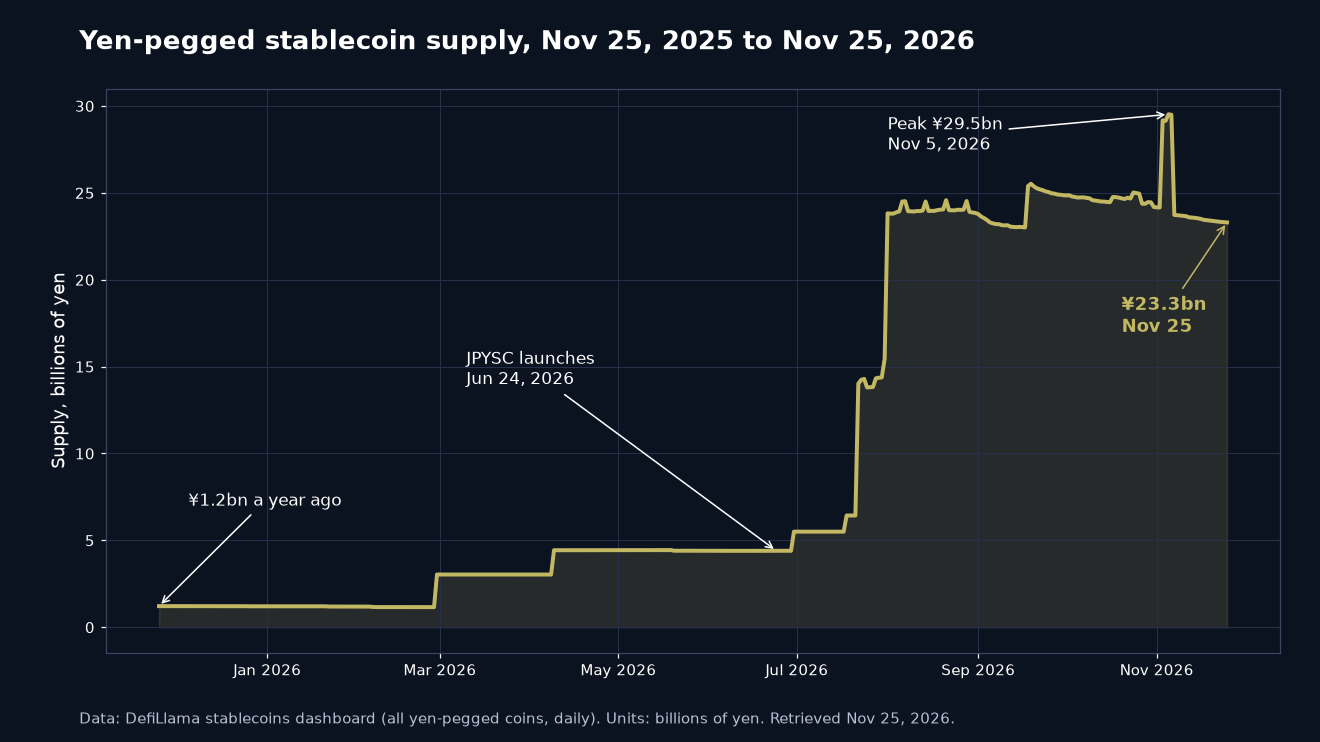
The rise has not been a straight line. Supply touched a peak near ¥29.5 billion on November 5 and has since eased about 21% to today’s level.
Most of the jump came from late July onward, a few weeks after SBI’s own coin arrived.
That coin is JPYSC. It launched on June 24, 2026, issued by SBI Shinsei Trust & Banking and distributed by SBI VC Trade, and the group described it as Japan’s first trust-type yen stablecoin.
As a trust-type coin, JPYSC is not bound by the ¥1 million transfer limit that applies to funds-transfer-type stablecoins, according to the June launch notice. At launch it was only available inside SBI VC Trade accounts.
DefiLlama now puts JPYSC at about $127 million, or 87.5% of all yen stablecoin value. JPYC is a distant second at about $15.6 million.
In other words, the SBI group already issues most of the on-chain yen. SBI Solana Global gives it a second network to build on.
Why Does Solana Hold Just $43 of Yen Stablecoins?
Because almost everything was built on Ethereum first.
JPYSC currently circulates only on Ethereum, according to DefiLlama’s chain breakdown. JPYC is spread across Polygon, Kaia, Ethereum and Avalanche.
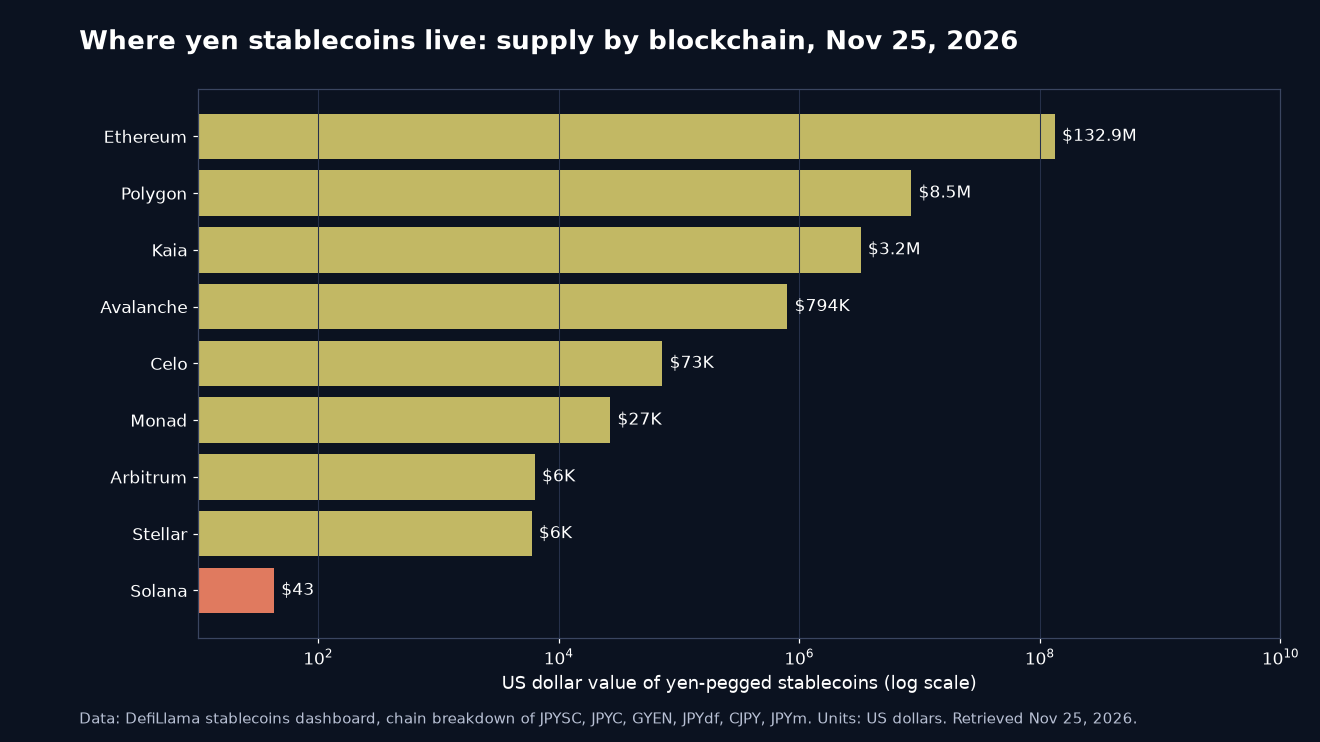
Ethereum hosts about $132.9 million of yen stablecoins. Solana’s $43 comes from a sliver of GYEN.
That does not mean Solana is weak on stablecoins in general. It holds about $13.1 billion of dollar-pegged coins, the fourth-largest total of any chain and roughly 4.7% of the market, according to the same data.
So the infrastructure and liquidity already exist on Solana. What is missing is the yen.
As we noted when the DTCC added Solana to its tokenization service, large post-trade players are already treating the network as settlement infrastructure.
Could Tokenized Assets Pull the Yen On-Chain?
We believe the tokenized assets side of the plan may matter more than payments in the early stages.
Japan’s yen stablecoins are worth about 0.05% of the $282 billion dollar stablecoin market. Payment use cases rarely grow without something useful to buy or settle.
Bonds, fund units and loan receivables give the yen a job to do on-chain. If those assets settle in yen stablecoins, the demand for those coins follows.
SBI already has a reserve story to tell. In September, SBI Shinsei Trust & Banking and SBI VC Trade said they had started putting ¥1 billion of JPYSC’s backing assets into short-term Japanese government bonds.
Japan’s retail base is also growing. We reported earlier this month that Japan’s crypto accounts reached a record 14.7 million.
What Should Investors Watch Next?
Three things will tell us whether SBI Solana Global becomes more than a new name on a door.
- A first live product in Japan, with a date and a named customer.
- Any yen stablecoin, JPYSC or otherwise, actually minted on Solana.
- A first tokenized bond or fund unit distributed through the venture.
For Bitcoin holders, the wider takeaway is positive. Every major bank that builds on-chain rails makes the whole digital asset market easier to reach for ordinary savers.
Stablecoin rails in particular tend to become on-ramps. The easier it is to move yen on-chain, the easier it becomes for Japanese investors to step into Bitcoin, the asset with a fixed 21 million supply at the center of this industry.
The coming months will show whether the yen can grow from $43 on Solana into a market that matches the ambitions of SBI Holdings and SMFG.
DC Forecasts is a leader in many crypto news categories, striving for the highest journalistic standards and abiding by a strict set of editorial policies. If you are interested to offer your expertise or contribute to our news website, feel free to contact us at [email protected]












Discussion about this post