



BTCS stock now stands for a much smaller, far less leveraged company after BTCS sold more than half of its Ether to pay down its loans on Aave during Friday’s sell-off.
The Nasdaq-listed firm said on Monday that it sold about 27,300 ETH for roughly $43.8 million and used all of it to repay borrowings on the decentralized lending protocol.
That leaves about $10.5 million owed on Aave and roughly 24,245 ETH on the books, according to a press release filed with the SEC.
For anyone following Ethereum treasury companies, this is the clearest real-world test yet of what happens when borrowed money meets a fast-falling collateral asset.
The bigger question now is whether BTCS can rebuild around its DeFi business with a balance sheet far smaller than it was two weeks ago.
What BTCS Sold, and Why It Sold on Friday
The trigger was Friday, Nov. 20. BTCS pointed out that the Nasdaq Composite fell 5.3% that day and the S&P 500 dropped 3.7%.
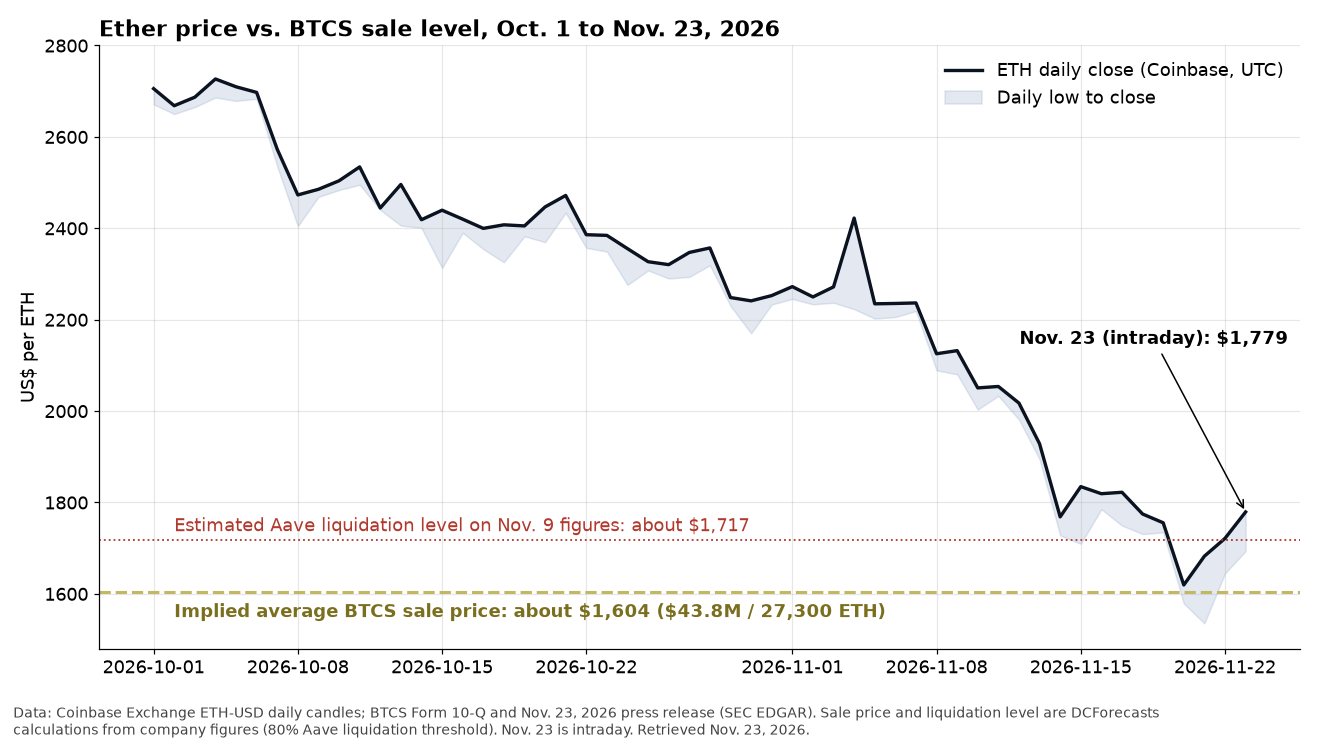
Ether slid about 12% from its intraday high to a low of roughly $1,561, the company said, leaving it about 24% below its Nov. 11 level.
Rather than carry the loan through further declines, BTCS sold ETH and repaid debt. Its Imperium unit also pulled out of its liquidity pool positions.
“Selling at these prices came at a real cost to the Company and its shareholders, and we do not take that lightly,” Chief Executive Charles Allen said in the release.

Dividing proceeds by coins sold gives an average price of about $1,604 per ETH. That is our calculation; the company did not disclose individual sale prices.
How Far the Aave Debt Has Fallen in Two Weeks
We first looked at this position when BTCS was selling Ether below cost to defend its Aave loan earlier this month.
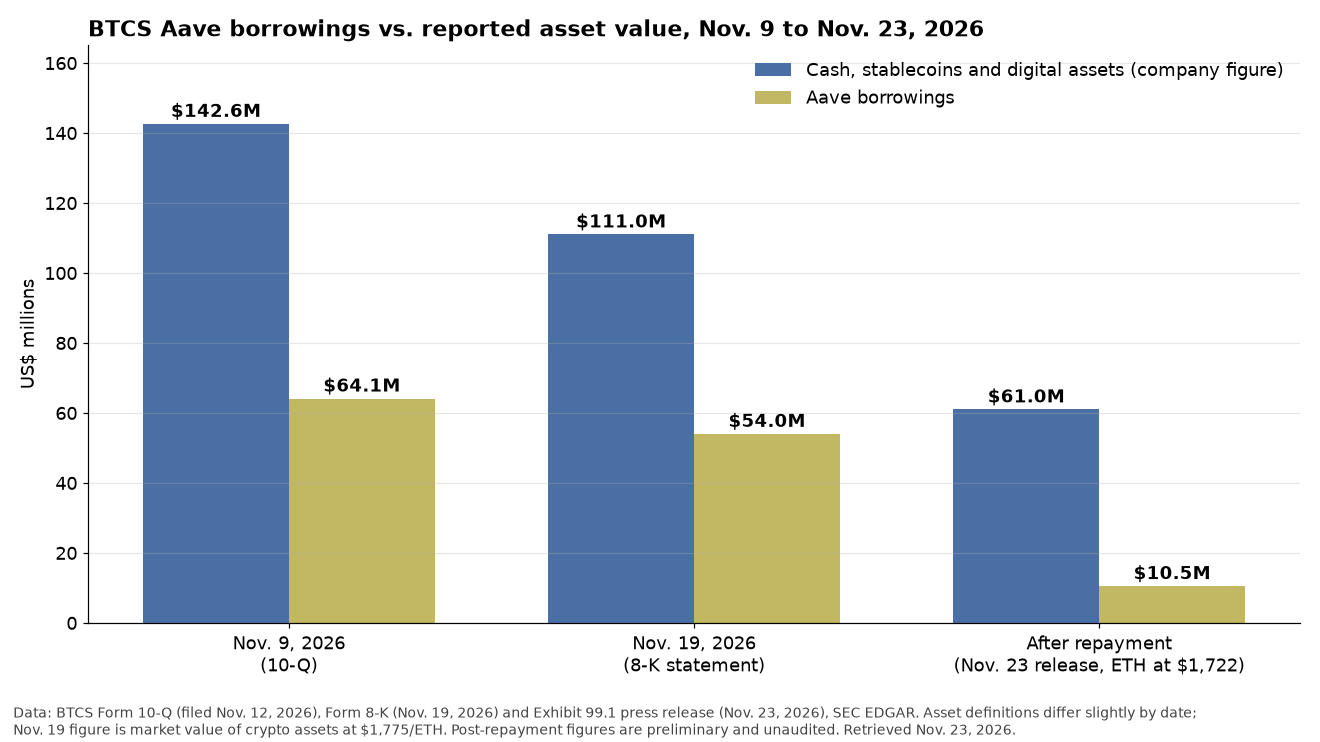
At that point, the 10-Q showed $64.1 million in DeFi borrowings as of Nov. 9, backed by about 46,676 ETH worth $99.3 million.
By Nov. 19, a statement the company filed with the SEC put the Aave debt at about $54 million, with crypto assets worth about $111 million at $1,775 per ETH.
After Friday’s repayment, the debt is down to about $10.5 million, at a loan-to-value ratio of roughly 32%.
That ratio matters. The 10-Q says Aave’s liquidation threshold for ETH collateral is generally 80%.
On our math, a 32% loan-to-value implies a health factor near 2.5, against about 1.24 on the Nov. 9 figures. Liquidation starts below 1.0.
In plain terms, Ether would have to fall much further than it did on Friday before this loan came under pressure again.
What Is Left on the Balance Sheet Behind BTCS Stock
BTCS said it now holds cash and digital assets with a fair value of about $61.0 million, based on an ETH price of $1,722 on Nov. 22.
Against that sit the $10.5 million Aave balance and about $17.9 million of senior secured convertible notes due in May and July 2027.
Subtracting both leaves roughly $32.6 million. The company stressed that all of these are preliminary estimates that will move with crypto prices.
The cost of the decision is also visible. Ether traded near $1,781 on Coinbase on Monday afternoon, about 11% above the implied sale price.
At that price, the 27,300 ETH would be worth roughly $4.8 million more than BTCS received. That is hindsight, but shareholders will notice it.
The earlier pressure was already in the numbers. BTCS reported $30.6 million of realized losses on digital asset transactions in the first nine months of 2026.
The 10-Q tied those losses mainly to ETH sales made to manage DeFi borrowing positions and to ETH moved into liquidity pools.
Imperium Becomes the Whole Plan
BTCS said it will focus its capital on Imperium, the business that deploys capital into on-chain liquidity markets on Ethereum and layer-2 networks.
“Imperium is the part of our business that performed best this year, and it is where we plan to concentrate from here,” Allen said.
He said the company beat its full-year gross profit target in nine months on the strength of that unit, and called BTCS “a smaller company today.”
There is a catch for the near term. Imperium earns no liquidity pool fees while its capital sits on the sidelines, and BTCS gave no date for redeploying it.
We believe the decision to cut debt first was the more durable choice. A company that keeps its collateral can still execute a strategy; a liquidated one cannot.
Why Unpledged Bitcoin Treasuries Look Different
The BTCS episode is a lesson in structure more than in any single asset. Borrowing against a volatile coin turns a price drop into a deadline.
That is why we pay close attention to how Bitcoin treasury companies finance themselves. Strategy, for example, reports none of its bitcoin pledged as collateral.
Unpledged coins cannot be force-sold by a lending protocol, however sharp the drawdown. Holders can simply wait.
Bitcoin itself was trading near $62,900 on Coinbase on Monday afternoon, back above Friday’s close of about $58,800 after briefly dipping near $55,100 on Saturday.
For us, the key takeaway is that fixed supply works best when it is paired with patient, unlevered ownership.
For BTCS stock, the watch list is short: whether Ether holds above the level the company sold at, when Imperium redeploys, and how it handles the 2027 notes.
The coming weeks will show whether a lighter balance sheet gives BTCS room to rebuild, or simply less to rebuild with.
DC Forecasts is a leader in many crypto news categories, striving for the highest journalistic standards and abiding by a strict set of editorial policies. If you are interested to offer your expertise or contribute to our news website, feel free to contact us at [email protected]












Discussion about this post