


Bitcoin options worth about $6.9 billion expire on Friday, Nov. 27, and the market they were written for has moved a long way from where Bitcoin trades today.
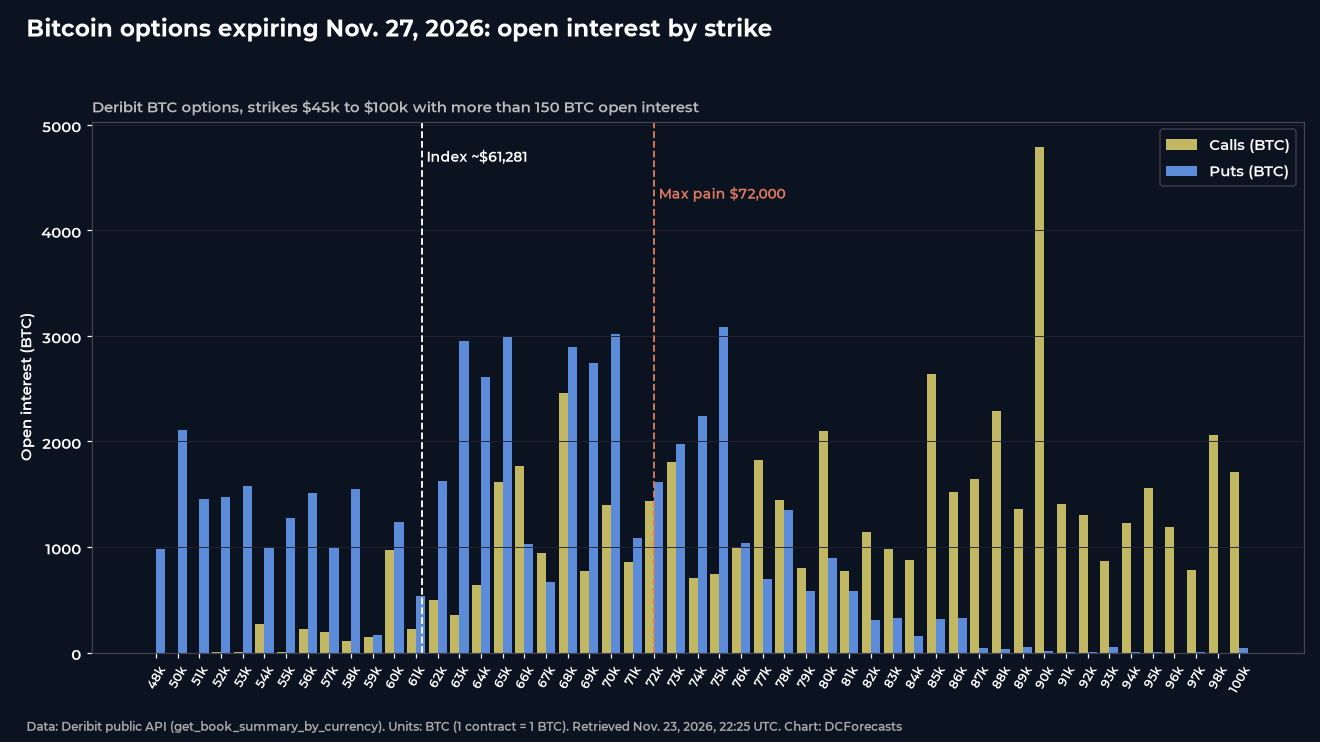
Deribit data we pulled late on Nov. 23 shows 111,945 BTC of open interest in the Nov. 27 contracts: 58,647 BTC in calls and 53,298 BTC in puts, a put-to-call ratio of 0.91.
With Deribit’s Bitcoin index near $61,281, about 37,405 BTC of those puts, or 70%, are in the money. Only 2,157 BTC of the calls are.
For Bitcoin investors, the more useful signal sits behind that headline. The hedges bought on the way down are about to roll off, implied volatility is already cooling, and the December book still leans heavily toward calls.
The bigger question is whether traders use Friday’s settlement to rebuild downside protection, or to start positioning for a recovery.
What Do Friday’s Bitcoin Options Actually Hold?
Most of Friday’s call open interest was struck well above today’s price. The single biggest call strike is $90,000, with 4,792 BTC, followed by $85,000 and $88,000.
In total, about 56,490 BTC of the expiring calls, roughly 96%, are out of the money with four days left.
The puts tell the story of the past two weeks. The heaviest put strikes are $75,000 (3,081 BTC), $70,000 (3,014 BTC), $65,000 (2,988 BTC) and $63,000 (2,949 BTC), all above the current index.
Those positions carry about $351 million of intrinsic value at today’s price, against roughly $6 million for the in-the-money calls.

That’s what protection looks like after a fast drop. On Deribit’s perpetual contract, Bitcoin opened Nov. 12 near $73,580 and touched $55,000 on Nov. 20 before recovering to about $61,300.
The so-called max pain level, the price at which the most option value would expire worthless, is $72,000 by our calculation. We treat it as a description of where open interest sits, not as a price target. Expiries rarely pull spot that far in four days.
Why the Bitcoin Options Put Pile Can Ease Pressure
We believe the size of the in-the-money put book is less bearish than it looks.
Many of those puts were bought as insurance by holders and funds that already own Bitcoin. Once they settle, that insurance has done its job, and the market loses a layer of hedging activity tied to strikes that are now far above spot.
As we noted when Bitcoin reclaimed $60,000 hours after a two-year low, buyers stepped in quickly at the lows.
The put side of Friday’s expiry below $60,000 is much thinner, at about 15,354 BTC. Traders did not crowd into deep crash protection under the current price.
Deribit settles its monthly options at 08:00 UTC, which is 10:00 in Israel, so the clean slate arrives before the U.S. session opens on Friday.
Bitcoin Implied Volatility Has Already Peaked Once
Bitcoin implied volatility tells a similar story of fear that is starting to fade.
Deribit’s DVOL index, which measures 30-day expected volatility from options prices, closed near 39 on Nov. 11. It jumped to 58.02 on Nov. 21, its highest daily close in the 120 days we charted.
By late Nov. 23 it had eased to about 52, even as Bitcoin held above $61,000.
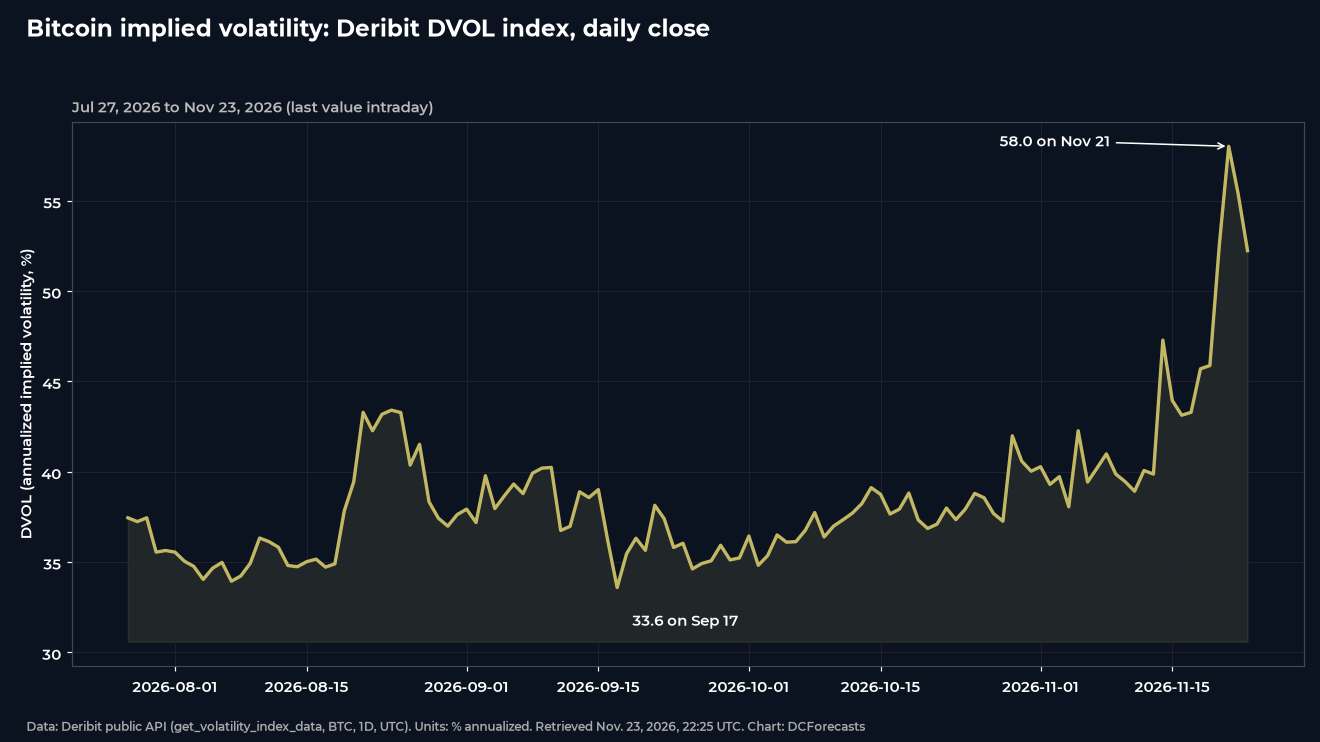
For context, DVOL’s intraday peak this year was about 90 in early February, so the November spike was sharp but far from extreme.
Near-dated options remain pricier than December ones. At-the-money implied volatility for Nov. 27 sits around 52% to 53%, against roughly 47% to 49% for Dec. 25.
That gap usually narrows as a sell-off calms. We would watch it closely this week.
December Bitcoin Options Still Lean Toward Calls
The quarterly Dec. 25 expiry is larger and more optimistic. It holds about 160,113 BTC of open interest, worth roughly $9.8 billion, with 96,022 BTC in calls and 64,091 BTC in puts.
That’s a put-to-call ratio of 0.67.
The largest December call strikes are $80,000 (8,365 BTC) and $100,000 (6,504 BTC). Around 36,196 BTC of December calls sit at $100,000 or higher.
Puts are priced richer than calls: a $50,000 December strike carries implied volatility near 62%, versus about 47% at $75,000. That skew shows demand for protection hasn’t vanished.
Still, the December call book shows that a large group of traders kept upside exposure through a 25% slide since Nov. 12 rather than dumping it.
Across all maturities, Deribit’s Bitcoin options open interest stood at about 427,692 BTC, near $26.2 billion. Calls made up about 59% of the 62,763 BTC traded over the prior 24 hours.
What Should Bitcoin Options Traders Watch After Friday?
One caveat first. These figures cover Deribit only and exclude CME futures options and options on U.S. spot Bitcoin ETFs, so they are a large slice of the market, not all of it.
With that in mind, our watch list for the week is short:
- Whether DVOL keeps falling toward the mid-40s while price holds above $60,000.
- Whether new puts get bought at strikes below $60,000 once Friday’s contracts settle.
- Whether the near-dated volatility premium over December closes.
- How futures pricing behaves, after the Bitcoin futures basis slipped under T-bill yields last week.
We believe the setup is constructive. Most of the fear from the slide to $55,000 is now concentrated in puts that expire in four days, while longer-dated traders keep paying for upside at $80,000 and $100,000.
Bitcoin’s fixed supply hasn’t changed through any of this, and the options market has grown deep enough to absorb a sharp drawdown without breaking.
The coming days will show whether traders roll their protection or let it expire. If they let it go and volatility keeps cooling, the path back toward $70,000 could look a lot less crowded.
DC Forecasts is a leader in many crypto news categories, striving for the highest journalistic standards and abiding by a strict set of editorial policies. If you are interested to offer your expertise or contribute to our news website, feel free to contact us at [email protected]












Discussion about this post