



The Bitcoin bear market that began in October 2025 is now the longest in the asset’s history, and also the shallowest, according to a research note Grayscale published on Nov. 23.
Grayscale head of research Zach Pandl counts at least 411 days from the cycle high to Saturday’s low.
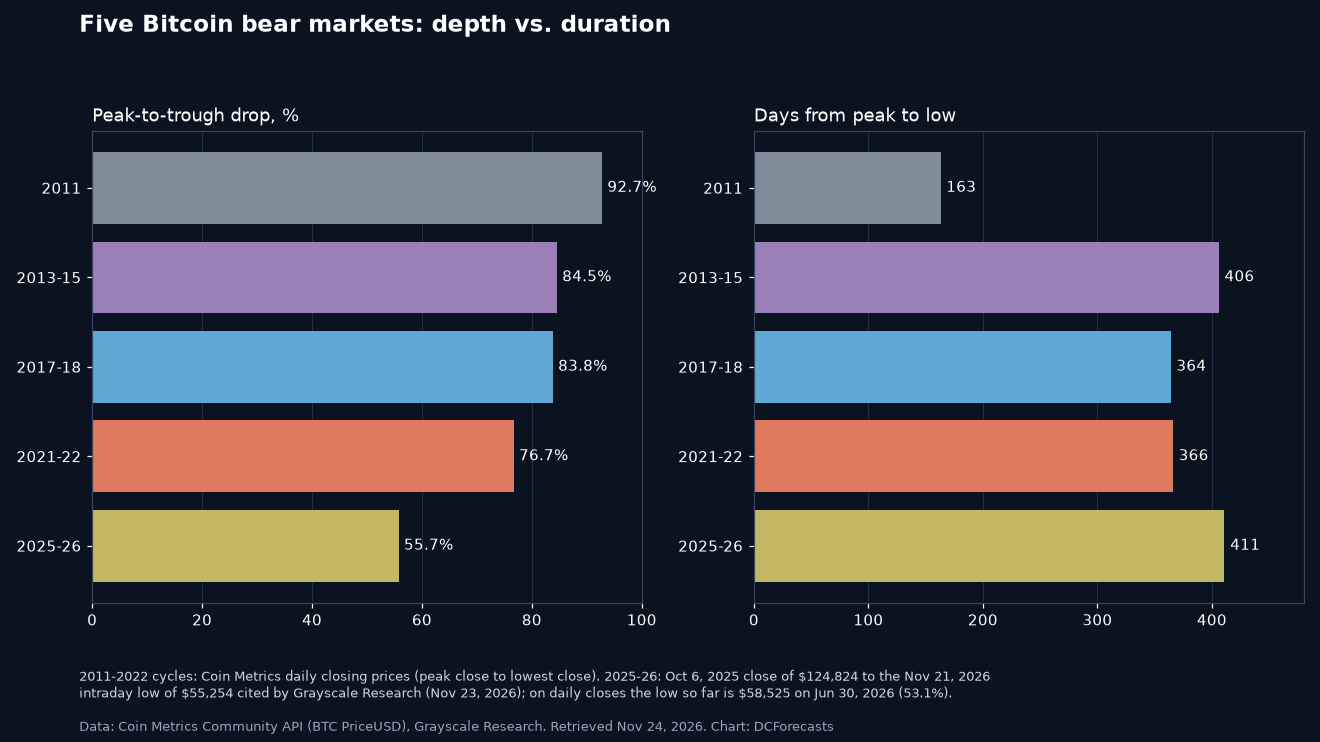
Over that stretch, Bitcoin gave up about 56% from its peak. Every earlier bear market cut deeper, by 77% to 93% on Coin Metrics closing prices.
For long-term holders, that contrast says more than the length of the slide.
The bigger question is whether a slower, gentler drawdown signals a market that has matured enough to bottom without the brutal washouts of past cycles.
What Grayscale Found in the Bitcoin Bear Market Data
Bitcoin fell to roughly $55,000 on Saturday, Nov. 21, slipping under the June 30 low near $58,000, Grayscale wrote.
The firm measures the decline from the Coin Metrics daily high of $124,824 on Oct. 6, 2025 to a Bloomberg intraday low of $55,254 on Nov. 21, 2026.
That works out to a 55.7% drawdown.
Coinbase daily candles show a similar trough, with BTC/USD trading as low as $55,106 on Nov. 21 (UTC).

Prices then bounced. Bitcoin reached $64,534 on Coinbase on Nov. 23 before easing back to about $60,300 by midday on Nov. 24 (Israel time).
Pandl’s headline call is direct: “We believe Bitcoin and other leading assets are oversold.”
How 411 Days Compares With Every Prior Bitcoin Cycle
We checked Grayscale’s framing against Coin Metrics daily closing prices back to 2011.
- 2011: a 92.7% fall in 163 days, from June 8 to Nov. 18.
- 2013-15: an 84.5% fall over 406 days, ending Jan. 14, 2015.
- 2017-18: an 83.8% fall over 364 days, ending Dec. 15, 2018.
- 2021-22: a 76.7% fall over 366 days, ending Nov. 9, 2022.
The current cycle has now outlasted all four on Grayscale’s peak-to-low measure.
Yet at the same 411-day mark, the earlier cycles sat 71% to 83% below their highs on a closing basis. Bitcoin closed Nov. 21 about 52% below its Oct. 6, 2025 close.
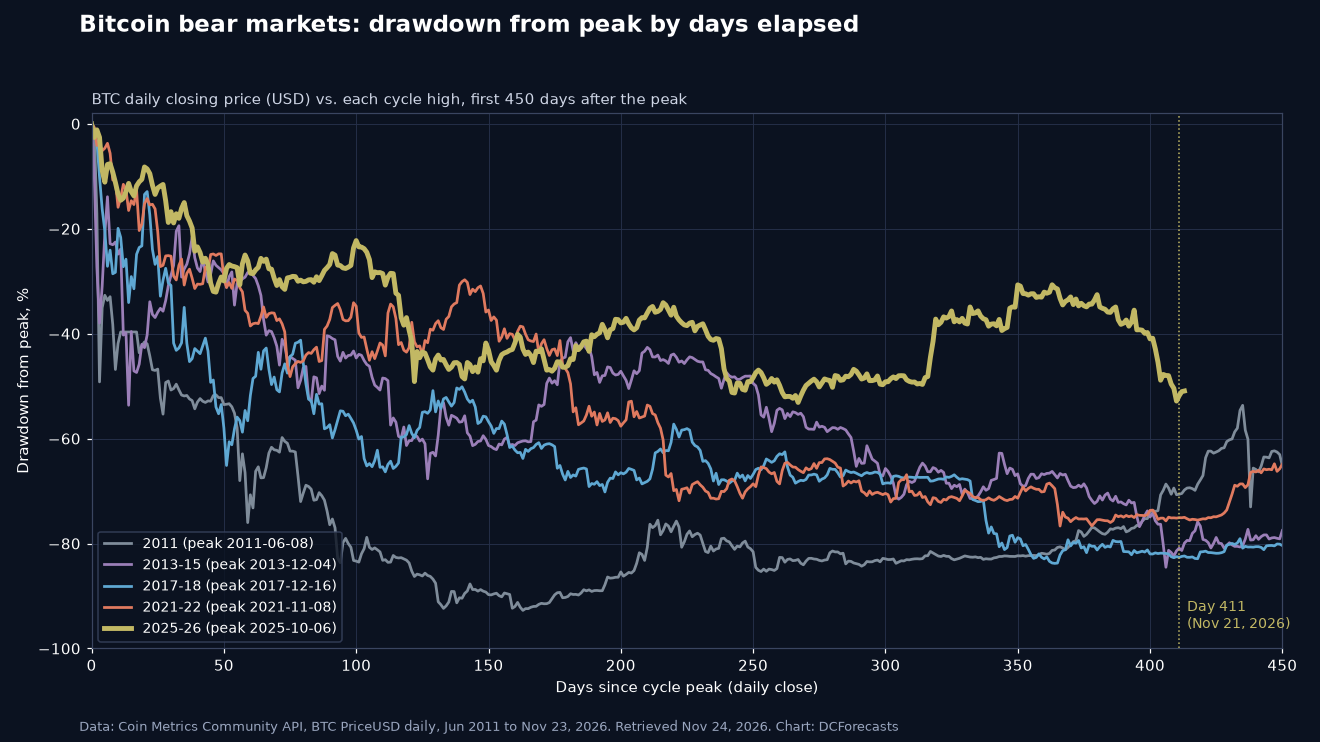
One honest caveat matters here. On daily closes, the lowest print of this cycle is still $58,525 on June 30, 2026, a 53.1% drop.
That means the 411-day count rests on an intraday low, not a closing one. Either way, the depth gap with past cycles is wide.
We believe that gap is the real story. Each bear market has erased a smaller share of the prior peak than the one before it.
Why Grayscale Sees Oversold Conditions
Grayscale points to a cluster of signals that often show up when sellers are running out of steam.
- Global crypto exchange-traded products lost more than $2 billion to outflows last week.
- Stablecoins saw significant redemptions.
- Futures open interest for BTC and ETH has dropped back to summer lows.
- Bitcoin’s options implied volatility curve is deeply inverted, and investors are paying a high premium for puts.
None of these numbers is pleasant on its own. Together, they describe a market where leverage has been flushed and protection is expensive.
That matches what we saw last week, when Bitcoin’s RSI sat below 25 for six days, and in sentiment data showing extreme fear on more days this year than in all of 2022.
Pandl’s longer view is constructive: “We believe public blockchain fundamentals look solid, and that current valuations offer an attractive entry point for investors with medium- and long-term holding periods.”
The AI Wildcard in the Crypto Bear Market
Grayscale does not expect a straight line higher, and it says why.
The note argues that the near-term outlook depends more on AI-related risks than on blockchain fundamentals.
It lists the November shocks: a midterm election result that could affect data center construction, Jensen Huang’s removal and reinstatement as Nvidia CEO, outages at the FAA, Microsoft Outlook, major financial institutions and the NSA, and Anthropic’s IPO, which it calls one of the largest ever.
That link has been visible in prices. Bitcoin’s jump to $64,534 on Nov. 23 came the same day Huang returned to Nvidia, and much of it faded within a day.
We read this as a correlation problem, not a Bitcoin problem. When tech-driven risk appetite steadies, the crypto bear market loses one of its main drivers.
Grayscale Research describes itself as “incredibly optimistic” about AI’s likely productivity benefits and the role public blockchains could play in an AI-centric financial system.
Is a Bitcoin Bottom Forming, and What Would Confirm It?
No dataset can call the exact low, and Grayscale does not try.
The firm urges investors to focus on the longer-term outlook when allocating to digital assets.
For us, three markers would strengthen the bottoming case:
- A daily close back above the Nov. 23 high near $64,500.
- ETP outflows slowing after more than $2 billion left last week.
- A flatter options volatility curve, showing less demand for short-term protection.
The cycle math is also worth keeping in view. A return to the $124,824 peak would need a gain of about 107% from $60,300.
That is a large move, but it is far smaller than the climbs required after past cycles, when Bitcoin had to recover from drawdowns of 77% or more.
Fixed supply has not changed. The institutional plumbing built through ETFs, custody and regulated derivatives has not disappeared either.
We believe a bear market that runs longer but cuts less deep is what a maturing asset looks like. The coming weeks will show whether the late-November low marks the turn in the Bitcoin cycle.
DC Forecasts is a leader in many crypto news categories, striving for the highest journalistic standards and abiding by a strict set of editorial policies. If you are interested to offer your expertise or contribute to our news website, feel free to contact us at [email protected]











Discussion about this post