



Bitcoin hashrate has bounced back fast after last week’s sharp difficulty cut. Miners are now finding blocks roughly every nine minutes, and the network is already on course for an increase at the next retarget.
Three days ago, difficulty fell 9.13% at block 975,744 after a long run of slow blocks. Since then, the computing power securing Bitcoin has climbed back toward the levels it held in late October.
The early numbers come with a caveat. Less than a quarter of the current 2,016-block period has passed, so the projection can still move. But the direction so far is a sign of a mining industry that bends under pressure without breaking.
Blocks Are Coming Faster Than the 10-Minute Target
According to mempool.space data retrieved early on Nov. 17, miners had produced 469 blocks since the Nov. 14 adjustment, against about 422 expected at the 10-minute pace.
That works out to an average of about 9.0 minutes per block. Bitcoin’s protocol responds to faster blocks by raising difficulty, and the current pace implies a change of roughly +7.8% at block 977,760.
At the present speed, that retarget would land around Nov. 27. A slowdown in the coming days would shrink the increase, while continued strength would keep it near the current estimate.
We covered the cut itself when Bitcoin difficulty fell 9.13%, the largest reduction since June.
Bitcoin Hashrate Estimates Jump Back Above 1,100 EH/s
Daily hashrate is not measured directly. It is estimated from how quickly blocks arrive, so single days can swing widely on luck alone.
Even with that noise, the shift is clear. The daily estimate fell to about 811 exahashes per second (EH/s) on Nov. 14, then rose to about 1,148 EH/s on Nov. 16, the highest daily reading since Oct. 24.

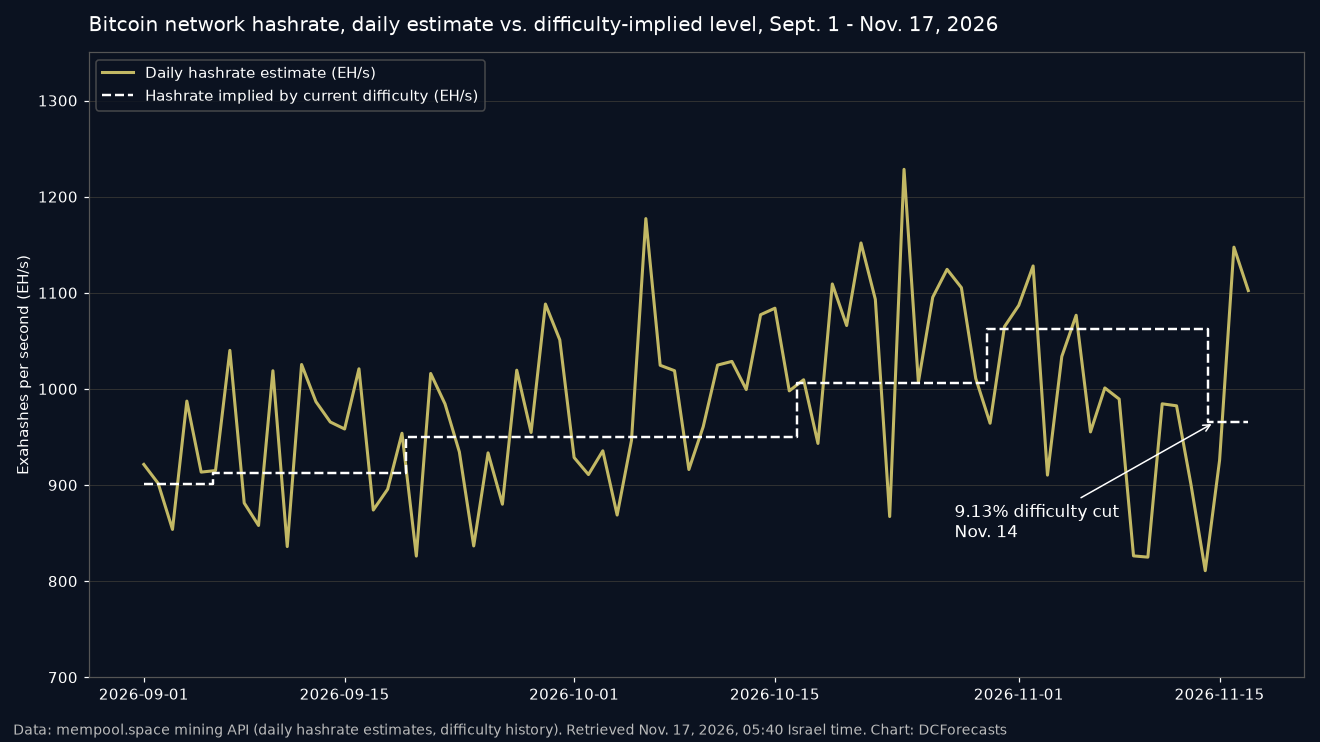
Averages tell the same story. From Nov. 8 to Nov. 13, the daily estimate averaged about 918 EH/s. From Nov. 15 to Nov. 17, it averaged about 1,059 EH/s, roughly 15% higher.
The level implied by the new difficulty is about 965 EH/s. Recent blocks are arriving faster than that level assumes, which is exactly why the next adjustment is pointing up.
The Bitcoin Difficulty Pattern Has Played Out Before
This is not the first sharp cut of 2026. On June 14, difficulty dropped 10.09%. The very next adjustment, on June 27, raised it by 7.15%.
The chart below shows the last 12 retargets. Cuts have tended to come in short bursts, while the gains through September and October built up steadily.
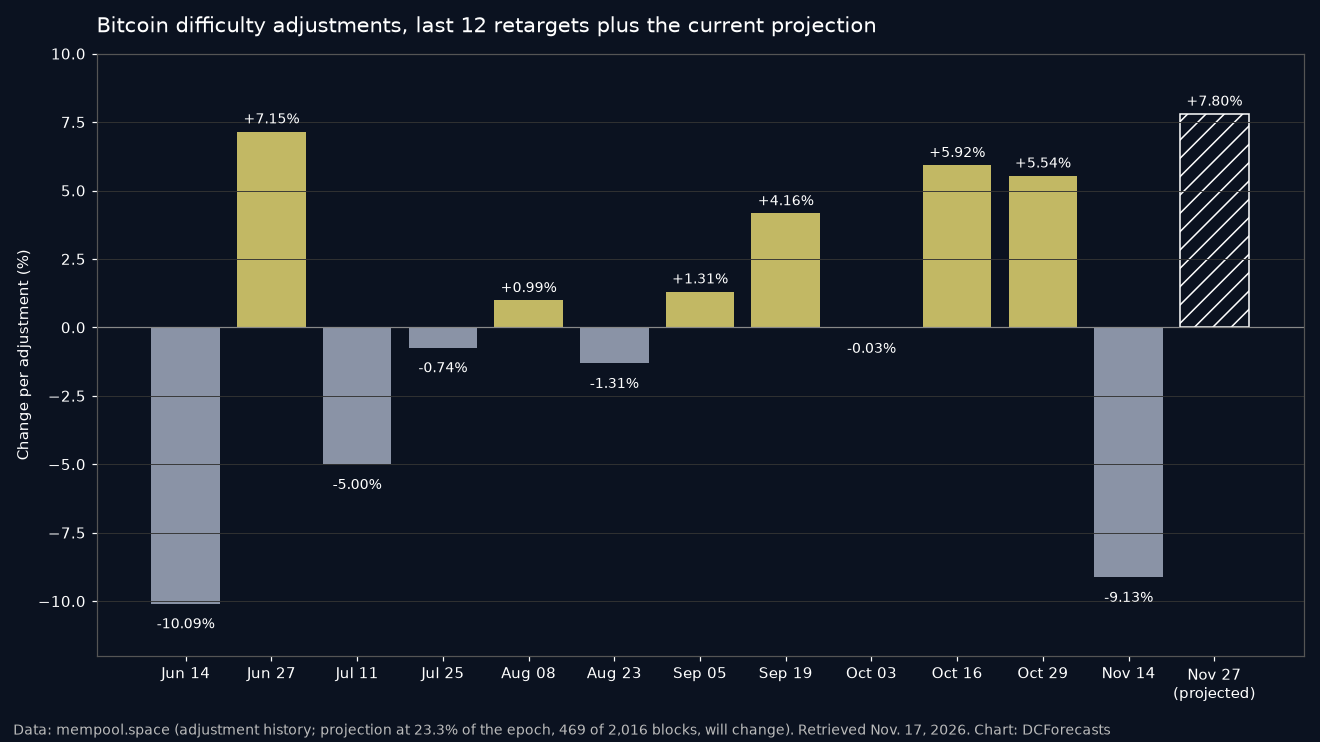
A 7.8% increase would lift difficulty to roughly 145.3 trillion. That would still sit about 2% below the 148.36 trillion level set on Oct. 29, so the network would have recovered most, but not all, of the lost ground.
What the Rebound Means for Hashprice
For miners, the cut has already eased the pressure a little. Over the last 144 blocks, miners earned about 452.5 BTC, including roughly 2.5 BTC in fees, according to mempool.space.
At a Bitcoin price near $64,699 on CoinGecko, and using the hashrate implied by current difficulty, that is about $30.33 per petahash per day. Our hashprice analysis put the figure at $29.52 on Nov. 13, before the cut.
That relief is temporary if difficulty climbs again on Nov. 27 without a higher Bitcoin price. Margins remain thin for older machines, and the jump in hashrate may partly reflect a run of lucky blocks rather than new equipment.
What to Watch Before the Nov. 27 Retarget
Three signals will decide how large the next adjustment ends up being. The first is block speed: as long as the average stays below 10 minutes, the projected change stays positive.
The second is price. Hashprice is set mostly by the Bitcoin price, so a recovery from the mid-$60,000s would give miners more room to keep machines running after difficulty rises.
The third is power costs. Large miners in the US often curtail during expensive hours, and colder weather can change that pattern quickly, which shows up in the daily hashrate swings.
We will track the projection as the period fills. With 1,547 blocks still to go, the final figure could land well above or below today’s estimate.
Why We See Strength in the Bitcoin Hashrate Rebound
Still, the speed of the return matters. Miners who switched off during the slowdown, or curtailed during costly power hours, appear to be plugging back in within days rather than weeks.
We believe that is the network doing what it was designed to do. Difficulty fell to keep blocks on schedule, profitability improved slightly, and computing power flowed back.
A rising difficulty is often read as a vote of confidence from the industry that spends the most money securing Bitcoin. If the current pace holds through Nov. 27, the network will have absorbed one of its biggest cuts of the year in a single period.
DC Forecasts is a leader in many crypto news categories, striving for the highest journalistic standards and abiding by a strict set of editorial policies. If you are interested to offer your expertise or contribute to our news website, feel free to contact us at [email protected]












Discussion about this post