



Bitcoin staking on Stacks just had its biggest month yet. Stacks Labs said on November 5 that Bond 3 sold out at 1,005 BTC, more than its Genesis Bond and Bond 2 put together. Two of the names behind it stand out: Bullish, the NYSE-listed exchange operator, and 21shares, one of the largest issuers of crypto exchange-traded products.
At a bitcoin price near $73,400 on November 11, Bond 3 represents roughly $73.8 million of BTC. The total across all three rounds now stands at 1,740 BTC, according to Stacks.
Who took part in Bond 3
21shares, which Stacks says oversees more than $6.5 billion across over 60 crypto ETPs, came back for a third time after joining the Genesis Bond in September and Bond 2 in October. Repeat participation from an ETP issuer suggests the first two rounds worked as described.
Bullish staked BTC from its corporate treasury. Stacks says Bullish holds 22,000 BTC, placing it among the ten largest publicly traded holders, and that it is the first company in that group to earn BTC this way. Bullish staked from BitGo qualified custody, using Bitcoin staking infrastructure BitGo announced on November 3. That detail matters for other institutions, because it means they can take part without changing how their coins are held.
Individual holders were in the round too, through pooled staking options such as the Xverse pool.
How Bitcoin staking on Stacks works
The mechanics differ from lending. Participants timelock their BTC on the Bitcoin base layer and pair it with a smaller position in STX, the native token of Stacks, for a fixed term. Stacks’ institutional terms set that pairing at 5% of the position.
The yield does not come from borrowers or token emissions. Stacks miners spend BTC to mine Stacks blocks and earn STX, and that BTC is distributed to stakers. Stacks says rewards are paid weekly in BTC, every 1,050 Bitcoin blocks, against a target of about 3% a year. That target is not guaranteed.
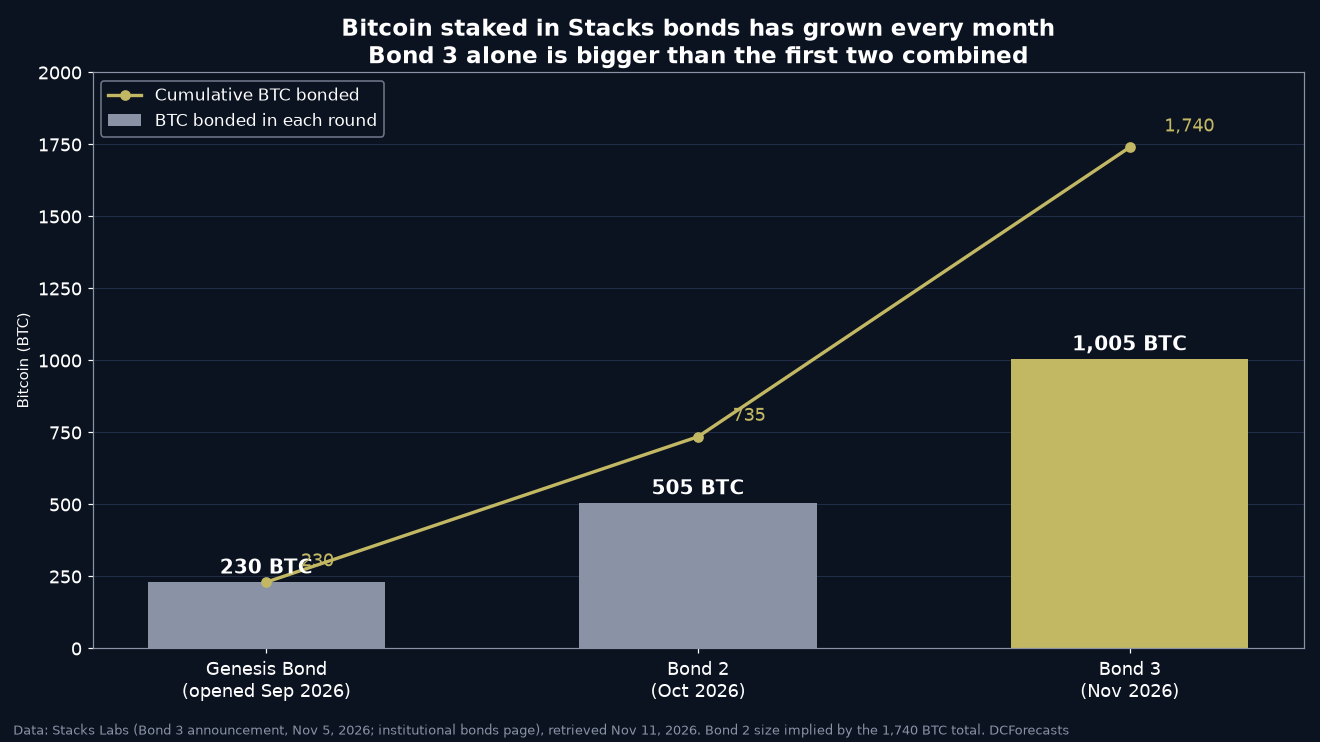
Stacks says the Genesis Bond opened at 230 BTC and Bond 2 at 500 BTC. Capacity is set each round by market conditions and the yield available. Bond 3’s jump to 1,005 BTC shows that demand has so far kept pace as capacity doubled.
The growth rate is steady. Bond 2 came in at roughly 2.2 times the Genesis Bond, and Bond 3 at roughly twice Bond 2. Weekly BTC rewards have been paid since September 17, Stacks says, so the earliest participants now have nearly two months of payouts on record. That track record is what institutions typically want to see before committing larger sums, and it helps explain why the third round drew a public company treasury for the first time.

What the yield adds up to
At the 3% target, 1,005 BTC would earn about 30 BTC over a full year, or roughly $2.2 million at today’s price. That is our calculation, and actual payouts depend on how much BTC miners commit each cycle.
That is modest next to Bitcoin’s price swings, but it is earned in BTC on coins that stay on the Bitcoin chain. Stacks also says principal can be withdrawn in roughly ten minutes through early exit, with no unbonding queue.
Why treasuries are paying attention
Stacks argues that public companies hold more than 1.3 million BTC, over 6% of total supply, and that most of it earns nothing. Treasury companies have been looking for ways to change that. Some have chosen more complex routes. Our recent report showed Trump Media has 11,385 BTC tied up in an options strategy, which brings counterparty and market structure risk.
The appeal of a timelock on the base chain is its simplicity. The bitcoin is not lent out, rehypothecated or handed to a platform. Custody providers are moving to support this. BitGo’s new staking service follows a year of strong client growth, which we covered in our look at BitGo’s latest quarter.
The risks to weigh
Bitcoin staking with Stacks is not risk-free. The paired STX position moves with the price of STX, and Stacks describes that 5% exposure as the product’s main specific risk. The yield also depends on miners continuing to value STX enough to spend BTC on it. If that demand fades, payouts fall below target.
Holders should also count the fixed term and the technical risk that comes with any smart contract or layer built on top of Bitcoin. None of these are reasons to dismiss the model, but they belong in any treasury committee’s notes.
What comes next
Bond 4 opens around December 3, Stacks says, for both institutions and individual holders. The key number to watch is capacity. If the next round again grows and sells out, it would show that a self-custodial Bitcoin yield market is forming among large holders.
For now, three straight sell-outs, each larger than the last, give Bitcoin holders something new: a way to earn BTC on their BTC without letting go of it.
DC Forecasts is a leader in many crypto news categories, striving for the highest journalistic standards and abiding by a strict set of editorial policies. If you are interested to offer your expertise or contribute to our news website, feel free to contact us at [email protected]












Discussion about this post