



PNC Bank, one of the largest lenders in the United States, has started letting some of its biggest business clients get paid in USDC. Under a pilot announced on November 9, 2026, eligible Corporate & Institutional Banking clients can receive the dollar-backed stablecoin on Ethereum, and every token that arrives is converted 1-to-1 into U.S. dollars and deposited into a designated PNC account.
Coinbase supplies the technology through its Coinbase Payment products. PNC supplies the bank account, the treasury management services and the client relationships. The result is a setup where a company can accept a stablecoin payment without ever holding a stablecoin on its balance sheet.
How the PNC pilot works
The design is deliberately simple. A payer sends USDC on the Ethereum blockchain. Coinbase’s payment infrastructure receives it, the tokens are swapped for dollars at par, and the money lands in the client’s PNC deposit account. From the client’s point of view, a stablecoin payment ends up looking like any other incoming deposit.
The service is inbound only. Clients can receive USDC, but the pilot does not let them send it. PNC is offering it on a limited basis to eligible clients and has not said how many companies are taking part, what it charges, or when the service might open more widely.
“Our clients are continually looking at new ways to interact and transact with customers, suppliers and business partners,” said Tom Lang, head of Treasury Management Product and Operations at PNC Bank. He described the launch as a chance to offer new capabilities “backed by the banking experience, risk management and expertise clients expect from PNC.”
Alec Lovett, head of Infrastructure Products at Coinbase, said stablecoins are “modernizing how businesses move money by making payments faster, more efficient and more global.”
Why a bank would start with incoming payments
Starting with receipts is the lowest-risk way for a bank to test stablecoins. The client’s books stay in dollars, the bank’s deposit base grows rather than shrinks, and the stablecoin exposure sits with the payment processor for only as long as the conversion takes.
The benefits PNC and Coinbase point to are speed and reach. Stablecoins move around the clock, including weekends and holidays when wire systems are closed, and they cross borders without passing through a chain of correspondent banks. For a corporate treasurer collecting from overseas customers, that can mean cash arriving the same day instead of several days later.
PNC framed the pilot as an addition to, not a replacement for, its existing faster payments tools. The bank said it wants to help clients “understand and evaluate emerging payment technologies and how they may fit within their broader treasury strategies.”

Why USDC on Ethereum
The choice of network reflects where the dollars already are. USDC had about $70.2 billion in circulation on November 11, 2026, and roughly $42.3 billion of that, or 60.3%, sat on Ethereum. No other blockchain holds more than about a sixth of that amount.
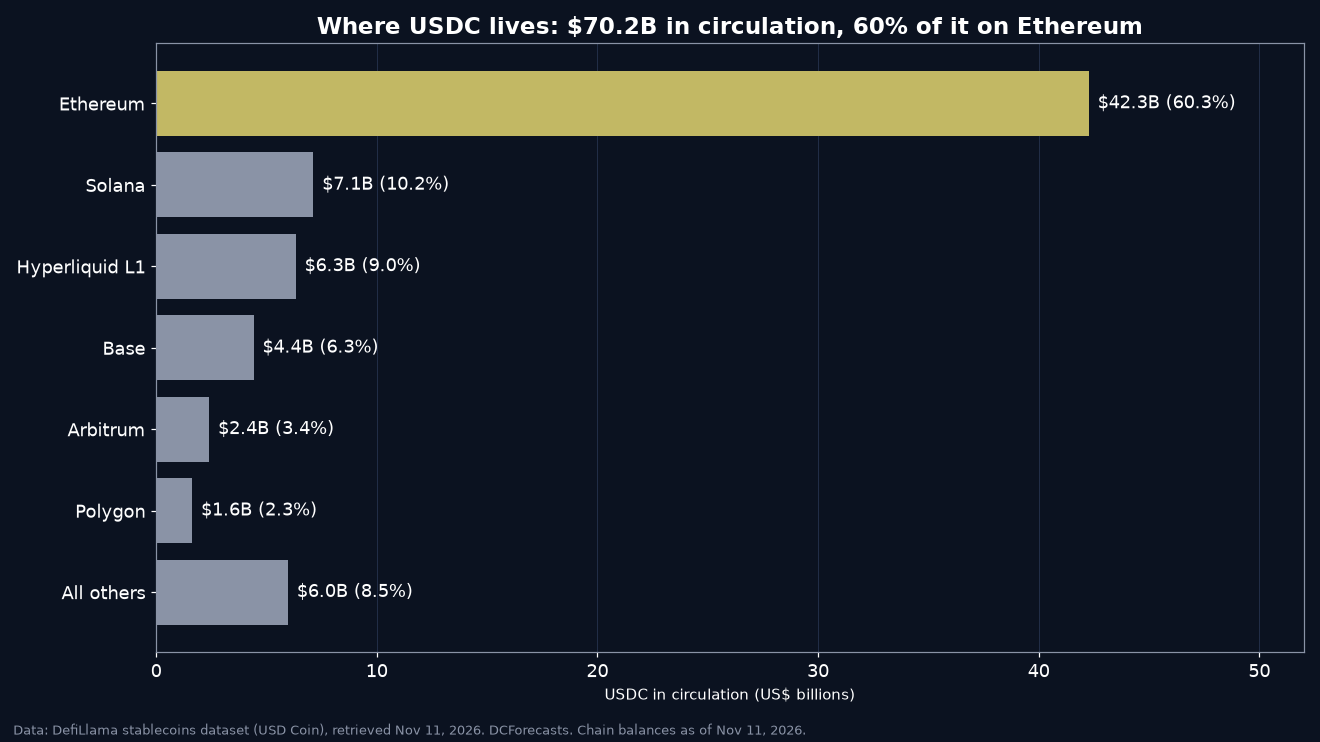
Building on the network with the deepest pool of USDC makes it more likely that a client’s customers and suppliers can pay without first moving funds across chains.
USDC supply has cooled from a peak of about $79.6 billion in March 2026, according to the same dataset, so the pilot arrives at a time when issuers are competing for real payment use rather than simply riding a rising tide of trading demand.
Part of a widening relationship with Coinbase
The pilot builds on a partnership PNC and Coinbase first announced in July 2025. Under that deal, PNC agreed to provide banking services to Coinbase and said it would let its own clients buy, hold and sell crypto through Coinbase’s crypto-as-a-service platform. That arrangement later led to Bitcoin trading for eligible PNC Private Bank clients.
The new step moves the relationship from investment products into everyday cash management. Trading access lets wealthy clients own Bitcoin. Payment acceptance gives corporate clients a reason to touch crypto rails as part of normal business, which is how familiarity with the wider digital asset system tends to spread inside large companies.
Big banks are moving at the same time
PNC is not acting alone. Citi expanded its own Coinbase partnership in September so institutional clients could accept stablecoin payments, with Coinbase converting them into fiat. Visa has been adding networks to settle stablecoin payments, and a group of banks including Goldman Sachs and Citi recently committed $270 million to a joint stablecoin.
The clearer legal footing helps explain the timing. The GENIUS Act, signed in July 2025, set the first federal framework for payment stablecoins, covering reserves, redemption and who may issue them. With rules on the books, banks can treat stablecoins as a payment method to evaluate rather than a compliance question to avoid.
What it could mean for Bitcoin and the wider market
A corporate stablecoin pilot does not buy any Bitcoin. Its importance is indirect. Every bank that connects its clients to blockchain payment rails adds treasury teams, compliance staff and auditors who now work with crypto infrastructure every day. That shrinks the gap between traditional finance and the networks where Bitcoin trades, settles and is custodied.
Stablecoins are also the main cash leg of crypto markets. DCForecasts has tracked how the stablecoin supply now compares with Bitcoin’s market value, and dollars that become easier to move on-chain are dollars that can reach Bitcoin markets more quickly when investors want exposure.
PNC was careful to call this a pilot. Client demand and usage will decide whether it grows. But when one of the country’s biggest regional banks starts routing customer payments through a blockchain, even in one direction and in small numbers, it is another sign that crypto rails are becoming part of ordinary banking.
DC Forecasts is a leader in many crypto news categories, striving for the highest journalistic standards and abiding by a strict set of editorial policies. If you are interested to offer your expertise or contribute to our news website, feel free to contact us at [email protected]












Discussion about this post