



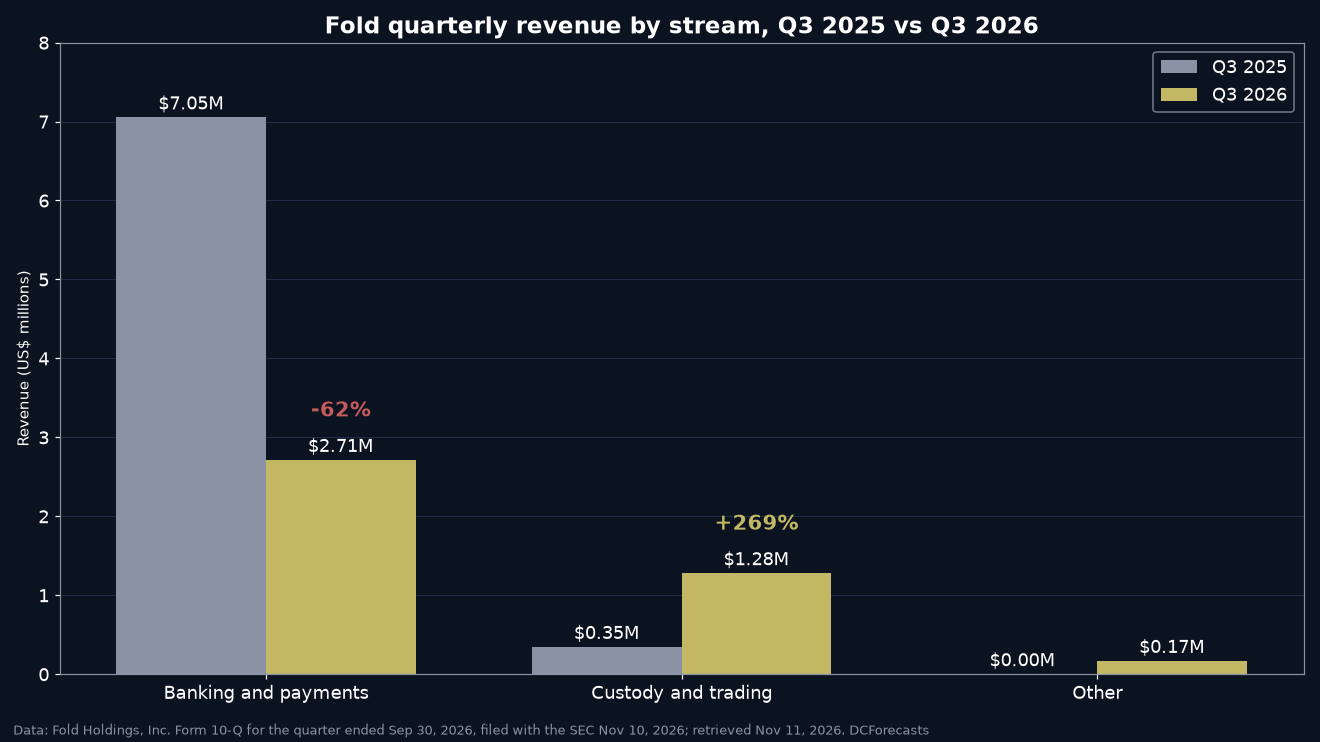
A bitcoin gift card sold through TikTok Shop has become the fastest-growing part of Fold’s business. The Nasdaq-listed bitcoin rewards company said custody and trading revenue jumped 269% in the third quarter, even as its total revenue fell 44%.
Fold Holdings reported its results on November 10 and filed its quarterly report with the SEC the same day. The filing shows a company in the middle of a deliberate rebuild, with a much smaller bitcoin treasury, less debt and a new focus on customer balances.
Bitcoin gift card sales drive a 269% jump
Custody and trading revenue rose to $1.28 million in the quarter ended September 30, up from $346,478 a year earlier. Fold attributed the increase to its bitcoin gift card.
The company said it became the first and only bitcoin gift card on TikTok Shop, and that the channel quickly became its largest for both gift card sales and new customers. September was a record month for gift card sales, and the product carries a 4.7-star rating, according to the release.
That is a notable sign of where everyday bitcoin demand can come from. A gift card bought in a social shopping app puts bitcoin in front of buyers who may never open an exchange account. It fits a wider trend of bitcoin reaching mainstream checkout flows, such as Square switching on bitcoin payments for U.S. sellers.
Why total revenue still fell 44%
The gift card gains were not enough to offset a sharp drop elsewhere. Banking and payments revenue fell 61.5% to $2.72 million, from $7.05 million a year earlier. Total net revenue came in at $4.16 million, down from $7.40 million.
Fold said the quarter reflected “the noise of a major transition.” It moved to a new banking partner, changed its deposit strategy and consolidated its merchant gift card offers onto Blackhawk, a program it says carries better economics. Nearly all merchants that were temporarily unavailable during the switch have been restored.
Costs moved in the right direction. Total operating expenses fell 21% to $10.5 million. The net loss was $2.6 million, or 5 cents per share, and the company’s adjusted EBITDA loss narrowed to $4.5 million from $5.5 million in the second quarter.
Total transaction volume was $159 million, and verified accounts topped 88,500 after about 1,500 were added during the quarter.

Fold bitcoin treasury shrinks to 247 BTC
The biggest balance sheet change happened earlier in the year. Fold held 1,606 bitcoin at the end of 2025. By September 30, it held 247.
The filing explains the moves. In February, Fold repaid a note from March 2025 by handing over the 500 bitcoin that had secured it, and separately sold 200 bitcoin for $14.4 million, about $71,900 each.
In June, it sold 632 bitcoin for $44.7 million, about $70,800 each, and used $20 million of the proceeds to repay its credit facility in full.
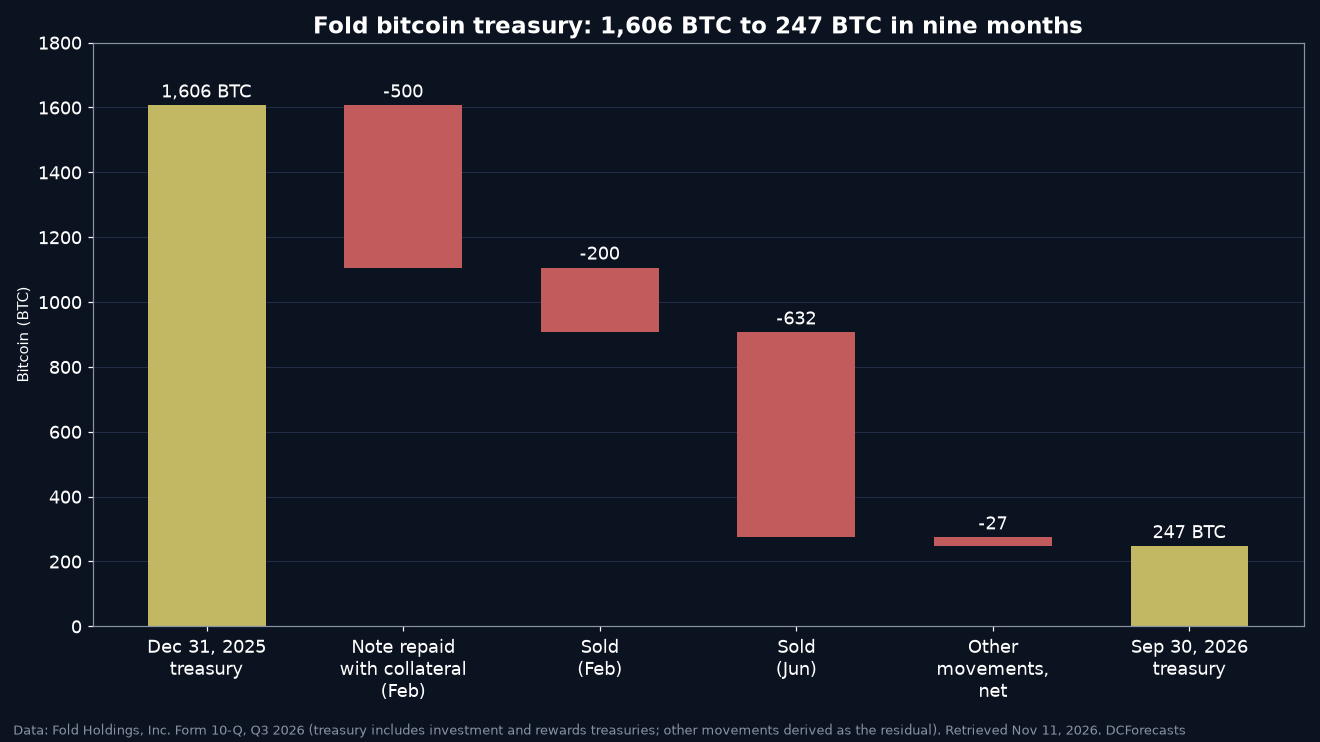
Of the remaining 247 bitcoin, 171 sit in its investment treasury and 76 back customer rewards. Fold says it intends to hold bitcoin as a near- to long-term investment.
The result is a cleaner balance sheet. The company ended the quarter with $21.7 million in cash, up from $7.7 million at the start of the year, and total liabilities of $21.8 million, down from $90.5 million. Its only debt, a $13 million note, now matures in November 2027, with an option to extend to 2028.
Fold credit card and the shift to balances
Chairman and CEO Will Reeves said Fold is moving “from a business built on gathering customers into one built on gathering assets.”
“A transaction pays us once,” he said. “A customer balance earns for us every month it stays on the platform.”
The new products support that plan. Fold Reserve lets customers hold funds on the platform to unlock its best rewards, including zero-fee, zero-spread bitcoin trading. Fold also launched spending accounts with deposits held at FDIC-insured Lead Bank, and pass-through bitcoin buying straight from any linked bank account.
The company said early demand is running ahead of expectations, and that customers using these balance products hold several times more than the average user.
The Fold credit card, which the company describes as a bitcoin rewards credit card, has expanded to about 2,500 cardholders in early access. Fold expects to name a financing partner for the card shortly, which would let the program grow beyond its own balance sheet.
What to watch for FLD stock
The stock still faces a listing hurdle. Shareholders approved a reverse stock split authorization on October 22, one tool Fold could use to regain compliance with Nasdaq’s minimum bid rule before a January 11, 2027, deadline.
The company also replaced a $250 million equity line with a smaller $25 million committed facility, which it says reduces potential dilution.
For bitcoin, the more lasting takeaway is the demand signal. A bitcoin gift card on a social shopping platform became a company’s top acquisition channel within a single quarter. Products like that bring new people into bitcoin in small, simple steps, at a price point that feels familiar. If Fold can turn those first-time buyers into account holders with balances, the gift card could prove more valuable than the treasury it replaced.
DC Forecasts is a leader in many crypto news categories, striving for the highest journalistic standards and abiding by a strict set of editorial policies. If you are interested to offer your expertise or contribute to our news website, feel free to contact us at [email protected]












Discussion about this post