



Israel Discount Bank will let private customers buy, hold and sell Bitcoin inside its mobile app from Nov. 26, 2026. The bank calls it a first for Israel: crypto trading run directly from an ordinary bank account, with no outside exchange and no separate wallet.
The service covers Bitcoin and Ether at launch. Holdings will sit in the customer’s securities portfolio next to stocks and bonds, and custody is handled through wallet infrastructure from Fireblocks.
The fine print on the bank’s own service page is just as important as the headline. Trades cost 2% each way, custody fees kick in after six months, and coins bought at the bank cannot be moved out.
We believe this is still a meaningful step. When a mainstream bank puts Bitcoin on the same screen as a savings account, it tells millions of ordinary customers that the asset belongs in a normal portfolio.
What Israel Discount Bank Is Launching
According to the bank, eligible customers will reach the service through the capital-market section of the app. They pick a coin, enter an amount and execute an immediate buy or sell in real time.
The coin appears in the investment portfolio as soon as the trade is confirmed. The cash side settles on the next business day, or T+1, the same rhythm many investors know from securities.
Trading hours follow the bank’s dealing room: Sunday through Friday, continuously from 09:00 to 23:00 Israel time. That is narrower than the 24/7 market Bitcoin trades in, and only immediate orders are supported for now, with no limit or future-dated instructions.
The service is open to Israeli residents aged 18 and over who have signed up for securities activity. It runs only through the private-customer app, so corporate accounts are excluded.
A 2% Commission and a Closed System
The bank lists two fee components. Buying or selling in the app costs 2% of the trade value, not counting any currency-conversion charge.

Custody is free for the first six months from the Nov. 26 launch. After that, the bank charges 0.25% per quarter.
The biggest limit is portability. The bank describes the service as a closed system: customers cannot transfer coins into the account from another provider, or send them out to external platforms or private wallets. It says that option may be examined in the future, depending on regulatory and business developments.
In practice, that means customers get price exposure to Bitcoin rather than coins they control with their own keys. For many first-time buyers, that trade-off may be exactly the point.
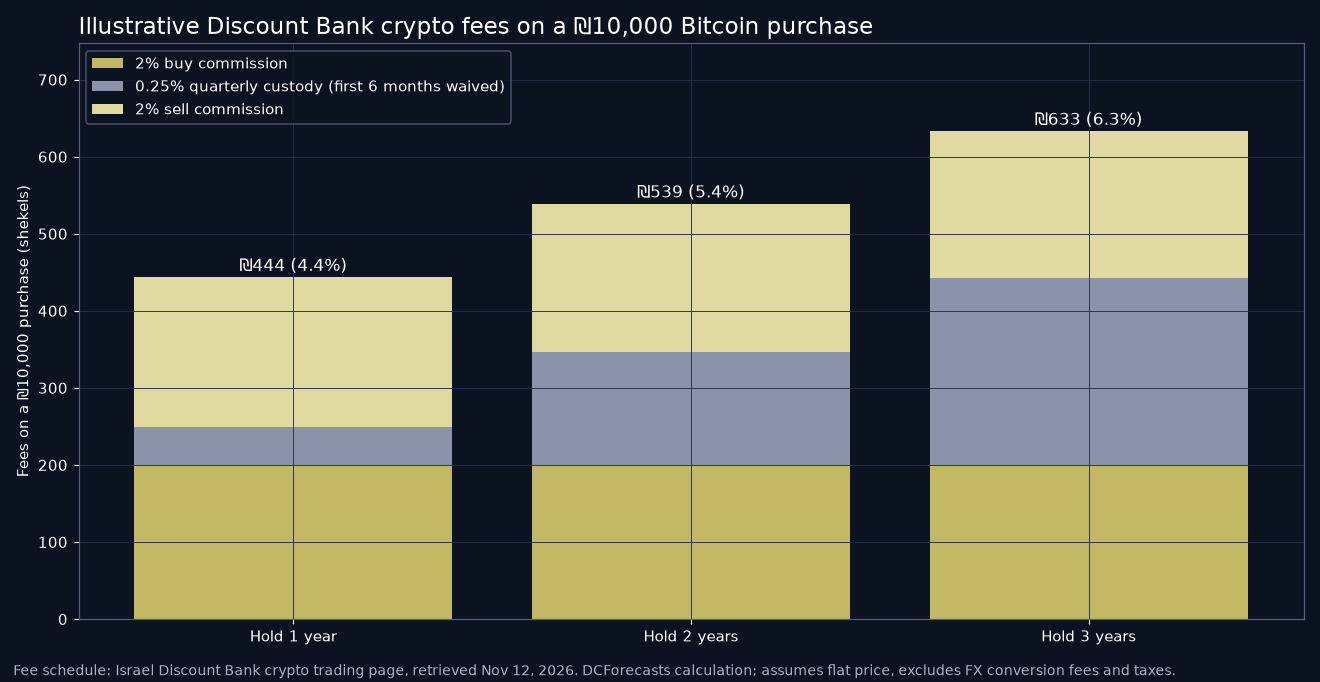
Our calculation shows the costs are front-loaded. On a ₪10,000 purchase held for a year at a flat price, the two commissions and custody would come to roughly ₪444, or 4.4%. Over three years the total rises to about ₪633, as custody fees add up.
Why the Tax Feature Could Matter Most
The bank’s strongest selling point may be tax handling rather than convenience. Because the coins sit inside the regular investment portfolio, the bank says gains and losses on crypto can be offset against capital gains and losses on securities, with tax withheld at source.
The bank notes that investors using outside platforms generally have to file a tax coordination report on their own to get the same offset. For a cautious saver, removing that paperwork may count for more than a lower trading fee elsewhere.
It also removes a common fear for newcomers. With no private keys to manage, there is no risk of losing access to a wallet, which the bank highlights as a core benefit.
Banks Are Building Their Own Doors to Bitcoin
Discount’s move lands in a busy week for bank-grade Bitcoin access. Germany’s largest lender switched on digital asset custody for Bitcoin and Ether on Nov. 11, aimed at institutional clients.
On the payments side, Square turned on Bitcoin at checkout for eligible U.S. sellers. Together, these launches show Bitcoin moving from specialist platforms into the financial apps people already use every day.
Israel’s offer is aimed squarely at retail savers. That is the group that most often stays away from crypto because opening an exchange account and securing a wallet feels risky or complicated.
What Israeli Bitcoin Buyers Pay Today
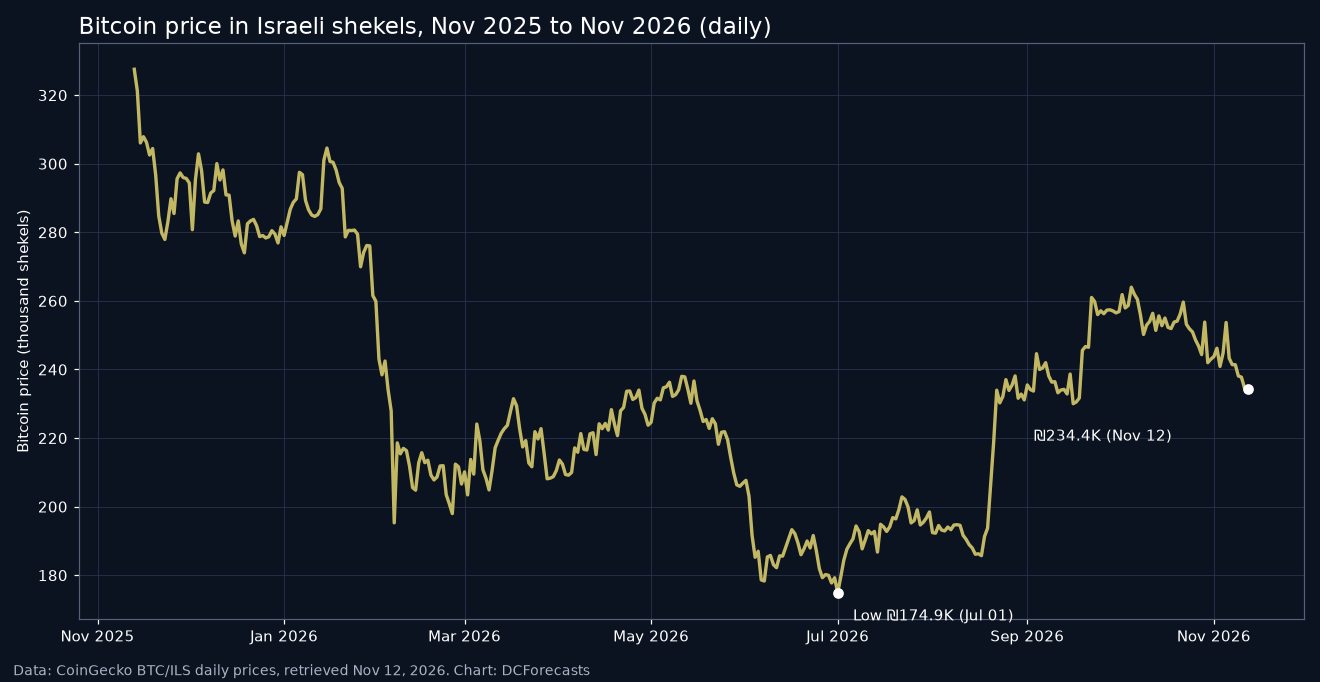
Bitcoin traded at about ₪234,400 on Nov. 12, according to CoinGecko data. That is roughly 28% below the ₪327,600 level of a year earlier.
It is also about 34% above the one-year low of roughly ₪174,900 reached on July 1. Customers arriving on Nov. 26 would be buying well below last year’s levels, after a recovery that has already lifted the shekel price off its summer floor.
The bank itself warns that crypto trading carries high volatility and the risk of total loss, and that its announcement is not investment advice. That caution belongs in any decision about how much to buy.
We believe the longer-term signal is clear. Bitcoin is arriving in the core banking app of a major Israeli lender, wrapped in familiar rules on tax, custody and settlement. If demand is strong, wider coin choice, longer hours and transfers out could be the next things customers ask for.
DC Forecasts is a leader in many crypto news categories, striving for the highest journalistic standards and abiding by a strict set of editorial policies. If you are interested to offer your expertise or contribute to our news website, feel free to contact us at [email protected]












Discussion about this post